Amid slew of corporate tax ideas, California Gov. Gavin Newsom chose one likely to hit people's premiums
Published in News & Features
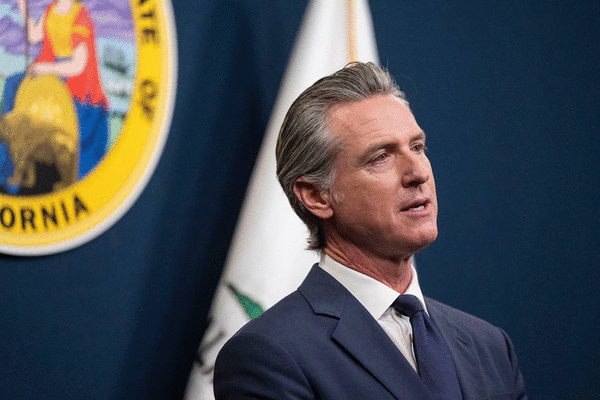
SACRAMENTO, Calif. — For much of this year, progressive lawmakers, labor unions and advocacy groups have pushed Gov. Gavin Newsom and the California Legislature to shore up the state’s healthcare system against federal cuts by taxing corporations more.
After all, proponents argued, Republicans in Washington, D.C. cut into healthcare programs for California’s most vulnerable residents to pay for tax cuts which largely benefited corporations when they passed the One Big Beautiful Bill Act last year. That bill included slashes to the Medicaid dollars that fund much of California’s safety net, as well as an extension of President Donald Donald Trump’s corporate tax cuts from his first term.
But as Newsom and leaders of the Assembly and Senate hash out their final budget agreement, the tax increase with the most momentum in those negotiating rooms is one that is likely to fall largely on everyday Californians in the form of increased costs for private health insurance monthly premiums. The money raised is not set to go into the state’s Medi-Cal funding but instead into the general fund, infuriating advocates who note Newsom’s budget maintains rollbacks to health insurance for undocumented immigrants, low-income elderly Californians and other vulnerable populations.
Tax health plans or lose more federal funding
Newsom, in his May revise, unveiled a plan that sharply increased a state tax on managed care organizations: private health insurance companies like Anthem, United Healthcare or Kaiser. Those organizations had expected a tax increase because of changes to federal rules, but were caught off guard by the amount, Charles Bacchi, president of the California Association of Health Plans, which represents the groups, told The Sacramento Bee.
Insurance companies will pass through the tax to employer-provided plans, he said, and the association estimates individuals will see increases to their monthly premiums of around $100 a year, or $400 to a family of four. Bacchi estimates the tax to his industry at about $1.5 billion a year.
Though industry groups often threaten to raise prices to dissuade elected officials from pushing forward a tax hike, in this case none of those involved in the debate and interviewed by The Bee disputed that Newsom’s proposal would lead to an increase in premium costs.
It was up to the companies how much of the tax they’ll pass on to people’s premiums, H.D. Palmer, a spokesperson for the California Department of Finance, told The Bee.
“Some may choose to pass some of their cost to consumers by raising premiums,” he said. “Some may choose to absorb some of the cost by reducing their profit margin to keep their premiums more competitive.”
A federal rule change is forcing the state into the change, Palmer said. For years, the federal government has reimbursed California for hefty taxes the state placed on Medicaid plans — a roundabout way for California to draw more federal dollars into its Medi-Cal programs. But now, the federal government is requiring states to tax Medicaid programs and commercial programs equally.
Under those new rules, California had to either levy a higher tax on commercial plans or end the taxes on the state plans and lose yet more federal funding. Newsom’s proposal, “strikes an appropriate balance between the need to provide support for the Medi-Cal program and the potential impacts to health care affordability,” Palmer said.
Newsom’s budget also includes a new cap on some corporate tax credits and a new application of the state’s sales tax onto cloud-based software programs.
There are better tax options, opponents say
But opponents say the governor had other options. Unions, including political powerhouses like SEIU California, the California Teachers Association and California Labor Federation, joined healthcare access and immigrant advocacy groups and lawmakers in both chambers to build support for new corporate taxes. Chief among them was a new way of taxing multinational corporations who offshore their assets and a fee leveled on companies whose employees rely on Medi-Cal for health insurance. That proposal was aimed at companies like McDonald’s or WalMart, with proponents of the tax arguing those companies allow taxpayers to subsidize health care to their employees so they don’t have to shoulder the costs.
Outside the state Capitol, there is also a ballot measure, pushed by SEIU-UHW, which aims to levy a temporary tax on billionaires to make up for the federal cuts. Newsom emerged early on as that idea’s chief opponent. He was quieter on the taxes considered by the Legislature. All those proposals could backfill the state’s Medi-Cal program without risking an increase in people’s insurance premiums, their supporters say, though opponents argued the tax would hit consumer wallets one way or another.
“It’s hard to see how things like the offshoring tax proposal shows up on someone’s monthly bill,” Bacchi said. “This (tax on health plan companies) pretty clearly will be reflected in working families’ pocket books.”
That sentiment was shared by advocates for increased health access, who begrudgingly support the tax on commercial health plans if the proposal is changed to dedicate the funding to Medi-Cal, instead of the state’s general fund.
“We understand why it’s needed, and we understand why the governor is pushing for it,” Rachel Linn Gish, the communications director for Health Access California, told The Bee. “It’s unfortunate, the situation that Congress and Trump put us in. But ... we’d rather put the onus on corporations rather than the onus on consumers.”
Kiran Savage-Sangwan, director of the California Pan-Ethnic Health Network, which has worked on the commercial plan tax issue for years, called Newsom’s proposal “a more regressive form of taxation,” than others proposed this year. But critical to Linn Gish and Savage-Sangwan’s organizations, and others in their coalition, is that Newsom back off his plan to use the money to balance the state’s budget.
“Proposing to put that money in the general fund while also proposing to kick people off of Medi-Cal, that we find unacceptable,” Savage-Sangwan said.
Though the offshore corporation proposal stalled out in the Legislature, the tax on companies whose employees rely on Medi-Cal found support with Senate leaders. They put it in that chamber’s budget package, set at a level estimated to raise as much as $8 billion a year to support state healthcare programs. Though some of that plan’s principle advocates were in the Assembly, that chamber’s leadership did not back the plan. Instead, they put their weight Newsom’s tax proposal.
On Wednesday, state Sen. John Laird, D-Santa Cruz, conceded that his side’s proposal was not likely to make the final budget agreement, but Newsom’s is.
“There’s just a limited appetite to do anything in that space,” Laird said, speaking at a panel hosted by the California Chamber of Commerce, which has opposed both tax increases.
____
©2026 The Sacramento Bee. Visit at sacbee.com. Distributed by Tribune Content Agency, LLC.






Comments