Gov. JB Pritzker pauses tax incentives for data centers after regulation efforts stall in Illinois legislature
Published in News & Features
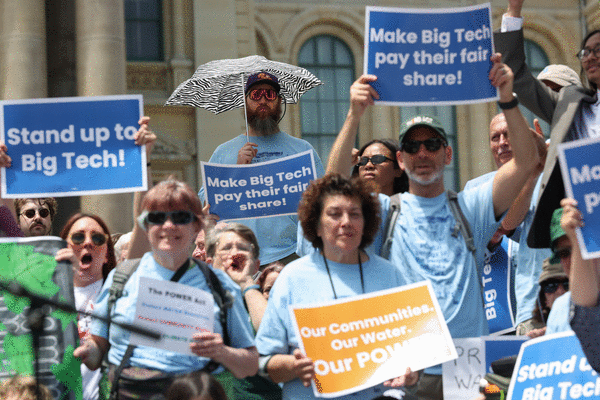
SPRINGFIELD, Ill. — Following an Illinois spring legislative session in which efforts to regulate data center development and curb government support for the energy-hungry facilities stalled, Gov. JB Pritzker took matters into his own hands Friday.
The governor issued an executive order instructing the state agency overseeing a program that issues tax incentives for data centers to pause the program beginning July 1.
In a statement, Pritzker said Illinois has “a responsibility to protect working families and local communities as the data center industry rapidly expands,” saying he’s pausing the tax incentives for data centers while his administration works with the Illinois General Assembly on legislation. Under the executive order, all tax incentives approved before July will continue.
The governor also announced a general framework to address data centers’ impact on energy and water resources and on communities.
Pritzker’s move follows celebrations by tech companies and labor unions after they successfully rebuffed several data center-related measures in the General Assembly, including a bill that would have extended the two-year tax incentive moratorium Pritzker initially called for.
In addition, the POWER Act, a sweeping proposal — similar to Pritzker’s proposed policy framework — that would have required large data centers to meet strict water and energy standards, did not pass. And a separate measure to strengthen local communities’ control over data centers never received a vote in either chamber.
“We just weren’t there this session,” House Speaker Emanuel “Chris” Welch said Monday, six hours after the session ended.
The inaction during the session comes as public frustration over data centers has been building across the state.
In Joliet, residents sued the City Council last month to block a 795-acre data center project, alleging violations of the Open Meetings Act. In Naperville, a proposed 211,000-square-foot facility was scaled back to 145,000 square feet before the suburb’s City Council rejected it outright. In Springfield, packed public meetings drew outbursts from the audience and police escorts before the Sangamon County Board approved a zoning change for a 280-acre data center.
At the center of those concerns: water, energy costs and an already strained electrical grid.
Data centers nationally consumed 17 billion gallons of water for cooling in 2023 — a figure that could quadruple by 2028, according to estimates from Lawrence Berkeley National Laboratory. Environmental advocates say the demand risks depleting both Lake Michigan and rural well water supplies. Data centers already account for 5.4% of Illinois’ electrical consumption, and those energy demands are expected to grow nationally by 133% by 2030, according to the U.S. International Energy Agency. Meanwhile, ComEd customers saw their electric bills climb 12% to about $120 a month in June.
“It is something that people are really frustrated by, and I think the failure to act is going to have consequences on our environment, our climate, and lawmakers are going to hear about it,” said Jen Walling, CEO of the Illinois Environmental Council.
Since 2020, Illinois has given 27 data center projects tax credits totaling nearly $1 billion, according to the government’s 2024 report on the program.
For Democratic lawmakers, data centers present a difficult balancing act between unions and environmentalists, two constituencies historically intertwined with the political party.
Labor groups aggressively lobbied against new regulations and the moratorium. Beyond job creation, groups like Climate Jobs Illinois and the AFL-CIO argue that data centers provide communities with a reliable source of property tax revenue that funds local schools and infrastructure. Pausing the incentives also means temporarily suspending tax credit rules that require data center projects that claim the credits to enter into labor agreements before construction begins to set wages, benefits, and working conditions — a beneficial policy for unions.
“This pause does nothing to lower utility bills, protect the grid, or advance clean energy,” Climate Jobs Illinois said in a statement. “Instead, it will send billions of dollars in investment and thousands of union jobs to Indiana, Kentucky, and Ohio — states that sit on the same electrical grid, where those data centers will be built anyway, just without Illinois workers protected by nationally leading labor standards and without the clean energy requirements we’ve collaboratively fought to establish here.”
The POWER Act would have required “hyperscale” data centers to meet water and energy reporting requirements, face new water efficiency standards, pay for their own energy generation and use renewable sources such as wind, solar and battery storage. Its Senate sponsor, Chicago Democrat Ram Villivalam, acknowledged more work was needed without specifying what stalled the bill.
“When we’re trying to accomplish a major goal change, it’s going to take time to, you know, work with our constituents, work with stakeholders to get something that I think is really groundbreaking done,” Villivalam said.
Welch echoed that sentiment.
“Clearly, something needs to be done, but you have to listen. We have to make sure everyone’s really heard. We’ve got to make sure our caucus is in one place on these issues,” he said.
Like the POWER Act, another effort to strengthen local control over data center location, development, design and size — endorsed by Republican lawmakers — failed to gain steam in either chamber.
Environmental advocates and progressive lawmakers say the issue will return during the November veto session.
Data center advocates, despite holding the line on regulations, did not get everything they wanted. Their push to reform the state’s 2008 Biometric Information Privacy Act — which allows people to sue companies for collecting personal data without informed consent — went nowhere. The law exposes data centers to lawsuits for storing unlawfully scanned fingerprint, facial and retinal data even if they were not the original collectors.
©2026 Chicago Tribune. Visit chicagotribune.com. Distributed by Tribune Content Agency, LLC.





Comments