In unusual move, Chicago school board reinstates teacher accused of pushing student
Published in News & Features
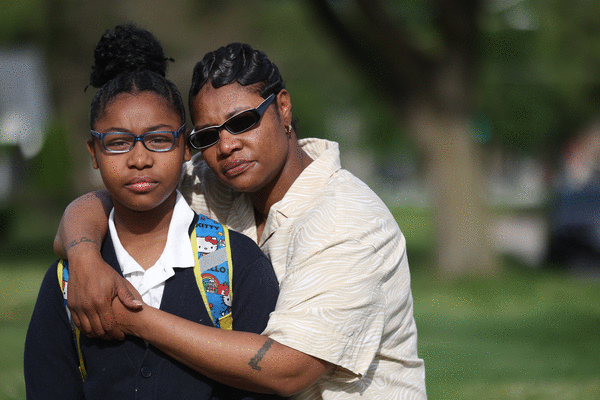
CHICAGO — Third grader Denym Jenkins was meeting with the assistant principal at her Far South Side elementary school two years ago when a teacher walked in and told her to “get out.”
The teacher pushed Denym out of the office, slammed the door behind her and berated the assistant principal, district documents show. Denym was shoved so hard that she nearly fell, and she was later diagnosed with a chronic back strain, her mother told the Chicago Tribune.
The following day, the teacher was put on leave pending an investigation. After a monthslong investigation and hearing process, Chicago Public Schools leaders recommended in August 2024 that the school board approve her firing.
But board members rejected administrators’ guidance, voting in February to reinstate the teacher. It was only the second time in at least a decade that the Chicago Board of Education had overruled a termination in a public vote.
The first time was a year earlier, when the same bloc of board members — all of whom are appointed by Mayor Brandon Johnson or aligned with the Chicago Teachers Union — overturned the firing of a school cook accused of waving a knife in the face of a fellow employee.
The move reflects emerging divides on the newly expanded, 21-member governing board. Previously, it consisted of just seven mayoral appointees and was widely seen as a unified body. The shift to a hybrid board has changed that dynamic, at times fueling contentious debate across elected and appointed lines.
It has also led to increased scrutiny of CPS policies, as board members raise questions about equity, race and representation while seeking to reflect the interests of newly drawn constituencies across the city. Those concerns have increasingly spilled into personnel decisions, reshaping how the board considers discipline and who gets to keep their job.
“One of the areas we’re trying to lead differently is to form an equity lens,” said Angel Vélez, the appointed board vice president, who represents District 9A on the South Side. “This is a way of thinking about the system from a restorative justice perspective.”
Denym’s mother, Chiquitta Walker, said she felt “angry, hurt and disrespected” when she found out the school board had overturned the teacher’s firing. Walker, a CPS alum, works as a janitor for the Chicago Transit Authority. Her daughter, who attends Ronald Brown Academy in the West Pullman neighborhood, is now 11.
“How would you feel if it was your daughter?” Walker asked. “How would you feel if that was your child, and some stranger put their hands on your child for no reason? How would you feel?”
The Tribune has withheld the teacher’s name because she has not been charged with a crime and is employed by CPS. She did not respond to a request for comment; she previously denied pushing the student in district hearings. The district’s investigation substantiated the allegations.
‘I will be a no vote on it’
CPS administrators have long sent the school board lists of problematic employees recommended for termination. Each case moves through an investigation and hearing process before top leadership weighs in, and the school board takes a vote. The teacher’s case was slated for Dec. 18.
But elected board member Jitu Brown, who represents District 5A on the West Side, twice moved to table the teacher’s case to allow for additional discussion.
“I think before we end somebody’s career, we should do our due diligence, and make sure we’re making an informed decision,” he said.
Finally, on Feb. 26, 10 board members voted to approve the firing, one short of the majority needed. Five voted against, including Brown, and five others abstained — all of whom are appointed or elected with CTU support.
Brown said before the vote that he was concerned about a “culture of hyperpunitive actions toward Black educators, Black teachers, Black administrators.”
“I’m not saying that this educator does not need to be held accountable, but I think ending someone’s career is very punitive, so I will be a no vote on it,” said Brown, a longtime community activist and organizer.
The district has struggled for years to recruit and retain Black educators. Retention rates for Black teachers remain lower than nearly every other demographic, according to state data. Black teachers make up about 21% of teaching staff, while Black students represent roughly one-third of enrollment.
A CPS spokesperson noted that the number of Black teachers has increased from 4,400 in 2019 to 5,000 this school year. But Black educators still make up a smaller share of the workforce than they did two decades ago.
CTU and other advocates also have argued that the district’s teacher evaluation system disproportionately targets Black educators, a claim that district officials dispute. Some board members have echoed those concerns and sought to use their seats to probe district policy.
“I do feel like when we challenge the system that way, then we do tend to make (the district) shift in another direction,” said appointed board member Norma Rios-Sierra.
Elected board member Che “Rhymefest” Smith said that the district’s personnel practices should be challenged “because we do notice targeting of certain types of educators.” But he argued the allegations, which were substantiated by the district, were too serious to ignore.
“I think that if it has been proven that someone has had egregious wrongdoing, then we should be willing to hold those people accountable,” Smith said. “That’s how we protect children.”
Others questioned whether intervening in individual cases is an effective avenue for driving districtwide change.
“Working to make sure that CPS’ disciplinary policies and procedures have an equitable impact is a goal that makes sense, and one that we should strive for,” said elected member Jessica Biggs, who is running for school board president. “Working to create system-level change only through individual cases and actions can create a problem for the original goal.”
In April, the board approved back pay for the teacher, deducting a 90-day suspension from the time she was away from the school — roughly two years. At the time of the incident, she was making an annual salary of $134,000, records show, which is in line with other educators of her seniority.
Back pay is legally obligated when the board overturns a termination, regardless of the misconduct finding.
“(The discipline process) takes forever to move because it is so thorough. For us to do things to circumvent it, it’s just bad governance,” said elected board member Angel Gutiérrez. “It puts us on the hook for all these dollars to pay people back pay when we shouldn’t.”
‘A whole domino effect’
The teacher, who has worked at CPS for more than two decades, has a past disciplinary history, according to personnel records obtained by the Tribune through a Freedom of Information Act request. At another school in 2020, the district substantiated allegations that she swore and yelled at students, left her classroom unattended and misled investigators about the incident. She also received a cautionary notice in 2012 for berating another principal.
The most recent incident took place in January 2024. After the teacher pushed Denym, she began to address the assistant principal, records show.
“You’re going to listen to me,” the teacher told the assistant principal. “(Expletive) that! I had a man dressed like you, look like you, put a gun to my head last night. I am not taking this (expletive)!”
The assistant principal later told the district he did not have any explanation for her behavior. A security officer escorted the teacher out of the school, according to documents, and she was put on leave the following day.
Denym returned to her classroom and told staff that she wanted to talk to her mother, records show. She said she was pushed “really hard” and felt “sad and afraid.” A family member came and picked her up from school.
“The school is supposed to be a safe place for the kids, and that was not a safe place for her at the time,” said Walker, her mother.
After the incident, Denym started acting out and began counseling, according to Walker. She felt unsettled at school and her grades started slipping. She complained about back and neck pain. “She was scared. It was a whole domino effect,” Walker said.
At her hearing, the teacher denied pushing Denym, and argued that termination would be excessive discipline, according to records. Documents show she initially denied having a disciplinary history, but acknowledged it when confronted, which administrators said raised concerns about her credibility. A CTU representative also denied the allegations on her behalf.
Eight months after the incident, in August 2024, then-CEO Pedro Martínez approved charges against the teacher for physical abuse, recommending her dismissal.
Instead, the school board issued a warning resolution in April. Several elected board members voiced opposition, noting that they would have preferred termination in February but supported the warning to preserve some form of discipline.
The warning resolution accepted the factual findings of the investigator, including that the teacher “violated policies against physical abuse, failed to maintain professional boundaries and failed to maintain a respectful and productive working environment.”
But it contended that the board “determines that discipline short of termination is appropriate in this situation.”
____
©2026 Chicago Tribune. Visit at chicagotribune.com. Distributed by Tribune Content Agency, LLC.






Comments