US pauses nightly strikes on Iran as Houthis clash with Saudis
Published in News & Features
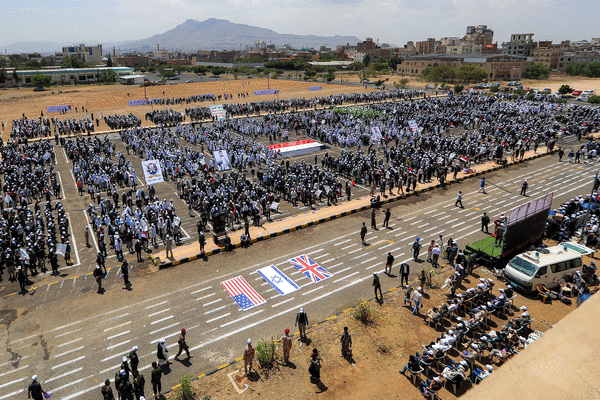
Skirmishes between Houthi rebels and Saudi Arabia intensified as a pause in the nearly two-week run of nightly U.S. strikes on Iran raised fresh questions about President Donald Trump’s strategy in the war.
The Houthis, Islamist militants based in Yemen and backed by Iran, said they fired missiles and drones at facilities linked to oil giant Saudi Aramco in the Red Sea port towns of Jizan and Yanbu. There was no immediate confirmation from the Saudi government or Aramco. Saudi authorities briefly issued emergency warnings but retracted them and said the danger had passed.
A Saudi-led coalition responded by striking Houthi military positions later on Saturday, according to Yemen TV, a channel affiliated with the internationally recognized Yemeni government. The day before, the coalition struck the port from which the Houthis’ maritime attacks normally originate. The Houthis also announced they would blockade Saudi ports and attacked two Saudi-linked oil tankers in the Red Sea.
After attacking Iran for 13 days, the U.S. apparently paused strikes Friday night into Saturday with no explanation or announcement. Iranian media and the government also didn’t announce any incoming attacks.
Even so, the escalation in the Red Sea — on top of the nightly U.S. strikes on Iranian military facilities and infrastructure, as well as retaliatory attacks by Tehran — compounds an already severe squeeze on regional energy flows.
Traffic through the Strait of Hormuz, normally the conduit for a fifth of global crude supplies, remains largely paralyzed by the hostilities. Any sustained disruption to Saudi Arabia’s Red Sea export routes, through which it’s sending millions of barrels of oil a day, mainly from Yanbu, would likely push up crude prices even more.
Trump, who is increasingly frustrated with Iran for refusing to reopen Hormuz, said late Friday that the U.S. is “locked and loaded” for major strikes on Iran. He added he had not made a decision on whether to go ahead with them, after telling Axios a few days ago he was mulling a “massive attack.”
One ally described the president as being in revenge mode against Iran while others said he is looking to exact a cost from Tehran for the war, which has driven up energy prices and put Republicans in a tough spot politically ahead of the November midterms.
Speaking at the White House Correspondents’ Dinner, Trump said Iran would “love to make a deal” but he doesn’t think “it’s time yet.”
He also said Friday that the warring sides are talking, though his administration is offering few details.
A delegation from Oman has arrived in Tehran for talks over operations in the strait, Axios reported, citing two regional sources. It was unclear whether the U.S. would abide by any outcome.
Brent crude has soared around 27% in the past two weeks as U.S.-Iran clashes worsened and the Houthis effectively opened a second front in the war. The global benchmark closed on Friday at $96.78 a barrel.
Houthi-Saudi truce threatened
The new apparent Houthi aggression in the Red Sea came despite a shaky truce between the Saudi kingdom and Yemen, which has been in a civil war for 12 years. The Houthis survived a roughly seven-year bombing campaign led by Saudi Arabia and the United Arab Emirates and still control areas containing most of Yemen’s population.
Iran is the main funder and sponsor of the Houthis, though the group is more autonomous than other proxies such as Hezbollah in Lebanon.
_____
(With assistance from Olivia Poh and Kari Lindberg.)
_____
©2026 Bloomberg L.P. Visit bloomberg.com. Distributed by Tribune Content Agency, LLC.






Comments