San Diego's Muslim community looks to healing in wake of mosque attack. 'We must find a greater love'
Published in News & Features
SAN DIEGO — A sound like firecrackers. Confusion. An “eerie feeling.” Then, understanding and terror.
This is how Iman Salem’s life changed the morning of May 18, when she was on her way to the Islamic Center of San Diego. She spotted a man she recognized as Nadir Awad, running from his house toward the mosque. He locked eyes with her and gestured urgently for her to leave.
As Salem, a physician and mother of three, drove away in panic, she saw a man lying motionless, bleeding from his head. That was Amin Abdullah, the mosque’s security guard. Within seconds, Awad also would be fatally shot.
Since the attack, she has had trouble sleeping. Her mind kept playing back the shocking things she saw. But she has also found ways to start to heal. Volunteering. Helping others. Crying. Talking. Hoping.
Almost two weeks after the terror attack on the Clairemont mosque that killed Awad, Abdullah and Mansour Kaziha, thousands are mourning the loss of three cherished community members and searching for ways to move forward. Last weekend the center hosted a day of healing, with activities for children and support from mental health professionals and religious leaders.
People have been organizing meal trains and donating money to help the families of the dead. The center canceled its summer camp, but the mosque has reopened and continues to draw crowds to prayers. They are reviewing security protocols and reaching out to elected officials. District Attorney Summer Stephan and Rep. Sara Jacobs recently toured the center.
More deeply, San Diego’s Muslims have been puzzling over the roots of the hatred that sent two young men into a holy place with the intent to commit mass murder.
All of this has overlapped with a key time in Islam: Eid al-Adha, a four-day festival that celebrates Abraham’s love for God and an intervention by God to allow Abraham to sacrifice a ram instead of his own son.
In a Facebook post, the Islamic Center drew connections between the holiday, the community’s sadness and the sacrifice the men made. They are considered heroes for interrupting the gunmen at the Islamic Center and are credited with likely saving the lives of schoolchildren and teachers.
“Eid will never feel the same without our three martyrs among us,” the statement said. “Their absence is deeply felt in our masjid, our gatherings, and our hearts. Yet even through sorrow, we hold firmly to faith.”
Tazheen Nizam, executive director of the San Diego office of the Council on American-Islamic Relations, or CAIR, said the pain might last forever, even as healing beings.
“This is such a devastating act of violence that the community went through. This is such a devastating loss. The grieving in the sense of mourning and crying and all that might stop, but the pain is going to be there. And that wound that has been inflicted on us may never heal completely,” she said.
That pain has many facets, she added. There is the “front and center” feeling when children return to the school after the holiday and don’t see Amin. The “back of their mind” feeling when they visit the center. The pain that “we were subject to this, and many questions about the reasoning, and what-ifs.”
Prayer, and pressure
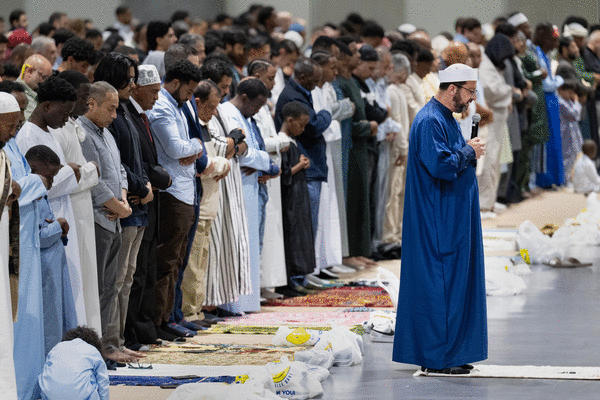
On Wednesday, thousands of Muslims gathered to celebrate Eid al-Adha at the San Diego Convention Center. A noticeable presence of uniformed San Diego police officers was inside the building, while a number of patrol cars were parked in front of the exhibit halls.
Dr. Ahmed Bailony, a mosque member and pediatrician, lamented that Muslims have been targeted by harmful prejudice, even though they help people and are part of the same community.
“I consider myself as American as the apple pie I shared with my friends at my house two nights ago,” Bailony said during one prayer service. “I was born in this city, I work in a hospital I was born in, and yet ever since my youth, ever since my elementary days, I’ve heard jokes about my bomb-making abilities.”
Hatred, he added, must be countered with “greater love.”
“There may be those of us in this society that categorize the people in this room as terrorists, and yet we show up here today as your pediatrician, as your electrician, as your teacher, your Uber driver, your cop and your neighbor,” he said. “There will be those that come into our homes with guns — and we must find a greater love, a greater purpose and respond with hugs and open hearts.”
Eid is normally a time of joy and gratitude. The holiday marks the conclusion of the annual Hajj pilgrimage to Mecca. The event was booked for the downtown venue to accommodate the large crowds that typically attend.
But Imam Taha Hassane, the director of the San Diego Islamic Center, noted that everyone feels this celebration “is different” because of the loss of “three beloved brothers, murdered in an act of terror against our community.”
Hassane told the gathering that he wants expressions of concern from others to translate into concrete action.
“Hate speech has been the very bullet murdering innocent people,” he said. “Your actions and silence have normalized racism and bigotry against my community. And you make it easy for people with ignorance and hatred in their hearts to attack and assault us. At this moment, being in your thoughts and prayers is not enough.
“We need action and laws that promote safety and security” for Muslim communities, he said.
‘I will pray in public’
Through those services, and in other spaces, people shared a similar sentiment: The May 18 attack will not silence or blunt their expressions of faith.
Ayham Dahlan and his wife were on their honeymoon in Malaysia when they heard about the shootings. The attack made him “more mindful,” but he said he isn’t afraid and plans to resume his regular prayer schedule at the mosque.
“I’m comfortable presenting to those around me as Muslim. I will pray in public. I just want to practice my religion freely,” said Dahlan, an attorney who lives in Normal Heights.
“This is an act of domestic terrorism that could have happened in many places of worship, and I don’t see it as just a threat to Islam itself; I see it as a threat to all religion or freedom of expression,” he added.
Amira Helmy, 21, is a lifelong member of the Clairemont mosque and went to school there through fifth grade. She was in New York visiting a friend the day of the attack and saw news footage of people running from the school. Among them, she recognized her kindergarten teacher.
Helmy said she’s often the only Muslim in her college classes at Cal State San Marcos and welcomes questions about her faith. She began volunteering with CAIR after the attack to try to help members of her community and plans to join the Peace Corps after graduation.
“If anything, I felt like I’m more proud to wear this hijab on my head, you know? I want people to know that regardless of what’s happening, I continue to be strong in my faith… I’m proud to be Muslim,” she said.
Zainad Altaii, a member of the San Diego Mesa College Muslim Student Association who helped organize a healing session at the campus Thursday night, emphasized the importance of dialogue.
“Maybe if one person actually talks about this, and maybe one student actually says something, something very powerful can change,” she said. “Maybe everyone will start speaking up, and then we’ll start having some change here … anything helps.”
Families in pain
Hassane, who was close with the three victims, said in an interview this past week that he is focusing on staying strong for his community at a time when people deeply need him.
To the families of the deceased, he is offering comfort and counsel.
Visits to their homes start with a big hug, he said. Then he reminds them about the importance of patience. Patience that they will be reunited with their loved ones. Patience also means accepting what death means: that one’s time in this world is over and it is time to return to God, he explains.
“And also, I remind them that they put their bodies on the line to save the kids of the school, to save all of us who were inside the building. That makes them very proud of their fathers, when they remember this.”
Many others have given condolences and looked for ways to support the families of the victims, Hassane added. People came from all over California and other parts of the U.S.
“So they have been surrounded, really, with a lot of people. Surrounded with love, surrounded with compassion,” he said.
He shared a detail about how the family of Mansour is beginning to heal and search for meaning in his death. As an institution at the mosque, Mansour had been the stalwart cook who prepared meals on Fridays and during Ramadan. To honor his memory, his children prepared a fast-breaking meal this past week and said they’ll start cooking on Fridays, as their father had, Hassane said.
Advice from a survivor
If anyone in San Diego knows what healing after an attack on a religious congregation looks like, it is Rabbi Yisroel Goldstein.
Goldstein, former director of the Poway synagogue that was targeted in an antisemitic shooting in 2019, said he was praying in that same synagogue when word came in that there had been a deadly attack at the Clairemont mosque.
“It just throws you into a total recall, and your whole mind and body and soul go into the same PTSD,” said Goldstein, who witnessed the fatal shooting of congregant Lori Gilbert-Kaye during the terror attack on Chabad of Poway. Three others were injured, including Goldstein, who lost his right index finger and is facing surgery this summer for amputation of a second injured finger. “What we learned (from the Chabad attack) was that we couldn’t change what happened, but we could change how we react.
“The loss of my two fingers is a constant reminder of what happened, but I’ve been able to transform the darkness into light, and instead of focusing on what I’ve lost and suffered, I focus on what I have and how fortunate I am to be alive.”
And that is the advice he would offer to not only the survivors of the mosque attack but also to anyone stricken emotionally by the brazen shooting.
“They need to realize, No. 1, that they are all survivors, and that their survival was such a miracle that they need to be grateful for that and realize that there is a reason why they survived, because God still wants them to be around, and they still have a lot more to do,” Goldstein said.
He acknowledged that over time, there will be unwelcome triggers of the two incidents as community members strive to stay on their path to healing. For him, it can be the sound of a car backfiring or simply the lighting of a candle with a match, which will bring back for him the smell of gunpowder inside the synagogue.
But situations like that needn’t be thought of as a setback, rather a reminder of the need to push on with life, he said.
The San Diego-based National Conflict Resolution Center was very much involved in helping people cope in the aftermath of the Chabad attack. A series of panel discussions and workshops was organized to help community members begin their journey of healing, said Steven Dinkin, president of the center.
Among those who participated in one of the discussions was a leader from the Tree of Life Synagogue in Pittsburgh, where there was a similar shooting, and a Sikh leader from Wisconsin, where seven people were shot and killed at a Sikh temple 14 years ago.
“At that time, we wanted to bring people together from across the region to discuss what was the impact that they felt and to listen,” Dinkin said. “Everyone was on edge, and so the first step was really about rebuilding trust and belief in one another as a community, but specifically building trust with someone who might look different than yourself so you can reopen the lines of communication.
“Oftentimes, people just think, well, let’s move into problem solving immediately and try to figure out the resolution before taking that step of what we call troubleshooting, to figure out how we can help the community to address the issue and how to prevent it from happening in the future.”
Dinkin’s organization has already begun taking steps to help the mosque and surrounding community process their grief, he said. The center has identified funding through the state Department of Health and Human Services’ Stop the Hate Initiative to “provide restorative, trauma-informed support to the Islamic Center.”
“Our intention is to provide professionally facilitated spaces where individuals can gather in community, process grief and fear, and feel supported during an extraordinarily painful time,” he said.
‘Good people need to stand together’
Salem, the mosque member who was warned away from the shooting, can’t help but play a game of what-ifs. What if she’d gotten there 10 seconds earlier? What if the children had been playing outside when the shooters approached?
A few things have helped her process those thoughts and feelings. “One is service,” she said. She visited the families of the deceased men, volunteered at a healing event at the mosque and supported other people who are “under a lot of pressure right now.”
She has also met with a therapist, cried and “talked this out over and over” with friends from the mosque community. She is confident it will thrive again.
“I guess our community will be more unified and we will love the mosque even more,” she said. She keeps her thoughts positive and hopeful when she thinks about the future: “There’s so many more good people than there are evil people in this world, and the good people need to stand together against all sorts of racism, including anti-Muslim hate, so that things like this don’t happen again, because the good people are loud.”
Now when she sets foot inside the serene mosque, she has mixed feelings. There is discomfort, violation.
But also, connection and purpose. “It still feels good to be together and feel like we’re carrying on the legacy of the people who gave their lives, serving,” she said. “And that’s not something that will be taken away.”
_____
Staff writer Caleb Lunetta contributed to this report.
_____
©2026 The San Diego Union-Tribune. Visit sandiegouniontribune.com. Distributed by Tribune Content Agency, LLC.





Comments