Americans hurt in Kuwait as Trump sends mixed signals on war
Published in News & Features
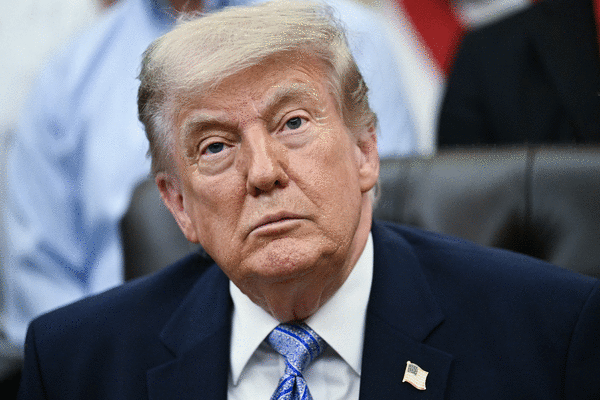
Several Americans were hurt in a missile attack on a Kuwaiti air base over the past day as negotiations to extend the ceasefire with Iran dragged on without conclusion.
President Donald Trump had suggested earlier in the week that an agreement was near, but the absence of any announcement after a two-hour Situation Room meeting on Friday was the latest conflicting signal from Washington over the prospects for a deal with Tehran.
The fragile ceasefire has largely held, even as a person with direct knowledge of the attack said an Iranian missile caused minor injuries on a U.S. base and the U.S. military separately said it disabled a ship headed for an Iranian port.
Trump will only make a deal that satisfies his red lines, a White House official said Friday on condition of anonymity, referring to the president’s demands that Iran must abandon its nuclear program, give up its enriched uranium supplies and open the Strait of Hormuz.
The back-and-forth continued a pattern of both sides suggesting an agreement was near, before signaling disagreement over many of those same sticking points.
On Saturday, Iranian state TV reported the existence of a new draft agreement, which it said gives the Islamic Republic “exclusive authority to determine the nature of transiting vessels” in the strait, a negotiating point the U.S. is unlikely to accept.
Trump once said Iran and the U.S. could manage its traffic in a joint venture. This week, the U.S. leader said emphatically no one country would control the strait but that the U.S. would “watch over” it.
The draft also said the U.S. has committed to giving Iran access to $12 billion in frozen funds within 60 days, to be sent directly to Iranian banks without restrictions, according to Iranian TV, which added that the document was “unofficial” and not “finalized.”
The White House did not immediately respond to a request for comment on the report.
Markets have been whipsawed by the abrupt turns in rhetoric, but hopes of a ceasefire extension helped drive stocks toward a historic streak of weekly gains by week’s end, even as sporadic attacks occurred.
An Iranian ballistic missile strike on a Kuwaiti air base within the past 24 hours caused minor injuries to several Americans and seriously damaged two MQ-9 Reaper strike drones, according to a person with direct knowledge of the attack, who requested anonymity to describe details that aren’t public.
The missile was intercepted but falling debris hurt about five people, including contractors and active-duty personnel, the person said. One Reaper was destroyed and at least one other was seriously damaged. The drones cost about $30 million each.
U.S. Central Command didn’t immediately respond to a request for comment.
The Navy blockade policing the strait disabled a Gambia-flagged vessel heading to an Iranian port on Friday, the U.S. military announced on Saturday. A U.S. aircraft disabled the vessel by firing a Hellfire missile into the engine room after the crew ignored more than 20 warnings, Central Command said in a statement.
Repeated demands
U.S. officials on Thursday confirmed that negotiators had reached a memorandum of understanding to extend the ceasefire by 60 days and launch further talks on the nuclear issue, pending Trump’s approval.
Yet hours after that confirmation, Treasury Secretary Scott Bessent declined to acknowledge a tentative deal, and Vice President JD Vance told reporters the sides were “going back and forth on a couple of language points.”
In a social media post on Friday, Trump repeated demands that Iran never develop nuclear weapons and that it reopen Hormuz without tolls, but didn’t say whether Iran had agreed.
Bessent outlined three “red lines” as prerequisites for any agreement: Iran reopening Hormuz, surrendering its highly enriched uranium and ending its nuclear program. Trump has sent mixed messages on those sticking points, on whether and how he might compromise.
In prepared remarks delivered in California on Friday, the Treasury chief suggested the U.S. could remove some sanctions on Iran, depending on how matters proceed in the current standoff with Tehran.
Iran’s side of the talks have remained opaque. On Friday, Iranian state media said the MOU wasn’t finalized and had changed in recent days. Iranian Parliament Speaker Mohammad Bagher Ghalibaf said they had “no trust in guarantees or words” and that “no action will be taken before the other side acts.”
Trump has insisted he won’t be rushed into a bad deal, even as he denies accusations that the war is the kind of military quagmire he’s long warned against. The conflict he’s called an “excursion” has well surpassed an initial four- to six-week projected timeline.
Polls show Americans disapprove of the conflict and soaring gasoline prices are amplifying worries about the economy. In public, Trump has said he doesn’t care about the political strain.
For all the mismatched rhetoric, there’s a broad understanding Trump alone will make the final call. “Everything depends on what the president wants to do,” Bessent said.
Other Iran news:
— Qatar said it might be possible to negotiate a temporary fee that ships passing through the waterway would pay Iran for services like mine clearing. But it opposed a permanent toll for transit, which the U.S., Europe and other Gulf nations also reject.
— The U.S. Treasury Department affirmed that American citizens aren’t allowed to make deals with Iran to safely sail through the strait — even those which don’t involve paying a toll — and that doing so could put them at risk of sanctions.
— Shipowners are increasingly optimistic about a pickup in traffic after more vessels left the waterway this week, with the U.S. sharing information to aid those making the journey.
— Omani authorities urged caution for vessels and seafarers after the sighting of a floating object suspected to be a naval mine west of the Inshore Traffic Zone in the Strait of Hormuz within Omani territorial seas.
_____
With assistance from Skylar Woodhouse.
_____
©2026 Bloomberg News. Visit at bloomberg.com. Distributed by Tribune Content Agency, LLC.





Comments