Maryland's Glock crackdown could test limits of Second Amendment
Published in News & Features
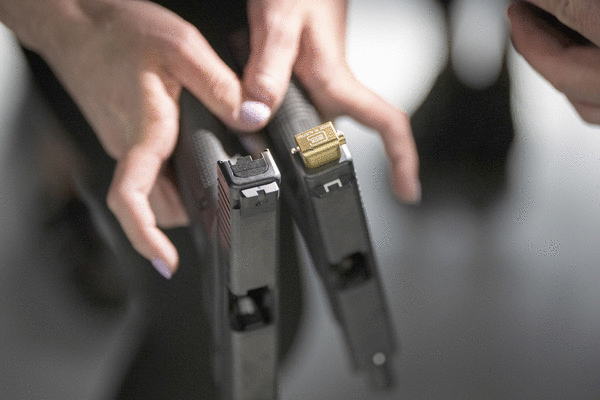
Maryland’s new ban on some semiautomatic handguns is already headed for a constitutional showdown — one that could test how far states can go in regulating firearms that can be converted into machine guns.
Gov. Wes Moore signed the legislation Tuesday, barring the manufacture, sale, and purchase of a range of semiautomatic pistols that lawmakers say are especially vulnerable to illegal conversion using “Glock switches” or auto sears — small devices that can transform a handgun into a fully automatic weapon capable of firing dozens of rounds in seconds.
The legal fight now forming around the law could become an early test of how courts apply modern Supreme Court Second Amendment rulings to firearms that occupy a legally murky middle ground: semiautomatic handguns that are legal to own, but can be rapidly converted into weapons already banned under state and federal law.
Gun-rights groups argue that Maryland is effectively banning commonly owned handguns protected under the Second Amendment. Supporters of the law counter that the state is responding to a growing public safety threat tied to weapons increasingly recovered in Baltimore criminal investigations.
The National Rifle Association of America, along with the Firearms Policy Coalition and Second Amendment Foundation, filed suit Tuesday alleging the law is unconstitutional.
Their complaint argues that pistol converters, including Glock switches, are already illegal under Maryland and federal law and that the state cannot prohibit firearms that are otherwise legal and widely owned.
“That is a handgun ban,” the lawsuit says. “The fact that the ban targets only one category of popular handguns does not make it constitutional.”
The suit names Moore, Maryland Attorney General Anthony Brown, and Maryland State Police Acting Superintendent Michael Jackson as defendants.
An evolving legal landscape
The challenge arrives amid a rapidly evolving national legal landscape shaped by recent Supreme Court decisions that have expanded Second Amendment protections.
In District of Columbia v. Heller, the court ruled that handguns commonly used for lawful purposes are protected under the Constitution. More recently, in New York State Rifle & Pistol Association v. Bruen, the court established a new standard requiring governments to show that modern gun restrictions are consistent with the nation’s historical tradition of firearm regulation.
Legal scholars say Maryland’s law may test how courts interpret those precedents when applied to firearms that lawmakers argue are uniquely susceptible to illegal conversion into machine guns.
The case also carries national implications because Maryland is not alone in pursuing restrictions aimed at so-called “machinegun-convertible” pistols. In 2025, the NRA, Firearms Policy Coalition, and Second Amendment Foundation filed a similar federal lawsuit challenging California’s law banning the sale of Glock-style handguns that can readily accept conversion devices. California lawmakers argued the weapons posed a growing public safety threat. In contrast, gun-rights groups argued the state was attempting to ban some of the most commonly owned handguns in America in violation of Supreme Court precedent.
Kathleen Hoke, a law professor at the University of Maryland Carey School of Law in Baltimore, said that at the center of this case is whether these kinds of firearms are protected under the Second Amendment.
Hoke said certain kinds of weapons, such as machine guns, fall outside of the Second Amendment and can be subject to “hearty restrictions.”
Essentially, she said, the court will have to determine whether these kinds of guns are more like handguns or more like machine guns.
“And I don’t think there’s an easy answer to that,” Hoke said. “Courts across the country would (probably) come out in different ways.”
Hoke said the lawsuit could take years to play out. She said the suit could be delayed when the law goes into effect. Currently, the ban is set to go into effect on Jan. 1.
Both the Attorney General’s Office and Maryland State Police declined to comment on the suit. Maryland State Police said the agency cannot comment on pending litigation.
Moore’s office did not immediately respond to a request for comment Wednesday.
A continuing problem in Baltimore
The constitutional fight is unfolding as Baltimore officials describe a problem involving illegally modified pistols.
While Baltimore has seen drops in crime in recent years, a lawsuit filed by the city last year claims an increase in the number of Glock pistols that have been illegally modified to operate like machine guns recovered in connection with criminal investigations.
According to the suit, filed against Glock and its Austrian parent company Glock GmbH, Baltimore Police recovered at least 100 of these weapons at crime scenes and in connection with investigations between 2023 and 2024.
“The problem is intensifying: almost double the number of illegally modified Glocks were recovered in 2024 than just the year before,” the lawsuit says.
In its complaint, the city alleges that Glock’s pistol design makes it susceptible to illegal modification and could be altered. “This is a problem that Glock can solve, but it has chosen not to,” the suit says.
“For years, Glock knew that their guns could be easily converted into automatic weapons — but they continued to put profit over safety,” said Jonas Poggi, press secretary for Baltimore Mayor Brandon Scott, in a statement. “Their refusal to address Glock switches demands accountability and the City will continue utilizing every tool available to hold them to account.”
Poggi called the state’s new law a “substantial step toward preventing the spread” of illegal guns. He said Scott supported the passage of the legislation and is “eager” to see it implemented.
Baltimore State’s Attorney Ivan Bates said in a statement to The Baltimore Sun that the state’s new law will help his office address the problem of illegally modified pistols.
Bates said these modified guns are “frequently” used by repeat violent offenders and people involved in gun violence in the community.
“By prohibiting the manufacture, sale, transfer, and possession of these weapons, Maryland is sending a clear message that we will not tolerate the spread of firearms designed to inflict mass harm,” he said.
Opponents of the law argue that the state is targeting lawful gun ownership rather than criminal misuse.
National Police Association spokesperson Sgt. Betsy Brantner Smith said the law “directly goes against” the right to bear arms. On top of that, she said, it is “just another piece of legislation that is designed to engage the emotion of voters.”
“Is this going to save lives in any way, shape, or form? It is very unlikely,” she said.
Smith argued that converting handguns into automatic weapons is already illegal under existing law and said the focus should instead be on enforcement and sentencing.
“We need harsher sentencing for violent crime,” she said. “So, whether you do an armed robbery with a firearm, a knife, or a stick, or your bare hands, you need to go to prison. The first time. Not the 10th time.”
Baltimore Attorney A. Dwight Pettit said he thinks the law will drive down crime rates. He said he’s seen the consequences attached to firearm violations cause people to reconsider breaking the law.
“All legislation in terms of getting guns off the street will be a benefit to the Baltimore community,” Pettit said.
Violating the new ban, a misdemeanor charge, could land a person in prison for up to three years or put them on the hook for up to $5,000 in fines.
Similar to Smith, Worcester County Sheriff Matthew Crisafulli said laws like this don’t increase public safety.
“Criminals do not typically abide by laws and firearm restrictions and regulations,” Crisafulli said in a statement to The Sun. “My belief is that this law will face legal challenges, as it challenges our Second Amendment.”
_____
©2026 Baltimore Sun. Visit baltimoresun.com. Distributed by Tribune Content Agency, LLC.




Comments