5 takeaways from the discipline, resignation of Minneapolis Police Chief Brian O'Hara
Published in News & Features
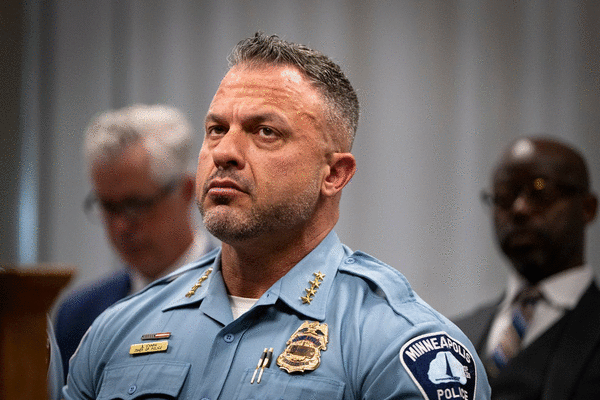
MINNEAPOLIS — Brian O’Hara has resigned as police chief of the Minneapolis Police Department in the wake of “concerning substantiated findings” that he concealed evidence during an investigation into sexual misconduct allegations, Mayor Jacob Frey announced late Tuesday.
The Minnesota Star Tribune has reached out to O’Hara for comment about his resignation.
Here are some takeaways from O’Hara’s resignation, including what led to his departure and what might be next for the Police Department:
At the hastily convened news conference Tuesday, Frey said the sexual misconduct allegations against O’Hara remain unsubstantiated, but investigators found that during the original probe he intentionally deleted a contact card for an individual from his city-issued cellphone in attempt to shield that evidence.
The mayor added that O’Hara defied orders not to discuss the probe when he told another city employee that his city cellphone had been seized in the investigation.
“The interference itself is a breach of trust,” Frey said. “Because of that, I informed the chief that I would be disciplining him up to and including discharge, and he resigned.”
O’Hara was scheduled to appear before the City Council on June 3 regarding his nomination to continue as chief through 2029.
“Chief O’Hara is the right leader for this particular moment in our city,” Frey said at a news conference from City Hall on May 7.
Frey touted the chief’s work to rebuild the department’s depleted ranks, steadily growing its headcount after the force bottomed out at 550 officers two years ago. The mayor also credited him with reducing homicides and other violent crime in recent years and rebuilding public trust.
That praise continued even after O’Hara resigned. In an email to MPD staff members, Frey wrote that O’Hara had led the department “through one of the most challenging periods in Minneapolis history, and under his leadership important progress was made. … He dedicated himself to this department and to Minneapolis, and I am very grateful for his service.”
Detractors on the City Council cited frustration around the pace of police reform since George Floyd’s murder by Minneapolis police in 2020 and MPD overspending its budget by nearly $20 million last year.
Then federal agents aggressively swept into the city during the especially forceful federal immigration crackdown. Several council members publicly derided O’Hara and his officers for not doing more to rein in the agents during the Trump administration’s Operation Metro Surge.
O’Hara came to Minneapolis in 2022 after serving as police chief in Newark, N.J. He came on board with a unanimous City Council confirmation vote and a mandate to bring about a new era of policing in the city after Floyd’s murder marked one of Minneapolis’ darkest periods.
Through monthly TV and radio interviews and impromptu media briefings at crime scenes, O’Hara asserted himself as an especially accessible police chief.
He often spoke candidly and made sure to give a nod to the officers who remained on the police force, which he described as depleted and demoralized in the aftermath of 2020.
Not long after this honeymoon period, however, investigatory stumbles led to calls from community activists for O’Hara’s resignation as far back as 2024, when the department mishandled its investigation of Davis Moturi’s shooting by a mentally ill neighbor after Moturi repeatedly called police to report him.
Then came the investigatory shortfalls into the domestic violence deaths of Allison Lussier and Mariah Samuels, which further blemished O’Hara and his department.
Frey said Assistant Chief Katie Blackwell succeeds O’Hara as acting chief “effective immediately.”
The mayor said he has “full confidence that she will provide stability, continuity and strong leadership for the department during this transition [and] work to build a department that is effective, that is accountable and worthy of the public’s trust.”
Blackwell is a longtime senior leader in the department. She was inspector for the Fifth Precinct and once led officer training in the department.
Her largely behind-the-scenes presence was pierced in 2021 during the globally televised murder trial of Derek Chauvin, the officer who kept Floyd pinned to the pavement for several minutes.
While testifying, Blackwell was shown a photo from the viral video of Chauvin on Floyd’s neck and asked whether officers are taught that tactic. She replied, “I don’t know what kind of improvised position this is.”
Frey said the city will embark on a thorough search for a permanent chief in hopes of finding a nominee who will secure City Council confirmation.
O’Hara’s resignation and the city’s handling of its investigations into him could make all the more difficult the continued service of Toddrick Barnette as the city’s community safety commissioner.
City Council President Elliott Payne said in back-to-back social media posts that the revelations about O’Hara are “another indictment of Toddrick Barnette’s lack of oversight of MPD and its leadership. Minneapolis residents deserve better from leaders of such important public safety departments.”
Fellow Council Member Jason Chavez chimed in, calling for Barnette’s nomination by Frey to be rejected.
--------
—Liz Sawyer and Deena Winter of the Minnesota Star Tribune contributed to this story.
©2026 The Minnesota Star Tribune. Visit at startribune.com. Distributed by Tribune Content Agency, LLC.




Comments