Why experts, emergency crews haven't been able to find a solution to California's Garden Grove chemical threat
Published in News & Features
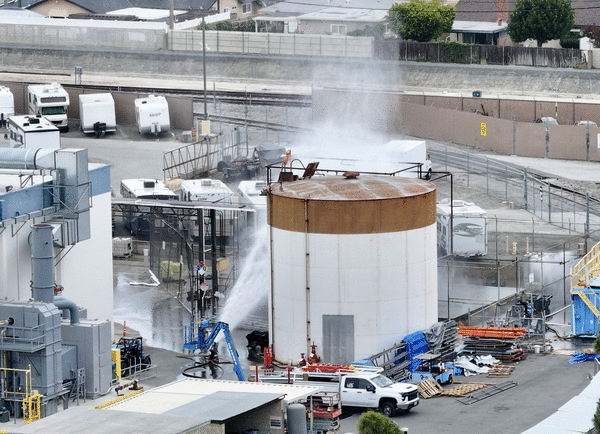
Experts and emergency crews have been working for nearly two days to try and prevent a potentially catastrophic chemical spill or explosion at Garden Grove, California, aerospace manufacturing facility, but have so far been unable to find a fix.
Anxious observers and residents may be asking themselves, what makes fixing this damaged chemical tank so challenging?
The chemical storage tank at GKN Aerospace began malfunctioning on Thursday rose to dangerous levels Friday and into Saturday while crews attempted to head off a disastrous explosion and tens of thousands of residents remained under evacuation orders.
The chemical at the center of the crisis — methyl methacrylate — is a highly toxic substance that in the short term can impact a person's respiratory system and cause skin irritation and eye irritation, officials said. But little is known about the long-term effects of the substance on humans, health officials said on Friday. Encountered at high levels, officials said it could cause severe respiratory distress and hospitalizations.
Finding a way to reduce the temperature within the tank or release the chemicals in a controlled way has proven elusive, officials said.
The valves that are usually used to control the tank are gummed up. The tank itself is made of thick steel, and even attempting to drill into it could create heat and spark the highly volatile chemicals, Orange County Fire Authority Capt. Steve Concialidi said.
Crews entered the plant on Friday night planning to introduce a chemical stabilizer meant to harden up the liquid chemicals, Concialidi said. They were able to add that stabilizer to two nearby tanks, but weren’t able to put it into the unstable tank before having to leave the area due to the higher than expected temperature.
While authorities acknowledged the large size of the evacuation zone was disruptive to the community, they wanted to make sure that no one would be in danger in the event of an explosion.
“Our hearts go out to all of them, but it is for their safety,” Concialidi said of the residents impacted by the evacuation orders.
In the event of an explosion, there would be metal from the tank and nearby tanks, debris from the plant and chemicals all pushed into the air.
Normally, the chemical gases would stay close to the ground, since they are heavier than air, Concialid noted. But an explosion with a large fireball would send the liquid and the vapors into the atmosphere.
Exactly how far the gas would travel would depend on the wind, which is expected to pick up in the afternoon on Saturday.
In the event of the tank cracking and the chemicals rapidly leaking out — a less catastrophic option — fire crews have set up a system of sand barriers to prevent the chemicals from entering from entering storm drains or river channels.
While there have been no reports so far of active gas leaks or plumes, the air quality in the area is being monitored and officials have strongly urged residents to adhere to the evacuations given the potential danger.
Cal/OSHA has confirmed that they will open an inspection report for the GKN Aerospace plant where the tank is located, though they have released no other details.
The plant on Western Avenue has been in the city for more than three decades. Prior to the current crisis, it was primarily known as the worldwide leading manufacturer of cockpit windshields, jet canopies and aviation windows for civil and military aircraft.
_____
The temperature inside a malfunctioning chemical storage tank in Garden Grove has risen to dangerous levels as crews continued to try to head off a disastrous explosion and roughly 40,000 people remain under evacuation orders, fire authorities announced early Saturday.
Crews who “put themselves in harm’s way” overnight realized that the interior temperature of the tank — which authorities previously believed had been dropping — was not actually cooling, officials said.
That left fire officials on Saturday morning still racing to find an “out of the box” solution to the compromised tank at GKN Aerospace in Garden Grove, amid dire predictions that it could either explode — potentially unleashing a fireball and chemical plume — or crack as 7,000 gallons of chemicals pour out.
Orange County Fire Authority crews first responded to the business on Thursday afternoon, following reports that an overheated tank had begun venting vapors. Firefighters began spraying the tank down with water in order to cool the chemical in the tank – methyl methacrylate, a toxic and highly flammable liquid chemical.
On Friday, worsening conditions forced authorities to set up a roughly one-mile buffer around the tank.
Fire officials on Friday offered a bleak assessment: The tank would fail and spill 7,000 gallons of “very bad chemicals” into a parking lot — which they described as the preferable option. Or the tank would go into “thermal runaway” and blow up, a more dire scenario.
In order to avoid such a scenario, crews were focused on keeping the temperature in the tank down. They described approximately 100 degrees as the point in which things could go out of control.
Looking at readings from drones of the outside of the tank, crews late Friday believed they had gotten the temperature down to 61 degrees, and were hoping to get it down to 50 degrees, the point where they believed it was possible to neutralize the threat.
Based on those readings, fire crews — aided by a chemist team — went from defense to offense on Friday night and went “in harms way” into the facility to try to neutralize the tank, Incident Commander Craig Covey said in a video update.
But when the fire fighters and chemists saw the actual tank, they learned the actual temperature was higher than they expected.
“Unfortunately, the temperature was 90 degrees,” Covey said. “Yesterday morning, it was 77 degrees when we backed out. It is averaging about a degree an hour increasing.”
An explosion or a rupture and a spill remain two possible outcomes, Covey said.
But authorities are beginning to consider a third outcome — that a “void space” above the liquid chemicals could reduce the pressure and prevent an explosion as crews continue to deluge the tank with water. Further research is needed to determine if that option is realistic, Covey said.
“We are bringing people in from all over the country, talking to people from all over the place, trying to come up with additional options,” Covey said. “Letting this thing just fail and blow up is unacceptable to us.”
While there have been no reports so far of active gas leaks or plumes, the air quality in the area is being monitored and officials have strongly urged residents to adhere to the evacuations given the potential danger.
Evacuation centers have been set up at Freedom Hall at 16801 Euclid Street in Fountain Valley, Savanna High School at 301 N. Gilbert Street in Anaheim, John F. Kennedy High School at 8281 Walker Street in La Palma and Oceanview High School at 17071 Gothard Street in Huntington Beach.
The Garden Grove Strawberry Festival Parade was canceled, though the actual Strawberry Festival itself remained open, according to the city. A planned vote center will not open, and an OC Food Bank was shut down.
Cal/OSHA has confirmed that they will open an inspection report for the GKN Aerospace plant where the tank is located, though they have released no other details.
The plant on Western Avenue has been in the city for more than three decades. Prior to the current crisis, it was primarily known as the worldwide leading manufacturer of cockpit windshields, jet canopies and aviation windows for civil and military aircraft.
The chemical at the center of the crisis — methyl methacrylate — is a highly toxic substance that in the short term can impact a person's respiratory system and cause skin irritation and eye irritation, officials said. But little is known about the long-term effects of the substance on humans, health officials said on Friday. Encountered at high levels, officials said it could cause severe respiratory distress and hospitalizations.
_____
©2026 MediaNews Group, Inc. Visit ocregister.com. Distributed by Tribune Content Agency, LLC. ©2026 MediaNews Group, Inc. Visit ocregister.com. Distributed by Tribune Content Agency, LLC.






Comments