Alberta premier stakes political future on Canada secession vote
Published in News & Features
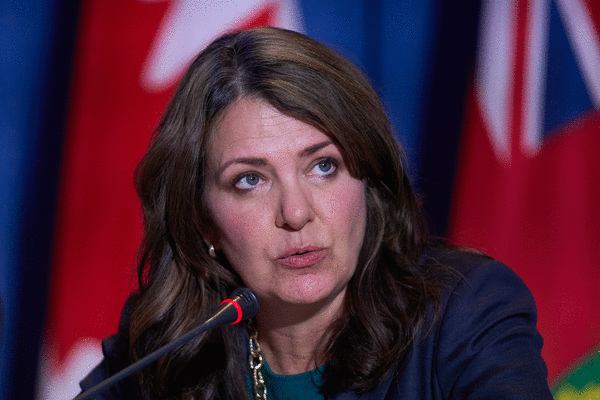
Alberta Premier Danielle Smith’s decision to call a referendum that could lead to the energy-rich province separating from Canada has angered both sides of the debate and triggered calls to challenge her leadership.
For decades, aggrieved Albertans have accused the distant federal capital Ottawa of unfairly holding back their province from reaping the rewards of its natural resources, and some have wanted to break away.
Yet while Smith has repeatedly said she wants Canada to remain united, the issue of separation has gained traction in the past year, partly thanks to her own actions.
And that leaves her walking a political tightrope, with each side complaining she’s doing the work of the other.
“Federalists are not happy about having the referendum at all,” said Lisa Young, a political scientist at the University of Calgary. And “separatists aren’t happy with this formulation of the question,” because although “it keeps the question alive, it doesn’t take them to the place where they want to go. So I don’t see a constituency for this question.”
Smith came to power in 2022 partly by harnessing a populist, anti-establishment sentiment which contributed to toppling her predecessor, Jason Kenney.
Her ruling United Conservative Party’s voters are twice as likely to support secession as Albertans overall, according to the Angus Reid Institute, and separatist sentiment is highest generally in rural parts of the province. But her oft-repeated stance is that she wants to strengthen Alberta’s sovereignty while remaining in Canada — something she was booed for saying at her party’s last convention.
Smith has expressed sympathy for separatists, but on Friday she said Canada “is working better every day” and that she would campaign to stay in the country.
To advance her agenda, she’s been making moves with Prime Minister Mark Carney to enable construction of a new oil pipeline to the Pacific coast. That would provide crucial diversified market access for a province that holds most of the country’s known oil reserves and exports millions of barrels daily, almost all to the U.S.
Smith’s rapport with Carney marks a sea-change after her combative relationship with his predecessor Justin Trudeau, who led Canada for a decade until last year and passed stricter environmental laws. Both Trudeau and Carney are Liberals, but Carney has relaxed some of those rules and is encouraging investment in extracting natural resources.
Smith cited this progress Friday as evidence Alberta is winning the argument and getting more of what it needs while staying in Canada.
At the same time, she’s also made it easier to trigger referendums, by lowering the threshold for citizen petitions that force public votes.
Two rival petitions — one pro-Canada and one against — collectively claim more than 700,000 signatures to tackle the issue, but legal and procedural hurdles derailed them from triggering a referendum.
So on Thursday, she decided to pose her own question for a public vote that she believes will avoid court challenges: “Should Alberta remain a province of Canada or should the Government of Alberta commence the legal process required under the Canadian Constitution to hold a binding provincial referendum on whether or not Alberta should separate from Canada?”
That question will be added to the ballot in a previously-scheduled plebiscite on Oct. 19, alongside nine others focusing on immigration and constitutional issues.
The move has enraged both sides, for either going too far or not far enough.
Jeffrey Rath, a leader of the separatist movement, encouraged supporters to join Smith’s United Conservative Party and call for a meeting to challenge her leadership.
“Anybody that supported independence that thought you were on their side, that believed that you were playing so-called 4D chess, and that you were secretly in support of independence and that we could trust you — all of that trust has now been completely disabused and people really see her for what she is,” he said in a phone interview.
A rival group called Forever Canada, led by former Deputy Premier Thomas Lukaszuk, garnered more than 400,000 signatures supporting the province staying within Canada. He said by phone that Smith’s question “is going to do nothing but cause a lot of harm to Alberta” by “prolonging a very painful process.”
“This is not the climate into which capital wants to be invested,” he added.
Business groups are also stark about the threat posed by a referendum.
“This process will further undermine regulatory certainty and jeopardize future economic advancement,” Calgary Chamber of Commerce CEO Deborah Yedlin said in an emailed statement. “People, businesses, capital and opportunity will leave our province — and never come back.”
Yedlin and others have previously pointed to how companies permanently abandoned Montreal for Toronto when separatism in the French-speaking province of Quebec flared in past decades.
Leaders of the two largest cities in the region echoed those concerns, warning the instability of a referendum would hurt their economies. Calgary Mayor Jeromy Farkas said at a press conference on Friday that the campaign would be “divisive” and “shooting ourselves in the foot,” while Edmonton Mayor Andrew Knack on X called it a “reckless” move.
Indigenous groups may also play an important role. A legal challenge from several First Nations thwarted the separatist petition’s signatures from being verified, because the government didn’t adequately consult them. On Friday, chiefs of the Treaty 8 First Nations in Alberta said they “continue to raise serious concerns” about the government’s willingness to uphold constitutional obligations and their treaty rights.
However, the University of Calgary’s Young suggested Smith might be able to survive the new separatist threats if she’s given her opponents too much to do. They will need to both campaign for the referendum, as well as her ouster.
Smith’s move “makes nobody happy,” she said, “but it is possible it saves her.”
_____
©2026 Bloomberg L.P. Visit bloomberg.com. Distributed by Tribune Content Agency, LLC.






Comments