US reaches limit of sanctions power in targeting Iran's economy
Published in News & Features
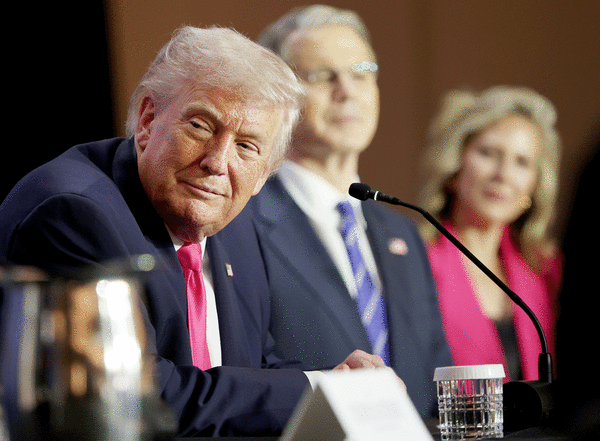
The Trump administration launched its “Economic Fury” campaign to hobble Iran’s economy with sanctions more than a month ago. So far, the country is unbowed.
Treasury Secretary Scott Bessent exhorted allies earlier this week to join the U.S. in its economic pressure campaign, which the administration rolled out shortly after it entered into a ceasefire that halted its military campaign against Iran, dubbed “Epic Fury.”
The new campaign appeared to be an update of “Maximum Pressure,” the tag line dating from Trump’s first term that described his approach of suffocating the Iranian economy. The new campaign that started April 16 promised to leverage “the full range of available tools and authorities” to choke off Iran.
So far, though, the actions largely resembled the previous strategy, and with the same effect: Iran has broadly held out against U.S. demands despite facing a steadily growing arsenal of sanctions dating back to 2018, when President Donald Trump backed out of a nuclear deal forged during the Obama era.
That’s brought the total number of sanctions against Iran imposed in the last eight years to nearly 2,000, according to Jeremy Paner, a partner at Hughes Hubbard & Reed, who tracks designations on Iran’s oil and petrochemical sectors.
“There really hasn’t been any significant shift in the targeting priorities,” Paner said. “The authorities are the same. The geographies being targeted are the same.”
The U.S. effort has targeted everything from oil companies and shipping firms to currency exchanges and intermediaries across China and the Middle East.
But all of those measures — even with an extensive bombing campaign alongside Israel and an ongoing US Navy blockade — have only underscored Iran’s ability to weather U.S. pressure, especially given continued oil sales to China.
The administration’s challenge with Iran is one that’s bedeviled successive administrations: squeezing Iran’s economy enough to force change while avoiding excessive harm to the global economy and American consumers’ pocketbooks.
“We’ve just reached the limit of what we can achieve with sanctions and economic pressure,” said Richard Nephew, a former State Department official who served as the deputy envoy for Iran and a coordinator for sanctions policy. “We need to either overwhelm them with something new — and this Economic Fury stuff isn’t it — or we need to start limiting our ambitions.”
A Treasury spokesperson didn’t respond to a request for comment.
There’s also the matter of timing.
Trump wants a quick end to a war that has closed the vital Strait of Hormuz and caused global energy prices to soar. On Saturday, Iran said talks on a peace deal was progressing with Trump and Secretary of State Marco Rubio also signaling a resolution was in sight.
Iran’s battered leadership has been hunkered down over what they see as an existential crisis. It doesn’t help that any deal with the U.S. would likely involve loosening the sanctions that Treasury continues to slap onto the regime.
“There’s not really a lot of incentive for them to capitulate when they know that the shackles come off in a couple weeks,” says Brett Erickson, a managing principal at Obsidian Risk Advisors. “A fully unified Western sanctions front would absolutely tighten the screws on Tehran over the long term. But the global economy does not have the luxury of an extended timeline.”
The resilience of Iran, despite the range of levies against it, echoes the persistence shown by other heavily sanctioned U.S. geopolitical foes, including Russia and North Korea.
This so-called axis of the sanctioned have ended up exporting weapons and munitions to each other in the face of U.S. measures — a network that has seen Russia using Iranian drones and North Korean shells against Ukrainians, and Iran getting targeting information from Russia.
Washington’s escalation to a full naval blockade against Iran — an act of war under international law — is just a further sign that the Islamic Republic has been able to withstand sanctions.
“There’s a very large kind of shadow economy that has been directly created by sanctions,” economic statecraft expert Nicholas Mulder said. “The blockade — and the war of which the blockade in a sense forms a part — is an admission that these sanctions that the U.S. has been using for decades have not achieved this goal.”
At the same time, the administration’s appetite for sanctioning China, which has long been the single largest buyer of Iranian oil, has been limited, according to Chris Kennedy, economic statecraft lead at Bloomberg Economics and a former State Department official.
The U.S. has sanctioned Chinese entities linked to the Iranian oil trade in recent weeks, including one of China’s largest private oil refiners and exchanges that helped convert oil sales made with Chinese yuan into other legal tender.
But after meeting Chinese leader Xi Jinping, Trump suggested he was weighing whether to ease sanctions on Chinese oil companies buying from Iran. The president later said he would only relax sanctions after a deal.
“It is spaghetti at the wall at this point,” Kennedy said. “They’re constrained by the China relationship, and it seems like they’re hoping that economic pressure is going to force a capitulation. Our assessment is that’s pretty unlikely.”
_____
©2026 Bloomberg L.P. Visit bloomberg.com. Distributed by Tribune Content Agency, LLC.





Comments