Blood moonshot: Pitt researchers' artificial, shelf-stable platelets are a major step forward for trauma care
Published in News & Features
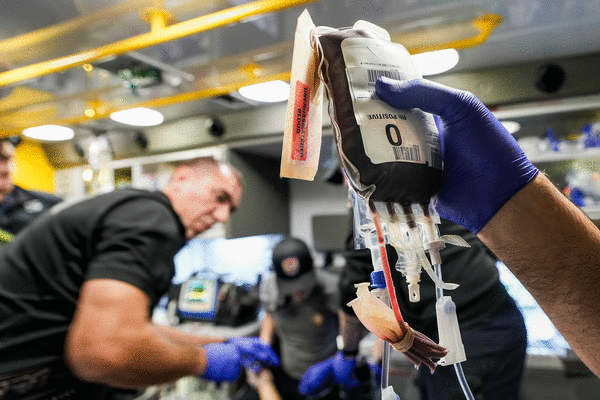
Researchers are getting closer to ensuring a vial of powder the size of a quarter — and with the potential to prevent tens of thousands of unintentional deaths per year from bleeding — is a staple in ambulances, first aid kits, airlift helicopters and military packs.
That small vial of powder, when combined with 10 milliliters of sterile water, creates artificial blood platelets that can clot blood and stop uncontrollable bleeding. It can be stored at room temperature and is shelf-stable for up to a year.
It’s the first time scientists have successfully created a shelf-stable artificial platelet product — and it happened right here in Pittsburgh.
“I take care of people who are severely injured and maybe bleeding to death, and I can tell you that one of the most frustrating things about my job are the patients that I never get to care for,” said Matthew Neal, a trauma surgeon with UPMC and lead author on a new paper showing the viability of these synthetic platelets, published in March in the Journal of Thrombosis and Haemostasis.
“They're the people who suffer from severe injuries, where we may have the tools and resources in a hospital to take care of them, but because of the severity of their injury, they can't actually get to the hospital.”
The synthetic platelets, called SynthoPlate, were developed in collaboration with Case Western Reserve University and biotech company Haima Therapeutics, both based in Cleveland. Researchers tested SynthoPlate on rats and found the product stopped hemorrhagic bleeding and helped the rodents recover significantly better than uninjured rats.
Researchers said artificial platelets may just be the “holy grail” for a long-held problem in the field of trauma — hemorrhagic bleeding — which kills 30,000 people a year. The project was supported with $4.6 million in grant money from the Department of Defense.
Human blood breaks down into three parts: Red blood cells provide oxygen to our organs, plasma carries nutrients and helps blood flow as a liquid, and platelets provide the “glue” that helps blood clot.
These blood components are often in shortage across the country. In January, for instance, the American Red Cross reported a shortage of both whole blood and platelet stock. Synthetic blood products are one way scientists are working to skirt these donor shortages.
Freeze-dried, or powdered, plasma has been around since the 1930s and was used in acute care of soldiers in World War II.
Platelets have historically been trickier for scientists to master. They are shelf stable for only a few days, limiting their ability to be used in transient situations. On the scene of a car accident, on the battlefield and in areas of Pennsylvania 50 miles from the nearest hospital, a bleeding patient’s life depends on quick access to platelets.
“Platelets have been a real stickler,” said Alan Murdock, a trauma surgeon with Allegheny Health Network who was not involved in the research. “Many wounded are in the field, and it takes a while to get to them. Anything you can do to control hemorrhage can make a big difference.”
A Maryland-based biotech company, Cellphire Therapeutics, has engineered freeze-dried platelets to tackle the storage and portability component, but its technology relies on donor platelets. Matthew Neal — who said he knows Cellphire’s work well and hopes both their products succeed — aimed to create an artificial platelet to get around the donor shortage.
SynthoPlate can be a “safety valve” if and when platelets are not available, said Philip Spinella, a trauma surgeon and professor at the University of Pittsburgh. A military veteran, he is also an author on the paper.
In the SynthoPlate study, the team also found that the platelets could be injected straight into bone marrow, which has a rich supply of blood, as opposed to needing an IV and the at-times tricky puzzle of finding a suitable vein.
“Having something you can give easily, quickly and right away to the patient, that can potentially save their life, is an amazing opportunity,” said Elliott Haut, a trauma surgeon and professor with Johns Hopkins University School of Medicine, who was not involved in the study.
Haut said his team regularly works with the military and clearly sees how the platelets could improve fatality rates.
“This is the perfect example of, they want things ready-to-go on the battlefield, they don’t have refrigeration and are literally working with the things they have on their back,” he said. “The thought of having this readily available during an acute injury is great.”
SynthoPlate still has to be tested in humans and approved by the Food and Drug Administration. Neal and his team hope to start Phase I clinical trials by early 2027, with the first clinical trials involving patients who are very sick and need the product. If that goes well, researchers would next move to healthy patients.
Neal expects SynthoPlate will be well tolerated in humans because of the success of the rat research. His team specifically tested the toxicity profile of the material, for instance, and found the rats could tolerate up to 250 times the therapeutic dose before showing signs of toxicity.
“It will be interesting to see how this plays out in humans,” said Murdock. He’s not surprised Pittsburgh played a role in the discovery, given its high-caliber research: “They’ve all been on the forefront of looking at blood products.”
As many of the authors are on the scientific advisory board for Haima Therapeutics, Neal said they have a conflict management plan in place and an independent reviewer of all results. Neal also won’t be the one conducting the human clinical trials, due to his ties to the pharmaceutical company, to prevent conflicts of interest.
The trials could take three to five years, but researchers are eager to get started. They don’t have time to waste.
“This is a very large public health problem that we need to solve,” said Spinella.
_____
© 2026 the Pittsburgh Post-Gazette. Visit www.post-gazette.com. Distributed by Tribune Content Agency, LLC.






Comments