Term limits for Supreme Court justices? Congressman's new bill fuels familiar political rift
Published in News & Features
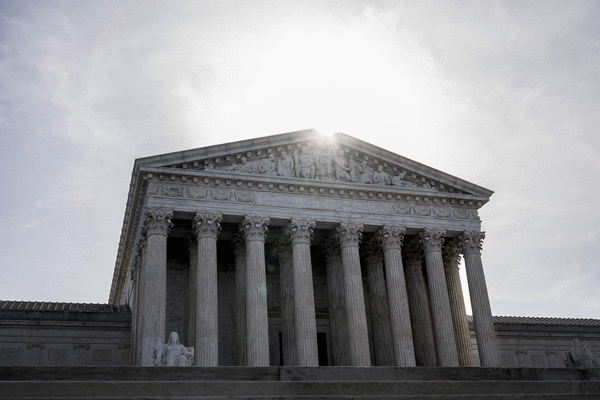
A proposal by Rep. Johnny Olszewski Jr. to impose term limits on U.S. Supreme Court justices is opening a familiar partisan divide, with the Democrat framing it as a needed fix and a Maryland Republican calling it an overreaction to recent rulings.
Legislation introduced by the freshman Baltimore County lawmaker would establish 18-year term limits for Supreme Court justices. The measure would reform a system that Olszewski, a former American history and government teacher, says enables justices “to serve for decades without accountability” because they have lifetime appointments.
Olszewski’s long-shot bill reflects national Democrats’ growing dissatisfaction with a court they see as increasingly partisan and conservative, willing to upend precedent, and out of step with public opinion. The legislation follows a 6–3 ruling last week in which the court limited the Voting Rights Act’s power to enact race-based remedies for maps that marginalize Black voters’ election impact.
“Whenever the Democrats don’t like the outcome, they just change the rules,” Maryland Rep. Andy Harris said in a response to Olszewski’s bill. Harris, the only Republican in Maryland’s congressional delegation, represents Harford County, the Eastern Shore, and a portion of Baltimore County.
Because it would apply to current justices, the bill would immediately change the court’s composition.
“For one thing, Clarence Thomas would be gone, as would (Samuel) Alito,” said Carl Tobias, a University of Richmond law professor with a focus on federal judicial selection.
Thomas and Alito are among six of the court’s nine justices appointed by Republican presidents, forming the current conservative majority. The two justices, along with Chief Justice John Roberts — also appointed by a Republican — have each served more than 18 years.
Supreme Court term limits have been proposed in past years, although not all the proposals applied to justices currently on the court.
In 2023, a bipartisan working group convened by the American Academy of Arts and Sciences proposed that justices serve 18-year staggered terms, with one vacancy every two years. Justices would not be removed from office but would shift to a “senior” role after 18 years, continuing in a limited capacity.
The working group said the change would lessen the political stakes of any single appointment and help restore public confidence in the court. But critics said frequent turnover could destabilize precedent and lead to sharper swings in constitutional law,
It’s not clear if Congress could impose term limits by statute or whether it would require a constitutional amendment. Amending the Constitution requires a two-thirds vote in both the House and Senate and ratification by three-fourths of the states.
Olszewski said in an interview that an amendment would be required.
“That would be a debate to be had,” Tobias said. “If both houses passed it, it could be law, and then somebody would have to challenge it.”
Olszewski said his proposal wasn’t prompted only by recent court decisions he disagreed with. He also cited scrutiny over justices accepting trips or other benefits, or attending high-profile political events.
“This is not an ‘in this moment’ feeling,” he said. “I think Americans have felt this way for a very long time. What was meant to be a lifetime tenure appointment to give these justices that ability to be apolitical has turned into a reason for them to abuse it.”
_____
©2026 The Baltimore Sun. Visit at baltimoresun.com. Distributed by Tribune Content Agency, LLC.






Comments