Voting rights groups sue state over Florida's new congressional map
Published in News & Features
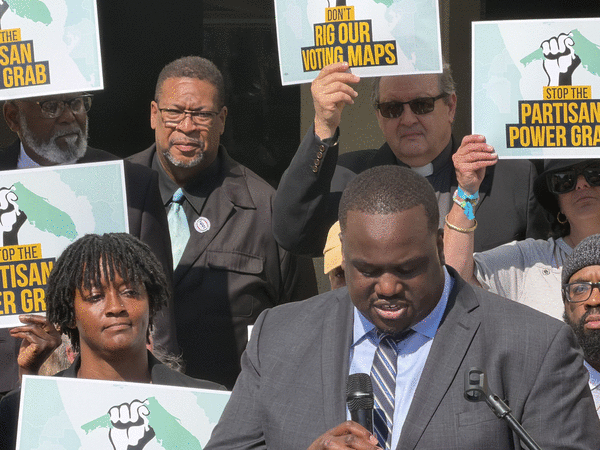
TALLAHASSEE, Fla. — A new congressional map signed into law by Gov. Ron DeSantis, which eliminates a Hispanic majority seat and aims to help Republicans keep control of the U.S. House of Representatives, has ignited what will likely be drawn-out court battles over Florida’s new voting boundaries.
Three different groups filed lawsuits in a state court in Tallahassee on Monday and Tuesday, claiming the map violates the state’s Fair Districts Amendment, which prohibits political gerrymandering. They were filed on behalf of Florida voters, including some in Orange and Osceola counties.
The lawsuits mark the third time a congressional district map approved by the Florida Legislature was challenged under Fair Districts, approved by voters in 2010.
The lawsuits call the map — which was drawn in secret, leaked to Fox News and then quickly slammed through a two-day special session of the Legislature — an egregious, blatant case of illegal gerrymandering that favors one party over another.
They are asking the court to stop the implementation of the new map, which kicks in for this year’s congressional races, and strike it down as unconstitutional, allowing the current map, drawn four years ago, to be in place for 2026 elections.
“This map is not just flawed, it is a deliberate and unconstitutional attempt to manipulate our electoral system for partisan gain, said Genesis Robinson, executive director of Equal Ground, one of the groups that sued, in a statement. “The newly enacted map — pushed through with an unlawful mid-decade redistricting process — is in direct violation of the Fair Districts Amendments, overwhelmingly passed by Floridians to prevent this exact type of overreach.”
The new lawsuits claim the redrawn districts violate Florida’s Fair Districts Amendments on several fronts, arguing they eliminate racial minority voting blocs, were drawn to favor one political party over another and violate rules to keep districts that are compact and preserve political and geographic boundaries. District 9, which had included all of Osceola and part of Orange, now sprawls 120 miles from Orlando International Airport to the edge of Lake Okeechobee.
The Equal Ground Education Fund sued on behalf of 18 Florida voters, within a couple of hours of DeSantis signing the redistricting bill into law Monday. The group is represented by the Marc Elias law firm, which successfully sued the state over its 2012 congressional maps, forcing the state to redraw its boundaries in 2015.
The Florida Supreme Court invalidated the 2012 map, ruling that it was poisoned by partisan intent. The 2022 map, drawn up by DeSantis and his staff after rejecting a plan approved by the Legislature, was also ruled unconstitutional in a lower court but ultimately upheld by the Florida Supreme Court last year.
The mid-decade redraw of the map came after President Donald Trump urged Republican-led states try to increase the number of GOP seats to hold onto Congress. DeSantis also said the state needed to redo its map to redistribute Florida’s explosive population growth more evenly.
The map devised by his staff redraws 21 of the state’s 28 U.S. Housel districts, flipping four Democratic-held seats to favor Republican candidates. It could change the balance of the Florida congressional delegation from 20 Republicans and eight Democrats to 24 Republicans and four Democrats.
The biggest change is the breakup or “cracking” of the Hispanic Majority district currently held by Rep. Darren Soto, a Democrat from Kissimmee who is of Puerto Rican descent. The redrawn map also affects the political makeup of majority Democratic seats in Tampa and South Florida, targeting incumbent Democrats Kathy Castor, Jared Moskowitz and Debbie Wasserman Schultz.
The governor’s office, secretary of state and attorney general did not immediately respond to a request for comment about the lawsuits.
Texas was first GOP-led state to adopt new maps, which kicked off a flurry of redistricting efforts and legal challenges in several other Republican states, including North Carolina and Missouri.
Democratic states California and Virginia countered by changing their constitutions to allow mid-decade redraws and sent their new maps to voters for their approval.
“In contrast, Florida made no efforts to amend its constitution when it sought to join the partisan wars and conduct a mid-decade redistricting for partisan gain,” the Equal Ground lawsuit states. “Accordingly, unlike these other states, Florida’s constitution continues to expressly prohibit partisan gerrymandering—a constraint the Legislature chose to ignore.”
DeSantis staff members told lawmakers partisan intent influenced the redrawn maps but said they advised by their legal counsel that they didn’t have to adhere to the Fair Districts Amendments due to a recent U.S. Supreme Court ruling that invalidated a Black majority congressional district in Louisiana.
Fair Districts also prohibit discriminating against minority voters. DeSantis staff argued that because the high court, in its Louisiana ruling, narrowed the scope of the 1965 Voting Rights Act, Fair Districts rules are also nullified — a position the lawsuits challenge.
Florida lawmakers are suggesting that ruling “is a green light to ignore the Fair Districts Amendment and justify their egregious partisan gerrymander,” according to the Campaign Legal Center, which filed the second lawsuit against the map, along with the UCLA Voting Rights Project.
“The Florida Legislature, at the behest of Governor DeSantis and President Trump, is attempting to fast-track an illegal gerrymander for partisan gain, blatantly violating the state’s constitution,” said Simone Leeper, senior legal counsel for redistricting at Campaign Legal Center. “Instead of abiding by this law, the Legislature is defying the will of voters and backing a map that was crafted entirely with partisan intent.”
The Supreme Court’s decision in the Louisiana case “does not erase Florida’s constitutional ban on partisan gerrymandering, and it does not give lawmakers permission to override the will of the voters,” said Bernadette Reyes, senior staff attorney at the UCLA Voting Rights Project.
The third lawsuit was announced Tuesday by the Southern Poverty Law Center, on behalf of Common Cause, the League of Women Voters of Florida, and the League of United Latin American Citizens.
Jessica-Lowe Minor, president of the League of Women Voters of Florida noted that DeSantis released a color-coded version of the map to Fox News with proposed districts shaded red and blue before he gave it to the Legislature. The map colored nearly the whole state red, with one blue district around Orlando and three others in South Florida.
“When a map is distributed in a red/blue format to the media before being transmitted to the Legislature, and when the governor’s staff openly acknowledges in committee that there is no new Census data being used to justify a new map, Florida voters can’t help but suspect that this is a partisan gerrymander,” Lowe-Minor said. “Floridians have consistently said they are not interested in political gamesmanship within redistricting, which is why they passed the Fair Districts standards overwhelmingly in 2010.”
------------
©2026 Orlando Sentinel. Visit at orlandosentinel.com. Distributed by Tribune Content Agency, LLC.






Comments