Trump says Venezuela is 'really happy', but poll shows fast-growing discontent
Published in News & Features
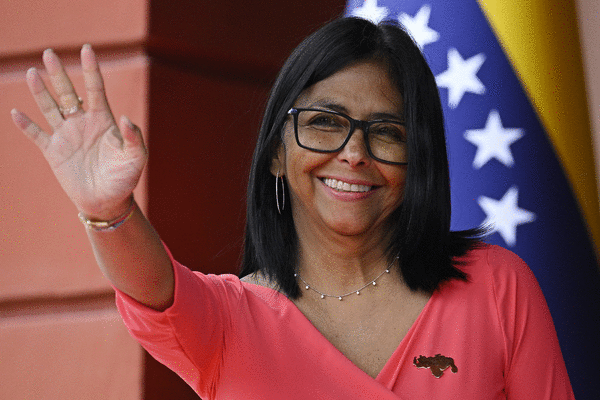
President Donald Trump says Venezuelans are “really happy” as the country undergoes political change, but new polling data suggests a growing disconnect between Washington’s optimism and public sentiment inside Venezuela.
Speaking Monday at a White House event, Trump highlighted what he described as a shift in Venezuela’s social and economic climate following the removal of Nicolás Maduro from power earlier this year.
“The people of Venezuela are really happy,” Trump said, adding that in the country “things are happening that they haven’t seen in 20 years.”
He also pointed to a renewed “spirit” in Venezuelan society and strengthening bilateral ties, including increased flows of Venezuelan crude to the United States.
“We have hundreds of millions of barrels of oil coming out of Venezuela, going to Houston and different places to be refined,” he said.
His remarks come amid a shift in U.S. policy toward Caracas, marked by closer energy cooperation and the opening of key sectors — particularly oil — to foreign investment under the interim government of Delcy Rodríguez.
But the latest data from Venezuelan polling firm Meganálisis paints a starkly different picture.
The survey, conducted in the third week of April, shows a sharp drop in support for Trump among Venezuelans. While 92% of respondents in January said they felt grateful to the U.S. president following Maduro’s capture, that figure had fallen to 47% by April — a decline of 45 percentage points in just three months.
The drop appears to coincide with Trump’s growing closeness to Rodríguez, who assumed power on Jan. 5.
Ruben Chirinos, president of Meganálisis, said the decline reflects a widening gap between expectations after Maduro’s removal and the slower pace of change on the ground. Speaking to Venezuelan outlet VPItv, he noted that initial gratitude toward Washington — which peaked above 90% in early January — has eroded rapidly as Venezuelans reassess the direction of the transition.
According to Chirinos, much of the discontent stems from a perception that economic interests, particularly in the oil sector, are taking precedence over the well-being of ordinary citizens. The data shows strong rejection of Trump’s backing of Rodríguez, with many Venezuelans increasingly uneasy about what they see as a policy focused more on energy deals than on political or institutional change.
He added that while some changes have taken place since January, they have been limited and slow to materialize, fueling frustration among a population that had expected a more decisive break from the past. Announcements of energy agreements and foreign investment have been accompanied by conflicting signals from industry representatives citing a lack of legal certainty, while the continued presence of figures linked to the previous regime has further undermined confidence.
“The country is at a crossroads of uncertainty,” Chirinos said. “The only one who appears to be certain is Donald Trump, when he says he is very happy with Delcy Rodríguez. But Venezuelans are not happy with Delcy Rodríguez.”
That sentiment is reflected in the broader data. Rejection of Trump’s relationship with Rodríguez is overwhelming: 89% of respondents oppose Washington negotiating with or backing the interim leader, compared with just 3% who support it.
At the same time, nearly half of those surveyed — 47% — now avoid taking a position on Trump, suggesting growing uncertainty or disillusionment.
Public perception of the country’s trajectory also remains largely negative. According to the poll, 78% believe Venezuela is “on the wrong track” under Rodríguez’s provisional leadership, while more than 70% say their family’s economic situation would worsen significantly if she remains in power.
Disapproval of Rodríguez’s performance is especially high across key areas. In the economy, rejection reaches 95%; in public services, 95%; in democracy and civil liberties, 94%; and in healthcare, 87%. In all cases, approval remains below 4%.
Against this backdrop, an electoral solution is emerging as the public’s preferred path forward.
Some 87% of respondents believe the crisis can only be resolved through presidential elections this year, with most favoring a vote between October and December.
In that scenario, opposition leader María Corina Machado is the clear frontrunner. In an open-ended question, she commands 71% of voting intention, rising to 76% when specific candidates are presented. Rodríguez, by contrast, garners just 4%.
Even in a hypothetical runoff, 76% say they would vote for Machado, compared with just 2% for Rodríguez.
Support for Machado is also reflected in other indicators: more than 73% consider her return to Venezuela very important, and 74% believe her presence would accelerate the end of the current political crisis.
Meanwhile, Rodríguez’s interim government continues to consolidate its position, balancing internal pressure for political reforms with external demands to sustain the economic opening that has enabled renewed investment and rising oil output.
©2026 Miami Herald. Visit at miamiherald.com. Distributed by Tribune Content Agency, LLC.





Comments