Dark money group behind Florida bill to terminate sister-cities programs with China
Published in News & Features
TALLAHASSEE, Fla. — A Florida bill meant to protect the state from China and other foreign enemies is backed by right-wing, dark money groups and could endanger some student exchange programs and sister-city initiatives, the feel-good efforts meant to promote cultural exchanges.
The proposal (HB 905) was approved by the Legislature in March but has yet to be presented to Gov. Ron DeSantis to sign into law.
It is the latest in a series of bills Florida lawmakers passed in recent years to curb the activities of foreigners, particularly Chinese nationals, in Florida. Those restrictions include banning Chinese citizens buying land near critical infrastructure, prohibiting universities from accepting funding or forming partnerships with Chinese entities, and restricting the hiring of students from China for academic research roles.
In 2023, DeSantis used the power of that year’s law to cut Park Maitland School, a long-established private school in Orange County, and Sagemont Preparatory School in Broward County from the state’s voucher program, claiming their ownership had ties to the Chinese government. The schools denied that, but their students are no longer eligible for state-funded scholarships that can help pay tuition at most of Florida’s private schools.
Supporters of the new bill say it will provide an extra layer of security, on top of federal regulations, to protect citizens against foreign influence. They say it is warranted given President Donald Trump’ executive order last March directing state governments to take the lead in protecting their critical infrastructure.
“China is using a variety of tools … to influence local agendas — spy balloons, secret police groups, charitable organizations targeting local government officials who are seen as more pliable than federal officials,” said Rep. Jenna Persons-Mulicka, R-Naples, the bill’s sponsor.
But civil rights advocates and other opponents say the measure connotes a new era of McCarthyism that focuses mostly on Chinese nationals and unfairly targets them as threats.
“This is blatantly xenophobic and anti-immigrant and not wanting people from other nations to be here in the United States,” Sen. Carlos Guillermo Smith said. “This was not a data-driven proposal, this was not based on statistics or on known threats.”
National right-wing groups have been raising the specter of undue foreign influence for years and urging states to fight it by pushing bills that target China, Russia, Iran, North Korea and, more recently, Venezuela and Syria.
These groups argue those nations could use technology to spy on Americans, steal trade secrets and interfere with elections. The companies they’ve targeted include Lenovo, LexMark, TP Link and Ali Baba, a Chinese company specializing in e-commerce and artificial intelligence.
They also argue that student exchange programs and sister-city programs are potential avenues to infiltrate local governments.
Sister Cities International says it works to “build bridges of understanding across borders” and has been forming partnerships since 1931 when Toledo, Ohio and Toledo, Spain became sister cities.
“There has indeed been a growing trend of misperception and general fear of Sister City relationships which are impacting the decisions of our state leaders,” said Carlo Capua, chairman of the board for Sister Cities International, in an email. “Most of it is grandstanding, but as we know, perception is reality.”
A Texas bill pased last year, for example, “prohibits Texas governmental entities from establishing, maintaining, or renewing sister-city agreements with countries designated as ‘foreign adversaries’, including China, Iran, North Korea, and Russia,” he said.
Florida’s bill, if approved, would terminate sister-city programs with any “foreign country of concern” on July 1. Those countries are identified as China, Russia, Iran, North Korea, Syria and Venezuela.
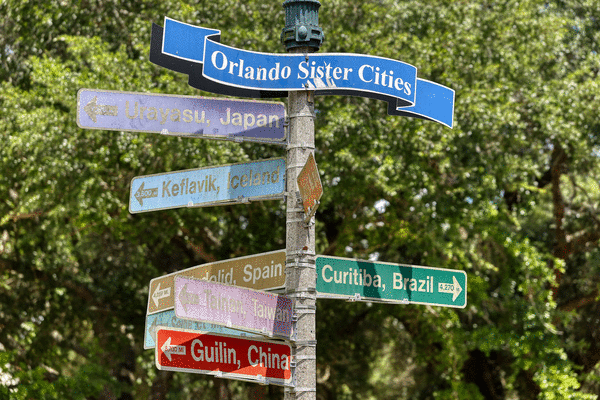
Eight Florida cities, including Orlando, have sister-city agreements with cities in China, and three each have agreements with cities in Russia and Venezuela.
State Armor, founded in 2023 in Austin, Texas, is one of the groups pushing these new laws. It spent between $60,000 and $219,000 on lobbying in Florida from 2023 to 2025, state records show.
It is run by Michael Lucci, a former member of the Cicero Institute, a right-wing think tank founded by Palantir co-founder Joe Lonsdale.
While federal law doesn’t require State Armor to disclose where it got the $3.4 million it raised in 2024, other documents show that most of it — $2.3 million —came from The Concord Group, a right-wing judicial advocacy group founded by Leonard Leo, a top official with the Federalist Society and a former Trump advisor.
Records show State Armor spent nearly $400,000 lobbying state legislatures that year.
State Armor has been pushing legislation in Nebraska, Texas, Kansas and other states targeting foreign influence.
In Florida, Persons-Mulicka said she drafted the bill herself, but was influenced by State Armor’s research and by bills filed elsewhere and in previous years in Florida.
“I looked at what State Armor, the Heritage Foundation had,” she said. “I definitely looked at everything as a resource.”
Her legislation initially incorporated several features of those other bills, including creating registries for foreign agents, barring contributions to charities from foreign countries, and terminating technology contracts with companies controlled by foreign interests considered hostile to the U.S.
A coalition of businesses, including Lenovo, LexMark, Hewlett Packard, Comcast and Ali Baba, worked successfully to get those harsher elements removed.
Her bill also targets foreign students who attend state universities and colleges, getting rid of a program that allowed some to pay in-state tuition and ending the Florida-China Linkage Program, a state program created in 1987 to develop educational and cultural ties between Florida and China.
Some lawmakers think the legislation goes too far.
“We absolutely have reservations about countries of concern but this goes way beyond countries of concern,” said state Rep. Anna Eskamani, D-Orlando.
The Brazilian consulate called her office to say that some Brazilian students would be forced to pay out-of-state tuition because of the bill, she said.
“To cast a broad net assuming every student is a spy is irrational,” Eskamani said. “International students add to our scientific excellence. We are not going to compete if we demonize every immigrant.”
And the bill still would end sister-city programs from certain countries.
“I’m not sure why this is even an issue or why this global organization is being singled out. There are other organizations working with countries of concern that are not named,” said Brenda Frinks, the Florida state representative for Sister Cities International.
Nobody has reached out to her, Frinks said, and she is not aware of any bad actors in the sister city programs in Florida. Also, most sister-city programs with China have been dormant since the COVID-19 pandemic. And Russian programs have been inactive since the beginning of the Ukraine war.
“This seems to be somewhat fear-based, deleting countries without provocation that we are aware of,” she said. “Has there been any spying in Florida? How did you single out sister cities and why?”
Orlando’s sister-city program with Guilin, China, has existed for 40 years, but has been mostly dormant in recent years, said Andrea Otero, public information manager for the city.
In September 2011, a small delegation paid its own way to Guilin to celebrate the 25th anniversary of its sister-city agreement, she said.
“But as with any legislation, we are reviewing the bill to ensure compliance if signed into law by the Governor,” she said.
One of Florida’s laws targeting those same foreign countries was ruled unconstitutional last year by a federal judge. The law would have restricted students from China, Cuba, Venezuela, Syria, Iran, Russia and North Korea from working at Florida’s universities and colleges unless they could prove they weren’t national security threats.
©2026 Orlando Sentinel. Visit orlandosentinel.com. Distributed by Tribune Content Agency, LLC.






Comments