Sedated, injured, even dead: Exotic bird smuggling cases underscore a problem at the border
Published in News & Features
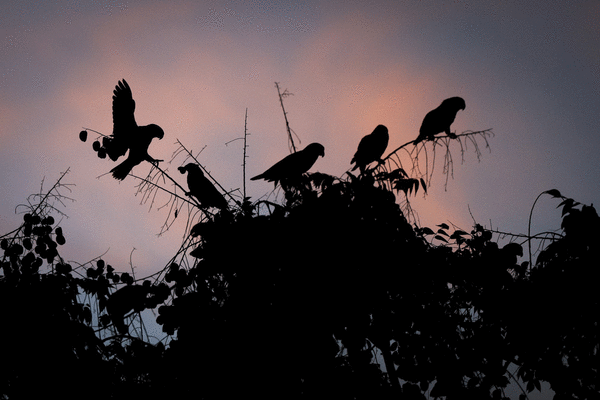
Two San Diego men have been sentenced for smuggling vulnerable birds into the United States, with one heading to prison and the other getting hit with thousands in fines.
Ricardo Alonzo was sentenced to three months in prison for smuggling 17 birds — two red-lored Amazon parrots, five yellow-crowned Amazon parrots and 10 Burrowing parakeets — into the U.S. without quarantining them to prevent the spread of disease, officials with the federal Department of Justice said in a news release.
In a second case, a federal judge ordered San Ysidro resident Carlos Abundez to pay $74,330 for smuggling 14 sedated keel-billed toucans in the dashboard of his Volkswagen Passat, the government said. Some of the birds suffered injuries, including broken tails and a broken leg.
The two cases provide the latest glimpse into a persistent problem plaguing the border: exotic birds — many native to Mexico or Latin America — being squirreled away deep inside vehicles or even a suspect's clothing.
In October, a Tijuana man was indicted after officers found two emaciated and potentially sedated orange-fronted parakeets stuffed in his underwear. In June, a 24-year-old was detained after officers found seven Amazon parrots in a cardboard box on his passenger floorboard. Two months before that, authorities arrested a man after concluding he had smuggled six birds in his boots and six more in his car — two of them dead.
Lawyers for Alonzo and Abundez did not immediately respond to requests for comment.
Mike Parr, president of the American Bird Conservancy, a nonprofit devoted to the conservation of bird habitat, said he is not surprised by some of the birds being trafficked. Captive parrots have become habituated to humans and popular with pet owners, he said.
"They're decorative. They make good pets. They talk. People just have an affinity for parrots," said Parr, who also co-wrote "Parrots: A Guide to Parrots of the World."
Alonzo was arrested in May at the San Ysidro Port of Entry. Investigators found bags under the rear seat of his 2015 Dodge Durango containing the 17 birds, as well as three chickens, which were used as decoys to "conceal the protected parakeets and parrots from detection by border officials," according to his plea agreement.
Many of the birds were extremely young. The two red-lored Amazon parrots died "as a result of the difficult journey," the plea agreement said.
All three species of birds in Alonzo's car were protected and listed as part of the Convention on International Trade in Endangered Species, prosecutors said. The surviving parrots and parakeets were sent to the Bronx Zoo, the agreement said.
Doug Ault, assistant director of the U.S. Fish and Wildlife Service's Office of Law Enforcement, said Alonzo's actions undermined efforts to protect vulnerable bird populations, while also bypassing laws aimed at preventing "the entry of zoonotic diseases and other pathogens into the U.S."
"This defendant used illegal smuggling practices that disregarded the laws of the United States, the lives of the birds he was smuggling, and wildlife within the United States," Southern District of California U.S. Attorney Adam Gordon said in a statement.
In his plea agreement, Alonzo admitted earning $40,000 for the sale of the birds. As part of his sentencing, he was ordered to pay the U.S. Fish and Wildlife Service $3,262 to cover the care and quarantine of the parakeets.
Abundez, the other defendant, was apprehended in June 2025 at the Otay Mesa Port of Entry. According to his plea agreement, he told the authorities he was heading to McDonald's and had nothing to declare.
During a search, a U.S. Customs and Border Protection officer found the 14 bound and sedated keel-billed toucans, including one duct taped under the car's dashboard.
Abundez was sentenced March 3.
His payment of $74,330 will go into the Lacey Act Reward Fund, which compensates tipsters who report wildlife crimes, federal authorities said.
©2026 Los Angeles Times. Visit latimes.com. Distributed by Tribune Content Agency, LLC.





Comments