After 20 years, Nevada may resume executions, though experts question practicality
Published in News & Features
LAS VEGAS — Clark County District Attorney Steve Wolfson remains uncertain about the possibility of an execution in Nevada, even after saying he wanted three convicted killers put to death.
“I am a gambler, but I’m not sure how much I bet on this one,” he said.
Wolfson said executions are more likely now than in previous years because of increased access to lethal injection drugs, though he said he expected additional legal challenges and delays.
The Nevada ACLU’s legal director, Chris Peterson, questioned the district attorney’s move to seek warrants and schedule dates for the executions of Zane Floyd, 50; Donald Sherman, 62; and Sterling Atkins, 52.
“We need to take very seriously the county’s decision to seek a death warrant,” Peterson said. “The prior history related to when the DAs have sought death warrants is concerning.”
Nevada has not carried out an execution since Darryl Mack’s death in 2006, though the death penalty is legal. The state’s two most recent attempts — including one involving Floyd — collapsed in their final stages.
In 2018, the state called off the scheduled execution of Scott Dozier after pharmaceutical companies challenged the use of their drugs, raising questions about the lethal injection protocol. In 2022, officials halted Floyd’s scheduled execution amid ongoing legal disputes and procedural concerns.
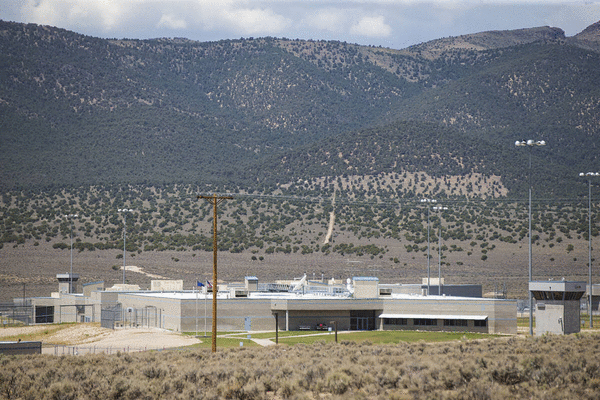
Two years before Dozier’s scheduled execution, the state built a new execution chamber at Ely State Prison. The $860,000 facility has never been used, underscoring Nevada’s ongoing difficulty in carrying out death sentences handed down by juries.
‘Other states executing with a drug combination’
Nevada law calls for lethal injection. The state’s most recent protocol authorized a 3- or a 4-drug cocktail for executions.
Still, problems with the drug combination proposed in Floyd’s planned execution played a key role in halting it. The state’s authorized drug supply expired, and the Nevada Department of Corrections’ execution protocol called for a new combination that had never before been used to carry out a death sentence.
The cocktail included the painkiller fentanyl or a similar drug, alfentanil, and potassium chloride or potassium acetate.
In Dozier’s case, drug manufacturer Alvogen sued Nevada, alleging that the state had obtained one of its sedatives “by subterfuge with undisclosed and improper intent” to circumvent the company’s restrictions against sales of its products for use in executions.
A Clark County judge stopped the execution, barring Nevada from using any Alvogen drugs in an execution.
Months later, Dozier was found dead by suicide in his prison cell.
Wolfson declined to discuss specifics regarding what drugs would be used in future executions, instead saying that he had had general discussions with prison director James Dzurenda. Wolfson said that Dzurenda reported having “two to three options.”
“The appeals have been exhausted, more states are utilizing and actually executing people with the combination of drugs, so I think it’s more likely than it was before,” Wolfson said.
NDOC has not responded to repeated requests for comment.
Asked specifically about the likelihood of NDOC obtaining lethal injection drugs and its plans to carry out executions, spokesperson Teri Vance confirmed that they would take place at the chamber at Ely State Prison.
“Any other plans have not been made yet,” Vance said. “The execution manual(s) will be created once the NDOC receives the execution warrant(s).”
Last year, two people were put to death in Arizona, where lethal injection is the only authorized execution method, and a Utah prisoner was executed by a single-dose pentobarbital injection in 2024, according to data provided by the Death Penalty Information Center. Both states injected a single drug for those executions, although in the past, different drug combinations were used. Utah has also employed firing squads.
A law passed in Utah in 2024 blocked the release of any identifying information about those who manufacture, supply, compound, or prescribe drugs, medical supplies, or equipment used in an execution.
Expects continued litigation
Wolfson said he had expected continued appellate litigation if his office obtained the execution warrants.
He said that judges are less apt to allow an execution to occur, but also that the Nevada defense bar challenges convictions and causes “an incredible amount of delay.”
“That’s why nobody has been executed in 20 years,” Wolfson said.
After a death sentence, defendants can pursue multiple post-conviction appeals, allowing defense attorneys to challenge issues such as ineffective counsel, prosecutorial or juror misconduct, and constitutional violations.
Court records show that Floyd’s most recent appeal of his criminal conviction was closed in 2022, Atkins’s in 2024, and Sherman’s last month.
These proceedings often take decades, and after an execution date is set, attorneys can raise additional claims, including those regarding the defendant’s intellectual capacity or the method of execution.
A. Richard Ellis, a former Atkins attorney, said that the man’s intellectual disabilities may ultimately prevent his execution.
Peterson said that, if a new execution date were to be set for Floyd or anyone else, the ACLU would review the execution manual for potential First Amendment violations.
Peterson added that, since the Supreme Court reinstated the death penalty in 1976, there have been botched executions in which government entities had misrepresented what had happened.
The ACLU works to protect the rights of third parties, ensuring that NDOC’s execution plans are clear and regulated.
“When an execution occurs, it’s done in the name of the state of Nevada,” Peterson said. “So, the governor’s responsibility is to be transparent with the public about the death penalty, and at the same time, I think the public has a responsibility to actually understand what that is.”
‘In pursuit of an agenda’
Peterson, again pointing to Floyd’s case, argued that the state’s first execution attempt was politically motivated.
“I think that when it comes to these death warrants, it’s always possible there may be some other interest that’s being played out here, rather than seeking what the county considers to be justice,” Peterson said.
In 2021, the Nevada State Assembly passed a bill to abolish the death penalty and convert death row inmates’ sentences to life imprisonment without parole.
A day later, prosecutors formally requested a warrant for Floyd’s execution, a move Wolfson called “purely coincidental.” Later, Senate leaders, including two prosecutors who, outside of session, had worked for Wolfson’s office, blocked the death penalty repeal bill.
Robin Maher, executive director of the Death Penalty Information Center, said that while her organization can make predictions based on data and trends related to capital punishment, predicting the actions of elected officials is much more challenging.
“I would be interested in knowing what the compelling reason is to schedule these right now,” Maher said. “The one thing we can’t predict is what elected officials are going to do. They often do things in pursuit of an agenda … for reasons that they don’t ever disclose.”
Maher also said the question of whether anyone would be put to death again in Nevada was a one of priorities.
“Elected officials have to decide whether to expend the substantial government resources that will be required to conduct an execution or instead invest those resources to address the urgent needs of Nevada voters.”
Asked if there was a strategic reason to pursue the execution warrants now, Wolfson said he believed he was fulfilling his duties as district attorney.
“A jury found that these three individuals should be executed for their behavior,” he said. “The jury weighed aggravating and mitigating information. These defendants received a great deal of due process: a trial by their peers, the right to confront and cross-examine witnesses, and all the other attendant due process rights. And at the end of the day, it’s time to move forward with the jury’s declaration.”
_____
Reporter Casey Harrison also contributed to this report.
_____
©2026 Las Vegas Review-Journal. Visit reviewjournal.com.. Distributed by Tribune Content Agency, LLC.






Comments