San Diego developing new generation of 'ghost ships' that are vital to the Navy's future
Published in News & Features

SAN DIEGO — The Navy is rapidly expanding its efforts in San Diego to develop small, fast, unmanned sea drones to help the U.S. adapt to the swift and dynamic ways naval warfare is changing throughout the world.
The drones are designed to perform autonomously or via remote control while doing such things as stalking submarines, spotting mines and serving as advance scouts for aircraft carriers. Some also could be used to launch missiles and grenades.
The Navy says human operators can precisely control a medium-sized sea drone if it is nearby. They can guide it hundreds of miles over the horizon using relay systems. And they can send commands thousands of miles using satellites.
Two years ago, the Navy created a new enlisted ranking called robotics warfare specialist for people who can operate air, water and ground drones — part of the movement toward creating a hybrid fleet.
Supervisors are executing a term-limits power play, not pushing 'reform', and other top stories from April 24, 2026.
In January, three new drone divisions were established in San Diego, roughly doubling the research and development the Navy has been doing here. Developers are mostly focused on creating 16-foot boats that can be quickly reconfigured for a variety of missions and can be acquired for less than $1 million each.
Sea drones “extend our operational reach, reduce risk to personnel, give us attack options, and enable persistent surveillance in high-threat areas,” Vice Adm. Brendan McLane, commander of Naval Surface Force, Pacific Fleet, said when the new divisions were established.
The surge was influenced by visits the Navy and Pentagon made last year to Ukraine to study the comparatively inexpensive, long-range sea drones that country has used to destroy parts of the Russian fleet. The accomplishment shocked military planners everywhere.
Currently, only a small number of U.S. “ghost ships,” as the drones are often called, have moved from experimental to operational status. But the Navy projects that in 2045, approximately 150 of its 500 ships will be sea drones, some with the ability to operate underwater.
The Navy says it will take a step in that direction this year when the San Diego-based USS Theodore Roosevelt becomes the first aircraft carrier to fully integrate an operational sea drone into its strike group for a major deployment.
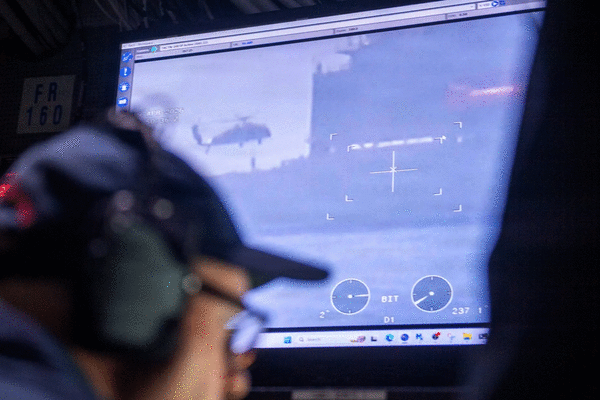
On April 19, 2026, the San Diego-based aircraft carrier USS Theodore Roosevelt participated in a training exercise with a sea drone, or so-called unmanned surface vessel. The Roosevelt may soon become the first carrier to deploy with a sea drone. (U.S. Navy) San Diego was made the primary center of drone development in recent years because it is home to the largest Navy complex on the West Coast and has a long history of innovation. It is the birthplace of naval aviation and helped develop the nation’s first aircraft carriers.
The city is also a gateway to the Indo-Pacific, where the U.S. faces tensions with China over the sovereignty of Taiwan, and the Middle East, where the U.S. is at war with Iran. And it is home to UC San Diego, which is deeply involved in military research, and such defense companies as Saronic Technologies, which is developing sea drones.
The precise state of the Navy’s San Diego program is not known. The Navy did not respond to four requests the Union-Tribune made for a briefing, likely due to the ongoing war with Iran.
In the past, the Navy talked publicly and proudly about all of its small and mid-sized drones — vessels that are regularly seen navigating San Diego Bay.
However, Capt. Tim Hawkins, a spokesperson for the U.S. Central Command, which is directing the U.S.-Iran war, confirmed to the Union-Tribune last week that an unspecified number of sea drones were present in the Persian Gulf region when the war began, mostly for stress testing in a real-world environment.
“We haven’t really gone into great detail on all the different platforms, and we will not … for operational security,” he said.
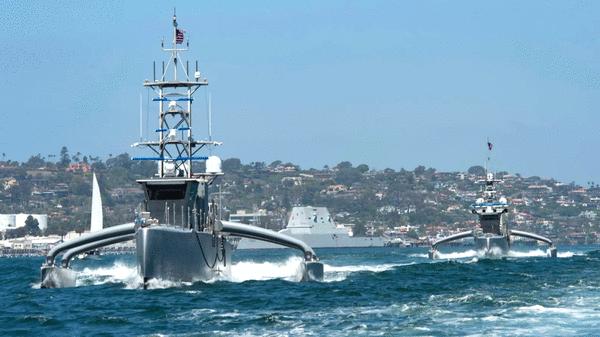
San Diego’s deep involvement with sea drones began in 2016 with the arrival of Sea Hunter, a 132-foot experimental trimaran that can go up to 90 days without refueling and travel about 12,000 miles. It can also handle heavy seas and travel about 31 mph, nearly as fast as an Arleigh Burke-class destroyer, the so-called workhorse of the Navy. The drone is largely able to do so because it does not carry humans and their supplies.
The drone was developed by the Defense Department, which estimated in 2018 that Sea Hunter cost $15,000 to $20,000 per day to operate. By comparison, a manned destroyer costs $700,000 a day.
The San Diego program took on a similar drone, Sea Hawk, in 2021 and turned it into a platform specializing in maritime surveillance, especially for such areas as the Persian Gulf. These watercraft are meant to augment the Navy’s ability to spot and track other ships.
The rise of such vessels “coincides with big advances in materials science, artificial intelligence and computer science, which helped make this kind of warfare possible,” said Henrik Christensen, a roboticist at UC San Diego.
The vehicles are becoming lighter, faster and more durable, plus they are far better at spotting, tracking and attacking targets. The drones also conduct “white shipping,” which generally refers to distinguishing between commercial (white) ships and military (gray) vessels.
The emerging ability of sea drones to detect and disable sea mines and spot submarines was supposed to be a core feature of Navy littoral combat ships. But the littoral vessels — which cost about $500 million each — have not proven that they can reliably perform this work.
The effectiveness and potential of sea drones also grabbed the Navy’s attention “because the ones that the Ukraine has been using against Russia showed that you can attack an enemy rather than just defend against one,” said Alexander Nawrocki of Rancho Santa Fe, a former NASA roboticist who has closely monitored the Ukraine-Russia war.
He was referring, in part, to early versions of the Sea Baby, an inexpensive, explosives-laden “suicide” drone that Ukraine crashed into Russian ships and infrastructure from 2022 to 2024. The drones evolved into reusable boats that can carry multiple rocket launchers. Ukraine has been developing an underwater version to go after submarines.
“We cannot overlearn the lessons coming out of Ukraine and the Middle East,” Chief of Naval Operations Lisa Franchetti said at a conference in Virginia in January 2025.
President Donald Trump fired Franchetti a month later as part of a shake-up of military leadership. But interest in sea drones didn’t tail off. Congress is currently reviewing a proposal to spend $74 billion on all types of drones and related technology.
_____
©2026 The San Diego Union-Tribune. Visit sandiegouniontribune.com. Distributed by Tribune Content Agency, LLC.






Comments