Ice breaks at the NC legislature on opening day, as budget talks finally move ahead
Published in News & Features
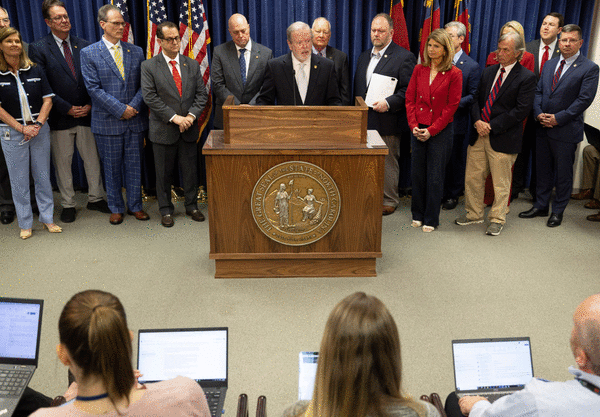
North Carolina’s General Assembly came back to work on Tuesday under high pressure to pass a long overdue budget, reach a deal on Medicaid spending and make decisions on tax cuts and raises.
At least one came to fruition right away, with a deal announced on funding Medicaid’s increased costs, and with votes expected starting Wednesday.
But the bigger battle, which has dragged on since last summer, is the state budget.
Republican leaders of the House and Senate, who have been in a months-long stalemate over taxes, were optimistic.
Change is in the air, as it usually is before sessions get bogged down in policy and politics.
Berger and Hall ‘optimistic’ on budget
About an hour before the legislative session began, Democratic Gov. Josh Stein made his latest budget proposal to lawmakers, hopeful they’ll send him a budget bill in 2026 — since they didn’t in 2025, when it was due.
“I’m optimistic. We’ll see. We’re not there yet,” Republican Senate leader Phil Berger told reporters Tuesday, about the status of budget negotiations with the House.
That’s a big change after months of a stalemate.
“We’re having conversations. They are substantive. They haven’t gotten us to to an agreement yet, but we are continuing to talk, continuing to exchange ideas,” Berger said.
Republican House Speaker Destin Hall told reporters that he thinks “we’ll get a budget done by the end of this short session.”
“The budget talks continue, and I’m optimistic, more so than I have been in the past, that we’re going to get a budget done and a good budget done.”
Tax cuts have been at the center of the budget stalemate. Hall said he and Berger are both willing to negotiate a final budget now, and that “everything is on the table. Both the House and the Senate want to cut (tax) rates.”
The tax debate between Republican leaders
Berger may have lost his primary in March, which is ushering in the end of his political career, but it hasn’t reversed his general position on tax cuts.
In short, Berger wants to reduce the individual income tax rate based on revenue benchmarks set by legislative Republicans in 2023. Hall wants to change the benchmarks to slow the tax reductions unless the state has more money.
“We’ve made a promise to the voters of North Carolina and to the taxpayers of North Carolina, that if we hit certain targets, we’re going to reduce taxes,” Berger told The News & Observer.
“We’re projected to hit the ... revenue target that gets us from 3.99%, to 3.49% — I don’t think we should go back on that,” Berger told The N&O about reductions to the individual income tax rate that would begin in 2027.
He expects North Carolina to continue to exceed forecasted tax collections, as it has in previous years. This year’s revenue forecast shows the state hitting benchmarks for its collections.
“And right now the projection is that we may also hit the target at 2.99%,” Berger said, referring to the benchmark that would determine whether the tax rate drops again in 2028. “I think we’ve got to keep those promises. Now, whether or not it needs to be on the same pathway that currently exists, or not, I think that’s subject to discussion.”
Asked by The N&O what he means by “pathways,” and if it could mean moving the year the taxes are reduced, Berger said: “All kinds of pathways.”
Raises and children’s hospital are factors
Other factors in the tax discussion are big-ticket items like raises for teachers and state employees, as well as funding for the Duke and UNC children’s hospital that will be built in Apex. The children’s hospital funding will be part of the larger budget conversation, he said.
“It’s a negotiation. We’ll see where it goes,” Berger said.
Hall said recent talks between the House and Senate have included discussing tax cuts, “and that we want to do it at the most responsible level possible. But when we pass a budget, I anticipate it continuing to contemplate reductions in the income tax rate over some period of time.”
Neither Hall nor Berger are ready to give specifics. And they still don’t have a deal. If they can agree on a tax package, they can decide how much money they can spend on raises for state employees as well as teachers, whose base pay is set by the General Assembly.
Tax rates tied to amount of raises
“One of the starting points is you’ve got to know what your finance package is going to be because that gives you a general idea of what revenues you have, and you really need to know those things before you get into the heavy discussion about the state employee raises,” Hall said.
“But I think based on what’s going on with our discussion on tax policy, we are certainly going to have the revenue to be able to do some of the things we’ve been trying to do on the House side,” Hall said, referring to raises for state employees and teachers.
Unlike Stein and other Democrats’ proposal, House Republicans are not going to freeze tax cuts, Hall said.
However, Berger also said he is open to passing legislation that includes raises that aren’t part of the comprehensive budget bill.
“I think it would be good if we could get it all wrapped together, but however we can make progress — if it’s separate bills, a single bill. I’m not necessarily opposed to multiple bills.”
So at the end of the opening day of session, the House and Senate are still divided.
But not on Medicaid funding, which is poised to pass shortly.
And they’re much closer to negotiating a budget that can pass by the end of the session. Hall put out a House calendar that shows the last voting day could be July 2.
Like every legislative session, hope springs eternal.
_____
©2026 Raleigh News & Observer. Visit newsobserver.com. Distributed by Tribune Content Agency, LLC.




Comments