As lawmakers ready bill allowing Coloradans to sue federal officials, prosecutors raise objections
Published in News & Features
DENVER — Wary of a potential court challenge, Colorado lawmakers are readying new legislation that would allow the state’s residents to sue federal officials — including immigration agents — when those officials violate locals’ constitutional rights.
But first, the bill’s sponsors have to overcome opposition from an unexpected source: the state’s elected prosecutors.
The new measure, which is expected to be introduced in the coming days, would expand on — if not replace — a bill by the same Senate sponsors that’s already passed that chamber and is a handful of votes away from Gov. Jared Polis’ desk. The new bill would allow Coloradans to sue any federal official for violating their civil rights. That’s a more expansive approach than Senate Bill 5, the earlier measure, which would apply only to federal officials involved in immigration enforcement.
SB-5’s supporters want to fill a gap in federal law that allows people to sue state officials for civil rights violations — but doesn’t provide the same remedy when it’s federal authorities violating those rights.
However, to improve the state’s chances against an almost-certain court challenge by the Trump administration, supporters argue, a new state law would need to apply to all government officials — not just those engaged in one area, like immigration enforcement.
“States cannot lawfully discriminate against federal officials, but they can pass laws that apply generally and equally to all government actors,” argued Beau Tremitiere, the deputy director of impact programs and counsel at Protect Democracy, a national advocacy group backing the new bill.
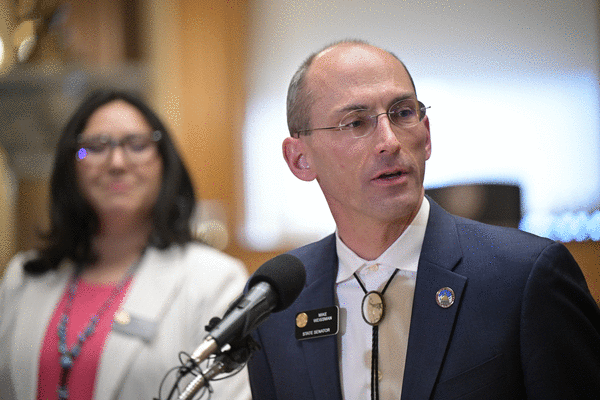
Both bills have been spearheaded by Democratic Sens. Mike Weissman and Julie Gonzales. The new measure would effectively try to invert parts of the 1871 Ku Klux Klan Act, a federal law that, among other things, allowed people to sue state officials for violating their civil rights.
The new bill would have broader applicability, too, Tremitiere and others said: While SB-5 would apply to immigration enforcement, the new legislation would also apply to any federal authority who violate people’s rights — like with elections or gun ownership.
The new version of the legislation would allow civil rights lawsuits against any person — meaning a state or federal employee. Lawmakers and supporters argue that would change nothing for local government officials, who have long faced the possibility of lawsuits under the Klan law.
DAs group calls bill ‘fundamentally flawed’
But the state’s district attorneys, along with groups representing local governments, disagree — vehemently.
In this new legislation, they see challenges to current legal immunities and, behind it, a potential wave of litigation against prosecutors and local government officials.
“I think it’s just fundamentally flawed,” said Tom Raynes, the executive director of the Colorado District Attorneys Council, of the expected new bill. “It can’t be crafted to do what they want it do to — and can’t be crafted in a way that protects state, municipal or county employees from doing their job — without the hanging fear of personal lawsuits for what is alleged and then having to assert defenses (when) no one knows whether they apply for sure.”
The group represents the state’s elected prosecutors, and it wields significant lobbying influence in the Capitol. CDAC hadn’t opposed SB-5, but it’s come out forcefully against the bill’s replacement.
Raynes said lawmakers’ proposal wouldn’t ultimately lead to any successful lawsuits against federal agents and would instead open the door for frivolous action against state employees. He dismissed arguments that the bill wouldn’t weaken prosecutorial immunity as speculative and said it would take litigation — meaning time and money — to determine if that was true.
Kevin Bommer, the head of the Colorado Municipal League, alleged that more litigation was the primary intent behind the measure.
The disagreement, which has slowed the new bill’s introduction, threatens to upend part of Democratic lawmakers’ plans to respond to aggressive actions by President Donald Trump’s administration this year. It also comes six years after Colorado lawmakers did end the qualified immunity granted by state law to police officers in a sweeping reform bill passed in response to the racial justice protests of 2020.
Prosecutorial immunity has remained intact, and district attorneys have kept their guard up. The District Attorneys Council approached some lawmakers earlier this year, concerned that legislators would look at their immunity next, and Raynes acknowledged that his group was generally worried about their protections.
Supporters dispute interpretation
The position taken by Raynes’ group on the civil rights bill has confounded some of the measure’s supporters. Ariane Frosh, a policy counsel for the American Civil Liberties Union of Colorado, said she “can’t explain why there’s been this kerfuffle about immunity.”
She — like others — pointed to language in the latest draft of the new bill, which states that current prosecutorial protections put in place in the Klan Act remain in effect.
“It’s not accurate,” Weissman, of Aurora, said of critics’ concerns Monday.
Added Gonzales, who represents a Denver district: “The question that every member of this legislature will have to grapple with is the actual strict analysis that this bill proposes to create, or (if they will listen to) fearmongering by the lobby.”
Gonzales said Polis’ office was on board with the new legislation. Polis spokesman Eric Maruyama said Tuesday the governor was “open” to it. The governor’s office said the proposal would maintain immunity protections, including for prosecutors.
“We are committed to working with legislators on bills that keep our communities safe and protect individual Constitutional rights while not leading to excessive or frivolous litigation,” Maruyama said in an initial statement Monday. “We are hopeful that productive conversations with all stakeholders continue.”
Jessica Smith, a partner at the Denver law firm Holland and Hart who reviewed the draft legislation for The Denver Post, said she didn’t think the bill would change anything for local officials, either.
She said the new bill appeared to be focused on filling the gap in federal and state law that generally doesn’t allow for civil rights lawsuits against federal authorities.
“When I first read the (bill), I didn’t read it as trying to undo or erode any of the state law immunities that exist, under (Colorado law) or otherwise,” she said.
But, Smith added, she understood that the broad language in the measure — that it would apply to all government officials — could spark the prosecutors’ concern. She said the bill’s sponsors could include even stronger language to assuage those fears.
Raynes, though, said he didn’t think the bill could be salvaged.
“What you get as an end result is a pyrrhic victory for (lawmakers) that says, ‘I passed a bill in an effort to provide a state cause of action against federal employees,’ ” he said. “But you won’t succeed under this action. But you will subject half of the government entities to significant litigation and costs.”
As the backroom arguments continue over the new legislation, lawmakers have scheduled SB-5 — the earlier, narrower measure — for a committee hearing Wednesday. The bill passed the Senate in February on a party-line 20-11 vote.
_____
©2026 MediaNews Group, Inc. Visit at denverpost.com. Distributed by Tribune Content Agency, LLC.






Comments