Effort to impeach Lexington judge is nearly unprecedented in Kentucky history
Published in News & Features
LEXINGTON, Ky. — Kentucky lawmakers’ current effort to remove a Lexington judge from the bench by impeachment is nearly unprecedented in the state’s history.
And in Kentucky’s modern court system, it’s never happened.
Fayette Circuit Judge Julie Muth Goodman faces impeachment after a petition was filed against her in January by a former state representative who is seeking election again.
The impeachment petition was filed in January by Killian Timoney, a former state representative for the 45th District, accusing Goodman of abusing her office. He cited six cases from Goodman’s court he argued constituted misconduct.
In one case, according to the petition, Goodman conducted her own research into a fatal-hit-and-run, overstepping her duties as a judge. According to the petition, Goodman searched for data that showed prosecutors charged Black defendants more harshly than other defendants.
In another, a case that determined whether the University of Kentucky had sovereign immunity — a legal doctrine that shields a government body from lawsuits — the petition and supporting transcript alleges Goodman said she willingly disobeyed a higher court’s precedent because she didn’t agree with it.
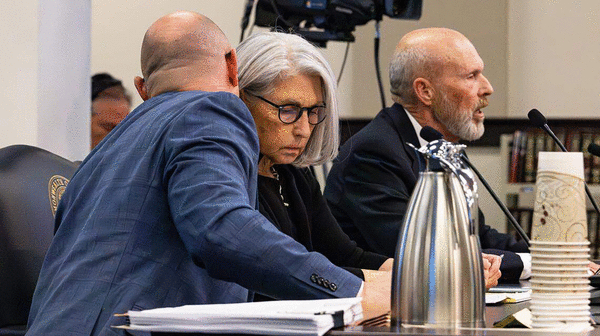
The impeachment proceedings advanced Wednesday when a committee of members of the Kentucky House of Representatives said they would issue a resolution with articles of impeachment.
The case now goes to the full House of Representatives, and if they vote to impeach Goodman, it goes to the Kentucky Senate.
If the effort is successful, it would mark the first time in Kentucky’s modern history a judge has been removed via impeachment.
It’s been more than 100 years since state lawmakers have even tried such a manuever.
Previous impeachments
In Kentucky’s modern court system, a sitting judge has never been removed from the bench through impeachment.
There have been only two instances of a judge being impeached or recommended for impeachment, and they both happened more than a century ago.
The first was in 1806, when appellate judge Benjamin Sebastian was impeached for receiving a foreign pension and involvement in a conspiracy for Kentucky to secede from the U.S.
Although Sebastian was impeached, he would not technically be considered a judge by the current Kentucky Constitution.
In 1916, McCreary County Judge J.E. Williams had an impeachment petition filed against him by local residents for unlawful acts related to public funds.
The Kentucky House of Representatives filed more than 20 articles of impeachment against Williams. However, he was not impeached because the Senate did not reach a majority vote to formally remove him.
Since Kentucky’s modern system was created as part of the 1975 judicial article that unified the court system, lawmakers have successfully impeached two state officials, though neither was a judge — one was Kentucky Agriculture Commissioner Ward “Butch” Burnette in 1991 and former Rowan County Commonwealth’s Attorney Ronnie Goldy.
Goldy was impeached unanimously by the Senate in 2023 for using his position in exchange sexual favors. Goldy resigned from office before articles of impeachment were handed down against him in the House of Representatives. He was criminally convicted in February 2024 of wire fraud and bribery.
Separations of powers
In addition to the unprecedented nature of Goodman’s impeachment proceedings, many legal officials say they blur the lines of separation of powers.
More than 70 Kentucky lawyers signed a letter to the impeachment committee arguing the procedures could be a constitutional infringement on separation of powers between government branches.
“The issue is not a left vs. right, Republican vs. Democrat, or prosecution vs. defense issue,” the 11-page letter reads. “Indeed, (it) is much larger. Separation of powers, equal branches of government, and judicial independence are cornerstones of the constitutional democracy that we enjoy as Americans.
They also voiced concerns about whether the impeachment proceedings were for alleged illegal acts, or because some of Goodman’s rulings were unpopular.
Goodman and her lawyers asked the same question when they filed a request for an emergency injunction in Franklin Circuit Court. They also argued the public impeachment proceedings violated Goodman’s due process rights as a citizen.
A state judge did not halt the proceedings as Goodman requested, and the case remains active.
Former Kentucky Attorney General Fred Cowan on Wednesday joined the chorus of lawyers arguing the effort violated the rule of law — in an op-ed in the Herald-Leader, Cowan called the impeachment proceedings a “dangerous misstep” that threatens to undermine the independence of judges and the Kentucky Constitution.
Current Kentucky Attorney General Russell Coleman has been mostly quiet about the impeachment proceedings against Goodman, though he played a pivotal role in challenging some of her individual rulings.
On several occasions in recent years, he intervened in cases over which Goodman presided, and many of those cases were mentioned directly in Timoney’s appeal for impeachment.
Coleman’s office has said only that it did not help Timoney write his petition.
_____
©2026 Lexington Herald-Leader. Visit kentucky.com. Distributed by Tribune Content Agency, LLC.






Comments