As Russian oil heads its way, Cuba turns defiant, leader blasts Trump 'takeover' talk
Published in News & Features
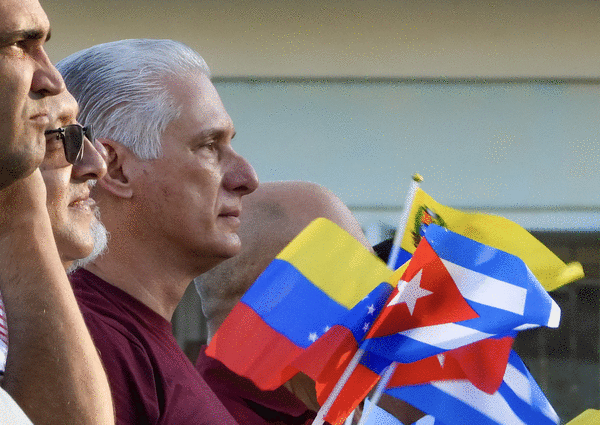
As Cuba adopts a more belligerent tone following President Donald Trump’s talk of “taking” the country, two tankers carrying Russian oil and gas are headed to the island, in defiance of de facto oil embargo the U.S. has imposed on the communist-run nation.
Cuban leader Miguel Diaz Canel replied to repeated comments from Trump’s about taking the island with a defiant message of his own, telling the United States that any aggression will be met with “impregnable resistance.”
“The U.S. publicly threatens Cuba almost daily with the forceful overthrow of its constitutional order,” he said in a publication on X on Tuesday night, the first time he has specifically addressed the U.S. president’s comments about Cuba. “Faced with the worst-case scenario, Cuba has one certainty: Any external aggressor will encounter an impregnable resistance.”
It is unclear if the change in tone by Díaz-Canel and other officials reflects not just Cuba’s leadership red lines about political changes but the chance that help might be on the way.
Citing maritime tracking data, Jorge Piñón, an expert at the University of Texas at Austin who tracks oil shipments to Cuba, said that two tankers carrying Russian oil appear to be heading to Cuba.
The Sea Horse is reported to be carrying approximately 200,000 barrels of Russian diesel fuel. Bloomberg reported that the Anatoly Kolodkin, under U.S sanctions, is carrying 700,000 barrels of Russian Urals crude oil.
“The Sea Horse is no longer drifting and it is moving at its own power at 9.9 knots,” Piñón said. “Our calculation shows that it would take her approximately five 5 days to reach Cuba’s north coast.”
At least two American warships are currently patrolling Cuba’s north coast, tracking sites show. If the tankers approach closer to the island, the Trump administration would need to decide whether to let the Russians provide Cuba with its first oil shipments in three months.
The Trump administration cut off oil supplies from Venezuela and Mexico to the country in an effort to bring Cuban leaders to the negotiating table. The oil shortages have worsened a severe economic crisis that has brought the country to the verge of collapse. Cubans have been protesting for 11 nights in a row, banging pots and pans during the night blackouts, including in the capital, Havana.
After suggesting “a friendly takeover” of Cuba, President Trump said earlier this week that he might have the “honor” of taking Cuba, calling it “a weakened nation.”
“I mean, whether I free it, take it. I think I can do anything I want with it, if you want to know the truth,” Trump told reporters at an event in the Oval Office on Tuesday.
“Cuba is now in a very bad shape. We will be doing something with Cuba very soon,” Trump said at the White House on Tuesday at the top of a meeting with Ireland’s prime minister. Also in the room was Secretary of State Marco Rubio, who is leading U.S. talks with Cuba and gave the clearest sign that the administration wants to see Díaz-Canel stepping down from his formal position as president of the country.
Speaking of the country’s economic problems, Rubio said Cuba doesn’t “get subsidies anymore, so they are in a lot of trouble, and the people there don´t know how to fix it, so they have to get new people in charge.” He also said measures announced Monday by a top Cuban official to allow Cubans abroad to own private enterprises and invest on the island are not “dramatic enough” to fix the ailing nations’ problems.
That might have been the last straw for Díaz-Canel, who had been restrained in his anti-American rhetoric after admitting Friday for the first time that the two countries were having talks to find “solutions through dialogue to the bilateral differences between our two nations” and move away from confrontation.
On Wednesday evening, he blasted the United States for weakening the country’s economy through sanctions and using the country’s crisis as as “an outrageous pretext” in “plans to seize the country, its resources, its properties, and even the very economy they seek to strangle into submission.
“Only in this way can we explain the fierce economic war being waged as collective punishment against the entire population,” he said.
The country’s foreign minister, Bruno Rodriguez, also weighed in on Wednesday evening.
“The U.S. threatens destroying the constitutional order and taking control of the country,” he said in a publication on X in English. “The collective punishment applied to us, Cubans, will not dent the full exercise of our sovereignty or our creativity in the face of the blockade and energy siege.
He added: “Every aggression of the empire will clash against the irreducible will of the Cuban people in the defense of the independence of the homeland.”
_____
©2026 Miami Herald. Visit at miamiherald.com. Distributed by Tribune Content Agency, LLC.





Comments