'Help is on the way': Audio captures Border Patrol and 911 dispatchers before Chicago PD response
Published in News & Features
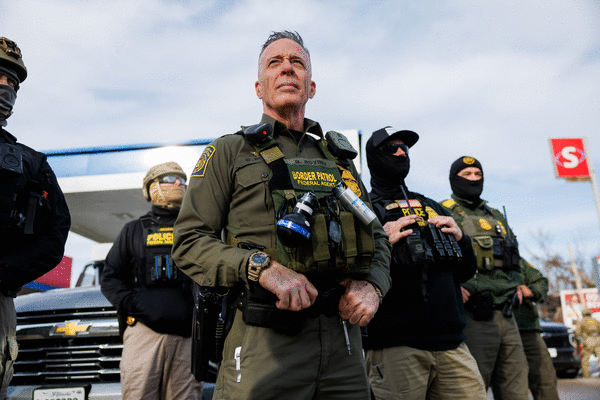
On the second day of Border Patrol Cmdr. Gregory Bovino’s brief, chaotic return to Chicago earlier this month, a U.S. Customs and Border Protection supervisor dialed 911 as a convoy of federal vehicles sped north on DuSable Lake Shore Drive.
“This is Supervisory Border Patrol Agent (redacted),” the agent said. “How are you doing today?”
The 12-minute conversation that followed between the 911 dispatcher, her supervisor and the Border Patrol supervisor shows that while Chicago police and emergency personnel did not assist Bovino’s caravan in its arrests or other immigration enforcement, local authorities coordinated with federal agents to meet their convoy as it traveled north toward Evanston and divert a pair of cars which the Border Patrol supervisor claimed were “trying to run us off the road.”
Bovino, speaking with a Tribune photographer in the parking lot of an Evanston Home Depot later that day, said he and his men had “for the first time, (received) some assistance” from local law enforcement during their brief return to the area.
Bovino didn’t elaborate on what that “assistance” was at the time, and the Chicago Police Department said in a statement that its personnel “only responded to the call they received regarding potential criminal action.”
The 911 call and other newly released records show that Chicago police activated one of its department helicopters, stopped a man who had been following the federal convoy and gave him a “verbal warning” about driving while using a cellphone while responding to the feds’ “assist the police” request.
And they highlight once again the fine line that local law enforcement in Illinois has had to straddle throughout Operation Midway Blitz, the Trump administration’s campaign to arrest and deport people living in and around Chicago without legal immigration status.
While they are prohibited from aiding federal authorities with immigration enforcement, city police and other state and local agencies are still obligated to respond to general public safety threats and maintain order.
Reached for a comment Monday afternoon, Chicago police representatives referred to the department’s earlier statement — that its officers had only responded to the feds’ 911 call of possible criminal behavior and that the department was conducting an internal review.
Chicago police were present at many of the most serious standoffs between residents and federal authorities this fall, mostly doing crowd control, documenting car accidents and forming skirmish lines between members of the public and agents. Police officers and supervisors themselves, speaking anonymously to the Tribune, said department members have a range of views on the “blitz” but anticipated that their actions would be seen as political no matter what they did.
After CPD’s response to a pair of car crashes and a shooting by federal agents in Brighton Park drew intense scrutiny in early October, Superintendent Larry Snelling said the department must remain politically neutral in order to enforce the law, and that officers will respond to any federal calls for assistance.
When the Border Patrol agent first called for assistance about 10:45 a.m. Dec. 17, the convoy was traveling north on what the agent referred to as “41 North and Monroe Drive.”
“So, Lake Shore Drive and Monroe?” the dispatcher asked.
“Yes, ma’am, that’s correct,” the agent replied. “We’re heading northbound.”
The Border Patrol agent said two vehicles, a dark-colored Chevy Equinox and a red Nissan, were “trying to impede operations … they got close to one of our vehicles. They act as if they’re trying to run us off the road here.”
The convoy was at Navy Pier, he reported. The dispatcher stayed on the phone with the agent as he periodically updated their progress, passing exits for North Avenue and Fullerton Parkway in Lincoln Park. The caravan had just passed the Belmont Avenue exit when the dispatcher relayed, “help is on the way, sir.”
In the background, an Office of Emergency Management and Communications supervisor can be heard saying, “tell him we have a couple of cars coming his way; stay on the phone with him.”
The Border Patrol agent, evidently speaking to his colleagues, told them that “Chicago PD does have units en route for that red (car).” The other car which had allegedly been following their convoy had “peeled off.”
The convoy passed Montrose Avenue, then Wilson and Foster.
“They’re coming up on you, sir,” the dispatcher said. “They’re approaching you.”
“Let them know they can come to the front of the convoy,” the agent said. He didn’t see the police cars, he said, but was “pretty sure the Nissan saw them … he started peeling off a little bit.”
The Nissan was about two car lengths in front of the convoy, he said. Then a Town Hall (19th) District police car pulled the car over near the Drive’s Hollywood Avenue exit.
“All right,” the Border Patrol agent said. “They blocked him off for us.”
An investigatory stop report obtained in a Freedom of Information Act request shows that a Town Hall District police officer gave the driver of the Nissan, Omar Luna, “a verbal warning about the dangers of operating a motor vehicle while in use of a cellphone.”
Luna, speaking to the Tribune the day of the stop, said he had been trying to keep up with the Border Patrol cars to record and broadcast their movements.
“We follow them to alert people,” Luna said. “I have never injured them or tried to crash into them.”
Records show that a second Town Hall police car moments later made contact with the lead car of the federal convoy and reported that “they are good.”
A second update shortly afterward read, “they just want to continue on. They don’t want anything with the red car. Just want them to leave the caravan.”
Records obtained through the Freedom of Information Act show Border Patrol agents have periodically called Chicago police for help as they’ve attempted to make arrests around the city and confronted enraged neighbors during many of the highest-profile melees to result from Midway Blitz, in East Side, Albany Park, Little Village and Brighton Park.
One of those calls came on one of the final and most chaotic days of the 64-day surge. As federal forces tore through Little Village, an off-site Border Patrol supervisor called to report that someone had fired at the agents near 25th Street and Kedzie Avenue.
“How many shots were fired?,” the 911 dispatcher asked. “Who was firing shots?”
“Currently unknown,” the supervisor said. “It got put out on the radio from one of our agents on the ground.”
“Are you all on the scene?” the dispatcher said.
“I am not on the scene. My — ”
The dispatcher interrupted: “I get that. Are they are on the scene?”
“Yes, ma’am, requiring assistance from Chicago PD with possible SWAT backup,” the Border Patrol supervisor said.
“Are the shots fired at Border Patrol, or you don’t know?”
“Currently unknown,” the supervisor said, before asking if there was an estimated time that police would arrive. The dispatcher said she didn’t have one.
Although Chicago police arrested a man in a car that matched the description Border Patrol agents gave of the alleged shooter’s vehicle and federal authorities have charged him with possession of a gun by a person who was unlawfully in the country, no one has thus far been accused of firing at the federal agents as they claimed that morning.
_____
©2025 Chicago Tribune. Visit chicagotribune.com. Distributed by Tribune Content Agency, LLC.




Comments