Health care fight returns in January with affordability at center
Published in News & Features
WASHINGTON — Health care policy will be top of mind when Congress returns to Washington in January, with lawmakers acknowledging that escalating insurance premiums are hitting millions of Americans.
That’s about where the agreement ends. The parties and even the factions within them are sharply divided on the path forward — with several avenues being explored that so far haven’t led to viable legislation.
The House is expected to vote on a Democrat-led bill to extend, for three years, enhanced Affordable Care Act tax credits that will have expired on Dec. 31. That’s the result of a discharge petition that four Republicans signed, meeting the threshold to force a vote.
With the knowledge that a procedural vote on a similar bill was rejected in the Senate, a bipartisan group of senators is working on a compromise to extend the credits. They may add some provisions that Republicans want, like guardrails to protect against fraud and caps to cut off credits to higher-income earners. Even within this group divisions remain, with some Republicans demanding Hyde Amendment anti-abortion protections for any extension, which is a nonstarter for Democrats.
Speaker Mike Johnson, R-La., has acknowledged the difficulty, calling health care “a very complicated issue” while adding that there is “much more to come … to bring down the cost of health care” in early 2026.
Here’s what Congress could look at next year beyond the tax credits.
Health savings accounts
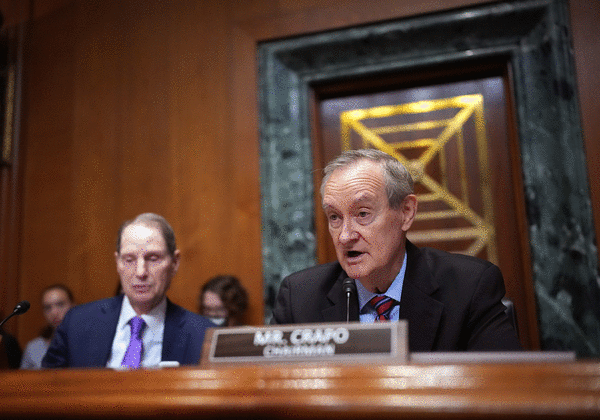
Expanding access to health savings accounts is a key part of a proposal from Sens. Bill Cassidy, R-La., and Michael D. Crapo, R-Idaho. The plan would provide up to $1,500 annually to people with health savings accounts covered by bronze ACA plans while letting the credits expire. President Donald Trump says he likes the idea of funding consumers directly rather than sending money to insurance companies.
Senate Majority Leader John Thune, R-S.D., has endorsed that idea as well, calling the Democrats’ three-year extension a “waste of money.”
While House Republicans said they didn’t have enough time to include a similar provision in the ACA credit extension alternative they passed before leaving for a holiday recess, they expect to return to it in the new year.
“I think we can get broad consensus on [health savings accounts],” Johnson said at a news conference in December.
Johnson has said the vehicle could be a reconciliation bill if the idea can’t get bipartisan support. “What we anticipate going into the first quarter next year is, possibly in a reconciliation package or in regular order as stand-alone, ideas just like this,” Johnson said.
Democrats, who view health care as an important issue for midterm voters, say they’re skeptical that HSAs can replace the expiring credits or provide comprehensive health coverage.
Employer coverage
Congress spent much of the past few months debating the cost of premiums in the ACA market, but the vast majority of Americans get insurance from an employer.
“I’d like to get something done for the affordability of the people on Obamacare, and then I’d like to do something for the affordability of people on the employer-sponsored, commercial insurance,” said Cassidy, who chairs the Senate Health, Education, Labor and Pensions Committee.
It’s not yet clear what that could involve.
Republicans have typically proposed ideas to address specific issues rather than widespread changes. That has included expanding so-called short-term health plans and other alternatives to traditional insurance. Crapo, the Senate Finance chairman, has talked about expanding the maximum deduction for individual tax filers’ medical expenses.
Crapo has also discussed an array of other possibilities, including legislation on consolidation in the health care market, which he said “can result in monopolistic powerhouses that block innovative disruptors, limit market competition and constrain consumer choice,” in a statement in November.
Pharmacy benefit managers
Congress has worked for years to try to change the way pharmacy benefit managers operate. While legislation has advanced in various committees and was temporarily attached to a government spending bill last year, factors largely unrelated to the issue have stalled any action.
PBM provisions were in the House’s version of Republicans’ signature 2025 reconciliation law but were removed in the Senate for not complying with rules about what’s proper for a reconciliation bill.
In late 2024, lawmakers negotiated a provision in a stopgap funding bill that would have required that PBMs pass 100 percent of rebates to sponsors of health plans, including employers and Medicare. It also would have prohibited a practice known as spread pricing, in which PBMs charge Medicaid and other plans more for drugs than what they pay to pharmacies.
But objections from then-Trump adviser Elon Musk led to Trump pushing Republicans to pass a “clean” spending bill without any policy riders.
The PBM issue is likely to come up again as health advocacy groups representing physicians, pharmacies and patients continue to push for action. It could also boost other health care legislation. According to the Congressional Budget Office, the changes proposed in 2024 would’ve generated $5 billion in savings, which could’ve helped pay for other health care priorities.
Crapo and Senate Finance ranking member Ron Wyden, R-Ore., reintroduced the wide-ranging PBM bill in December with broad bipartisan support.
“It’s long past time to go after middlemen who are making Americans’ prescription drugs more expensive,” Wyden said in a statement.
Other possibilities
Congress may look at other priorities as well, such as a long-term solution for Medicare telehealth flexibilities. Pandemic-era regulations allowed Medicare to cover a wide range of telehealth benefits for the first time.
When the emergency expired, Congress, acknowledging the popularity of such benefits, passed legislation temporarily extending the provisions. It has done that several times despite pressure from advocates for a long-term solution. That ad hoc approach came to a head earlier this year during the government shutdown, leading to a lapse in Medicare telehealth coverage that saw millions of people lose access to their doctors until government funding was restored.
Congress has also looked at changing Medicare payments for outpatient services at hospital-owned facilities, which Crapo has considered.
Currently, Medicare pays a higher rate for outpatient services delivered at hospitals compared with outpatient clinics that aren’t owned by hospitals. Legislation that would make payments equal for drug administration services passed the House in 2023 but didn’t advance past that.
It’s an idea that has interested Republicans, with the Trump administration finalizing a rule in November that would do just that and Congress eyeing further legislation.
©2025 CQ-Roll Call, Inc., All Rights Reserved. Visit cqrollcall.com. Distributed by Tribune Content Agency, LLC.






Comments