AI industry's gamble on Trump crashes into new political reality
Published in Business News
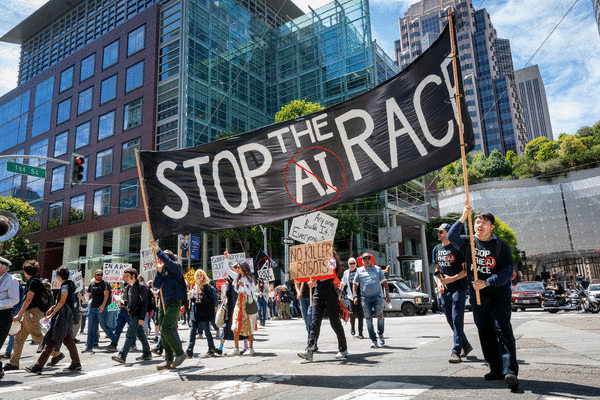
Trade disputes. Regulatory challenges. “Shifting public sentiment.”
Indications of a changing political wind are peppered throughout the latest filings from Meta Platforms Inc. as the firm readies plans to seek a record $98 billion share sale. There may be new taxes, Meta acknowledged, or regulations that will further “increase our capital expenditures and operating costs.”
The warning — from the company that has gone all in on artificial intelligence, and all in on President Donald Trump — was the latest signal that the tacit alliance between Silicon Valley and Washington is poised to unravel quickly. Similar disclosures have cropped up in recent reports from Anthropic PBC, Microsoft Corp. and Micron Technology Inc.
What initially seemed like a bet that would benefit both sides — AI firms got a laissez-faire regulatory framework to rapidly expand, and Trump got both an engine to power the economy and the support of influential billionaires willing to support him and his pet projects — now appears like a risky gamble, if polls and prediction markets that see Democrats sweeping back into power in Tuesday’s midterm elections prove correct.
While Trump has delivered on his promises to let AI companies grow unchecked, those firms are now staring down a grueling gauntlet of investigations and oversight — and furiously hiring lawyers and lobbyists in anticipation of a congressional onslaught. Those with particular ties to the president, like Meta — which donated millions to build the White House ballroom, and appointed a former Trump aide as the company’s president — could face particular scrutiny. Those preparations are playing out against growing angst of an AI bubble — fanned by skeptics like Citadel CEO Ken Griffin — ahead of Anthropic going public and a similarly massive IPO expected from OpenAI.
Meanwhile, voter frustration over data centers, which are seen as a key driver of higher energy prices, and the industry as a whole, which leaders have described as a potential existential threat to the U.S. workforce, is bleeding Trump’s political standing. If Democrats are able to retake both chambers of Congress, party elders are readying a regulation platform that is expected to serve as the centerpiece of their legislative agenda and further rock the AI industry.
Firms believed “that with the runway they get from the Trump administration, they might be able to show the broad positive impacts of AI that meaningfully shifts public opinion,” said Anton Leicht, an AI researcher and fellow at the Carnegie Endowment for International Peace. “Clearly that hasn’t worked out.”
All-in bet
The midterm elections have quickly become a referendum on the strategy both the White House and Silicon Valley embraced, leaving Trump and tech leaders to grapple with the fallout from a nationwide backlash toward AI and a potential slowdown of the national digital infrastructure build-out. November’s outcome could reshape how the industry — and the U.S. economy — grows and whether that ultimately puts China ahead in the AI arms race.
For now, the Trump administration has told agencies to stick to messaging about the president’s attempt to officially re-brand AI as “super intelligence” under an executive order signed in late September, according to people familiar with the matter who were granted anonymity to discuss internal deliberations.
The goal of the rebrand is to focus on the benefits of AI, and pivot away from the dangerous connotations the technology has carried in the popular mindset since the “Terminator” movies — fears that have only grown as industry leaders warn of massive disruption.
Even if Trump recognizes the political risk, he’s been unwilling to pivot his approach to AI. He’s dismissed calls for regulation from U.S. lawmakers and some industry leaders while unabashedly backing the rapid construction of new facilities. Instead, the White House has put a relentless focus on voluntary safeguards, company-led testing and third-party audits of the powerful new technology, arguing fresh regulation could stifle U.S. innovation and competition with China.
That’s despite two out of every three Americans saying they oppose the construction of new data centers in the U.S. while 57% of adults say AI is a bad thing for society, according to a Washington Post-ABC News-Ipsos poll released earlier this month. The same survey found about 67% disapprove of the way Trump is handling AI.
“There is just kind of like this void in leadership,” said Jessica Ji, a senior research analyst at Georgetown’s Center for Security and Emerging Technology. “They’re maintaining their hands-off approach, neither providing guidance on what should be done but still serving as this implicit block on other people who are wishing to take action.”
Late last month, Trump sought to quell rising anxiety by hosting a cadre of nearly two dozen AI executives for a luncheon at the White House, where leaders including Anthropic Chief Executive Dario Amodei, OpenAI President Greg Brockman and Nvidia Corp. CEO Jensen Huang signed a nonbinding accord vowing to use outside auditors to assess the safety of AI models and to meet regularly to set best practices.
The president also launched a new White House task force, led by Director of National Intelligence Jay Clayton, to address cybersecurity and oversight questions. The “Super Intelligence Force” is expected to commission a report to evaluate those concerns, while still deferring to industry leaders to implement recommendations.
Silicon Valley has sought to shape the AI conversation both by courting Trump and through two super political action committees that poured more than $70 million into the most expensive midterm cycle in the country’s history.
Lobbying inroads
That includes millions spent by Leading the Future, a group backed by venture capitalists Marc Andreessen and Ben Horowitz that advocates for light-touch federal AI regulation, and a similar spend from Public First, a safety-focused super PAC funded in part by Anthropic and Amodei.
The spending, so far, has boosted campaign accounts but left the policy debate more gridlocked than ever.
Still, the influence operation has laid important inroads for AI firms, who are bracing for the wave of oversight and regulation that Democrats including Hakeem Jeffries, in line to become House Speaker if they retake the House, have promised. Firms like Meta and Nvidia, who have donated to Trump’s pet projects — including the White House ballroom — risk particular attention.
In September, OpenAI hired Chuck Schumer’s daughter Jessica Schumer, who was formerly a public policy official with Amazon. Anthropic in August tapped Mariano-Florentino Cuéllar, a staffer for former President Barack Obama, as its first chief global affairs officer. Nvidia earlier this year brought on Bruce Andrews, a deputy Commerce Secretary in the Obama administration, to head government affairs.
At Meta, the social media giant elevated former Trump White House aide and Goldman Sachs executive Dina Powell McCormick to president earlier this year, but also announced the forthcoming departure of global policy head Joel Kaplan, the company’s longtime Washington whisperer who previously served in former President George W. Bush’s White House. Powell McCormick is expected to take on part of his portfolio, while Democrat Brian Rice, a former adviser to Secretary of State John Kerry, a longtime Meta employee, was promoted to U.S. government affairs chief.
Growing scrutiny
OpenAI and Anthropic have particularly expanded their lobbying footprints this past year, according to disclosures: Anthropic spent $5.6 million so far this year, compared to $2.29 million during the first three quarters of last year, while OpenAI spent nearly $3.8 million during the first three quarters of this year, up from $2.1 million during the same period last year.
Still, scrutiny is expected to grow with the upcoming IPOs for both OpenAI and Anthropic, which could value the companies at over $1 trillion each.
“It’s a matter of time before AI companies become the new social media companies and are hauled up there repeatedly,” said Michael Bopp, a partner at law firm Gibson Dunn who advises companies on congressional oversight.
Even as Democrats eye heightened oversight of AI, leaders in the party acknowledge they need a strategy for an industry increasingly critical to the overall economy and where the competition with China could have far-reaching consequences.
National moratorium
In the House, some Democrats have rallied behind a bill that would give federal oversight of powerful frontier AI models and preempt some state regulations. And a bipartisan group of senators are separately negotiating an AI safety framework that would create a federal standard and give the U.S. government the power to block the release of models deemed unsafe.
Others, like Bernie Sanders, envision a more extreme effort. He’s suggested a national moratorium on data center construction, while Ted Lieu, a California congressman, proposed a kill switch built into models in case of catastrophic harm.
The issue has even attracted former President Barack Obama, who highlighted an effort called Project Blueprint that hopes to help lawmakers and tech executives work together to develop a plan on AI. The push is being led by Obama’s former press secretary, Jay Carney, and is funded by Democratic megadonor and tech investor Ron Conway.
Carney cautioned Democrats against opposing measures they believe are not aggressive enough, adding that the goal is to "prevent or reduce the risk of a catastrophic event."
"Our hope is there are enough folks who are willing to compromise and find workable solutions in the near term that we can get something done," he said.
Meanwhile, Jeffries has privately told members to hold off until after the midterms to decide what approach to back.
‘Feel some heat’
The potential future House Speaker is also weighing whether to establish a dedicated committee focused on AI that could investigate and subpoena the companies as they seek to write new rules for the industry. That panel would likely look into the proliferation of AI-powered cyber attacks as well as how the data center build-out is impacting electricity costs.
“I generally think that in 2027, it is possible to move a framework on some level of safety stuff through in a bipartisan way,” said Rob Flaherty, former deputy campaign manager to Kamala Harris, now running anti-AI Democratic super PAC Tomorrow Together. “In order to get that done you need Republicans to feel some heat, like they are on the wrong side. But I think there is some possibility there.”
Bruce Reed, a top adviser to former President Joe Biden who oversaw the administration’s response to AI, said that regardless of November’s outcome, it’s clear that AI safety is an issue leaders from both sides of the aisle will feel compelled to address.
“I think the real problem for the administration and the industry is that they’re losing the American public and that will make their life difficult, no matter how the midterms turns out,” said Reed, who now runs AI safety initiatives at Common Sense Media. The White House, he continued, can’t afford to “hold their breath for another two years.”
©2026 Bloomberg L.P. Visit bloomberg.com. Distributed by Tribune Content Agency, LLC.




Comments