Delivery robots on San Jose streets can be fined under city's new regulations
Published in Business News
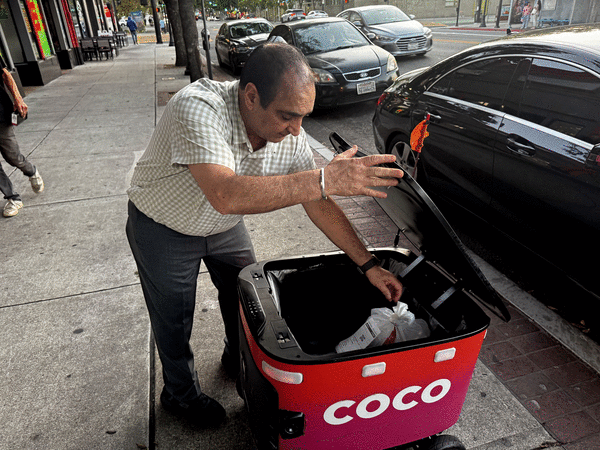
For months, delivery robots have rolled across San Jose’s sidewalks without any rules.
Now, the city is finally reining them in — establishing a 5 mph sidewalk speed limit, granting transportation officials broad oversight over their operation, and instituting fines ranging from $100 to $500 for devices that block curbs and crosswalks under regulations approved by the City Council on Tuesday.
Councilmembers Domingo Candelas and Peter Ortiz stepped out of the chamber before the roll call and did not vote.
According to the new regulations, companies must secure one-year permits and pay a $10,000 upfront maintenance and repair deposit, with annual per-robot fees ranging from $200 for sidewalk devices to $250 for models that use the road. Operators face citations and potential impoundment for violations like deploying unpermitted robots, exceeding the 5 mph sidewalk speed limit, improper parking, blocking access to public pathways and crosswalks, or failing to remove stalled devices within 30 minutes.
Addressing questions about enforcement, transportation staff explained that while the city tracks fleet movements via GPS, the data is not precise enough to show from a dashboard whether a stopped robot is safely parked or obstructing a curb ramp.
Instead, city personnel must physically verify and photograph a violation before issuing a citation, triggering a 30-minute window for operators to retrieve the device before facing fines or impoundment. On concerns over whether San Jose has the staffing to enforce the rules, officials noted the department just hired a program manager who will oversee delivery robots alongside e-scooters, bikes, and other future technologies like delivery drones.
Coco Robotics and Serve Robotics were allowed to rollout before the rules were approved because no state laws or local laws prevented them from operating.
Other Bay Area cities have taken varying approaches to regulating these robots.
Fremont granted DoorDash a permit to test its devices in bike lanes through March, while San Francisco enacted strict regulations on the machines nearly a decade ago.
In San Jose, DoorDash is third in line to deploy with “Dot,” which is larger and faster than the typical delivery robot, weighing about 350 pounds and designed primarily for bike lanes and roadways. Unlike its competitors, DoorDash chose to wait for the city’s regulatory framework before launching, and will operate under a one-year pilot.
Coco’s robots weigh 100 pounds empty, measure 2 to 3 feet tall, 2.5 feet long and 2 feet wide, and can travel up to 2 miles for deliveries. Serve’s robots weigh 161 pounds empty and stand about 3 feet tall.
“I think it’s really important as we experience technological change that we get ahead of it to the best of our ability,” Mayor Matt Mahan said. “And that we’re thoughtful in having a framework, a regulatory environment that balances… the benefits of new technology with any costs or trade-offs or risks.”
Vignesh Ram, Serve Robotics’ head of public policy, welcomed the council’s vote, responding in an email that the company looks forward to operating under clear municipal guidelines and earning residents’ trust.
“We’re excited to continue offering autonomous sidewalk delivery to San Jose under clear rules, and we’re grateful to the City Council for their careful deliberation in shaping a program that supports local businesses and benefits the community,” Ram said. “At Serve, we don’t take the privilege of operating on the city’s sidewalks for granted. From San Pedro Square to Willow Glen, we know that trust must be earned through safe operations, responsiveness, and being a good neighbor.”
Staff highlighted several advantages of the electric delivery bots – which are currently concentrated in and around downtown – noting they cut vehicle traffic and emissions and help residents with disabilities access groceries and meals.
Skeptical councilmembers and residents raised safety and clutter concerns, fearing the devices could obstruct wheelchair ramps, endanger cyclists and repeat the sidewalk congestion of the e-scooter boom. Beyond physical hazards, worries surfaced over the new technology’s high delivery fees sidelining low-income seniors and robots displacing human couriers.
“While this opportunity has a potentially positive environmental impact, I am very concerned about the congestion that will result on our sidewalks,” Vice Mayor Pam Foley said.
Foley also argued that the city’s penalty system was far too lenient.
“That doesn’t feel stiff to me if someone is in a wheelchair or a cane, and they can’t walk down the curb because it’s being blocked by one of these devices,” Foley said. “That’s going to affect them a lot more than $100 for the first offense.”
Councilmember Anthony Tordillos, whose downtown district has served as the testing ground for the devices, noted the hazards of delivery cars double-parking in travel lanes.
“We’ve seen this epidemic of double parking with delivery drivers that then has these impacts on visibility, particularly if people are crossing the street not at designated crosswalks,” Tordillos said. “To the extent we can get some of this off the roads and into the sidewalks, I think there is some potential for improved safety; but again, it’s balancing that against the risk with our pedestrians.”
On sidewalk obstructions, Councilmember Michael Mulcahy pointed to the city’s history with app-based rental scooters, which he said frequently end up abandoned, knocked over, and cluttering public pathways.
“We have a lot of really irresponsible players on our sidewalks that’s adding to blight on our streets, no question,” Mulcahy said. “And scooters are a part of it. Falling down, beat up, looking like hell.”
Transportation officials say the regulations give the city administrative authority to cap fleet sizes, limit the number of operators, and require companies to spread devices across neighborhoods if sidewalks become congested.
Liability quickly emerged as another major concern, with Mahan and Foley recalling instances where scooter injuries dragged the city into costly lawsuits. Foley questioned whether startup firms have the financial sustainability to honor legal agreements if sued, warning that the city often takes on that liability if vendors fail.
City attorneys assured the council that the new ordinance closes past loopholes by forcing operators to cover legal defense costs and indemnify the city against damage claims. While attorneys noted that claims would still be evaluated case-by-case if the city were deemed the sole cause of an accident, the baseline rule requires companies to accept San Jose’s cracked sidewalks and tree roots as operational hazards.
On bike safety, resident Nick Wester wrote to councilmembers urging the city to keep bike lanes reserved strictly for human cyclists.
“Ultimately, it comes down to that same overly simplistic fact: It’s a bike lane, not a bot lane,” Wester wrote. “It’s for us, the people of this city, and those robots aren’t us. It just feels like a tech company wanting to exploit a public service for their own profit margins.”
Transportation officials will evaluate fleet data over the next nine months before returning to the City Council next fall, when leaders will decide whether to make the rules permanent, add new restrictions, extend the pilot or pull the plug entirely.
©2026 MediaNews Group, Inc. Visit at mercurynews.com. Distributed by Tribune Content Agency, LLC.









Comments