As NASA takes back jobs, contractor Amentum to lay off 70 at Kennedy Space Center
Published in Business News
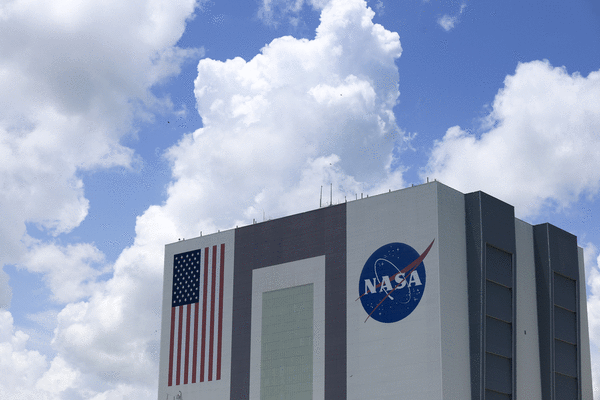
Earlier this year NASA Administrator Jared Isaacman announced NASA would begin taking back jobs it had doled out to contractors over the years. As a result, the company Amentum, with one of the biggest footprints at Kennedy Space Center, said it would lay off 70 positions on the Space Coast.
“NASA has notified Amentum, Base Operations and Spaceport Services (BOSS), of its decision to insource those skills and functions at Kennedy Space Center which NASA has identified as core competencies. As a result, Amentum will be unable to continue employment for a number of employees whose roles are affected by this transition,” reads a notice posted as part of the required Worker Adjustment and Retraining Notification (WARN) Act of 1988.
Amentum employed nearly 2,800 at KSC with hands on nearly every piece of hardware that comes into the space center. They work alongside NASA’s Exploration Ground Systems, for instance, responsible for things like driving the crawler transporter that brings the Artemis rockets to and from the launch pad.
They also made up the majority of the closeout crew that assisted the Artemis II astronauts into the Orion spacecraft before their launch.
The leader of that crew, Taylor Hose, was one of those who shifted roles.
“After almost 7 years as a contractor, today I can finally say I am a NASA employee!” he posted on X in late September.
Amentum’s notice said 14 of the 70 jobs effected were represented by a union. Most of the positions were listed as engineers, but also included analysts, planners and system administrators.
The BOSS contract is one of three Amentum has at KSC, and it had about 550 employed as part of it earlier this year filling institutional support service roles at KSC. Most of its employees at KSC, more than 2,100, fall under a $3.2 billion NASA contract called COMET, or Consolidated Operations, Management, Engineering and Test.
“We do all the flight integration of the hardware and maintain all the ground systems for launch,” said Jason Bollinger earlier this year, Amentum’s director of its Enterprise Support Operations directorate “We get all the Lego pieces from all the (launch hardware), put it together, integrate it, make sure everything checks out, talks to each other, we launch, and then we land and recover, that’s our that’s our COMET workforce.”
A third contract employs about 130 people and deals with providing liquid propellants to launch providers at both KSC and Cape Canaveral Space Force Station.
According to the 2025 fiscal year report for KSC, the facility employed 2,079 civil servants and 5,868 contractors as well as 540 construction workers.
Another 9,214 employees from private companies like SpaceX and Boeing were on site for a total KSC population of 17,701.
KSC posted an image this week on X after KSC Director Brian Hughes welcomed 150 new civil servants “who will help strengthen NASA’s operations and mission support work. Excited to have these talented professionals join the team as we shape the future of space exploration!”
The move to bring back talent to NASA came as Isaacman detailed the failures behind the Commercial Crew Program’s test flight of the Boeing Starliner that saw thruster failures and leaks on the spacecraft as it flew up two astronauts up to the International Space Station. NASA ultimately sent Starliner home without crew. Fallout from that mission revealed issues with oversight and management culture contributing to NASA later classifying it as a Type A mishap, calling it “nearly catastrophic.”
Isaacman said relying on commercial companies to get NASA where it needs to go isn’t something new, but the Starliner incident prompted a reassessment of how big a hand NASA wants to have in its programs.
“I think properly characterizing, categorizing this situation, ensuring the information is made available, that lessons are learned we can use that make sure our culture is correct, our internal expertise is correct, that we restore core competency in the areas that are that are essential for our mission success,” he said.
That has meant a shift by NASA to ensure it has more insight in program development and oversight.
“Relying on industry to get us there is one of our strengths at NASA, is not a liability, but there are certainly things we can do better here in order to achieve our objectives,” he said.
©2026 Orlando Sentinel. Visit at orlandosentinel.com. Distributed by Tribune Content Agency, LLC.








Comments