Meta says it will pay up to $18 billion over social media claims
Published in Business News
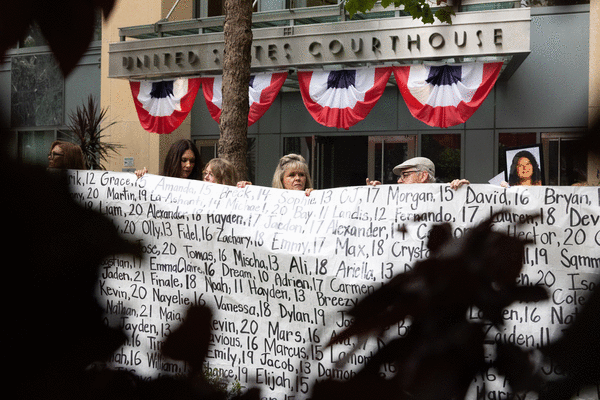
Meta Platforms Inc. said it agreed to pay up to $18 billion in landmark settlements to resolve social media claims from U.S. states that would require the company to make major changes to how it operates platforms like Facebook and Instagram.
Key parts of the deal, disclosed in a court filing Wednesday, require the company to put new guardrails on its platforms, including restricting how much time youths can scroll and preventing them from switching off certain safety settings without parental consent.
The agreement includes payments to resolve a variety of claims across multiple lawsuits. At the heart of it was an ongoing trial in Oakland, California, in which multiple U.S. states alleged that the company deliberately designed Facebook and Instagram to encourage compulsive use among young users.
Meta has agreed to pay up to $16.7 billion to resolve that lawsuit, according to the court filing. In addition, the company would pay another $459 million to resolve other privacy claims as well as $75 million in legal fees. Separately, Meta said it reached an agreement to pay Texas up to $1 billion.
Some of the payments are contingent upon other social media companies adopting similar platform changes and making their own payouts.
A judge needs to sign off on the agreement. In the filing, Meta denied the allegations against it and said the deal did not constitute an admission of liability.
Oakland trial
The accord comes in the second week of a jury trial in California federal court that posed enormous risk for Meta. The top legal officers of 29 states were seeking not only massive financial penalties on behalf of the public, but also court orders forcing the company to change how it operates its platforms.
The states had alleged violations of state consumer protection and federal privacy laws — which carry fines that add up quickly when multiplied by millions of young Instagram and Facebook users. By Meta’s own calculations, a loss at trial could have saddled it with penalties of as much as $1.4 trillion, an amount close to its market capitalization and unheard of in the annals of legal history.
Meta shares were up about 1.7% as of 2:56 p.m. in New York. Bloomberg reported late Tuesday that the parties had discussed a possible mid-trial settlement.
U.S. District Judge Yvonne Gonzalez Rogers suspended the ongoing trial on Wednesday morning, telling lawyers for Meta and the states that she expects to approve the agreement shortly.
“I’m quite happy to not have to finish up this trial,” she said. “I think it’s an excellent way to resolve these issues.”
“Ensuring teens have a safe and productive experience on our platforms is an absolute imperative for Meta. We want to get this right for parents and teens,” Meta said in a statement Wednesday.
Meta also said that the agreement includes default blocks from its apps at night as well as muted notifications during school hours.
The planned settlement includes the appointment of an independent auditor to oversee compliance, who can issue their own recommendations and report findings to the states. The agreement would also require Meta to enhance its age verification tools to better identify young users on the app. Access to features like viewing the number of likes on a post or beauty filters would be restricted for teens.
“Meta has agreed to make massive transformations that will reduce the risk of harm from its platforms — and will do it within months,” California Attorney General Rob Bonta said in a statement.
Settlement structure
The settlement doesn’t immediately require Meta to pay out the full value of the deal. Under the agreement, Meta is required to pay the states a total of $12.19 billion over 10 years. That amount will increase to the full $17.1 billion value of the settlement only if Alphabet Inc.’s YouTube and TikTok also agree to platform changes and settlement payouts, Meta said. Statements from several states said Snap Inc. would be subject to those terms as well.
Representatives for those companies didn’t immediately respond to requests for comment.
During the first week of testimony, jurors heard from Instagram head Adam Mosseri and a collection of current and former Meta employees who helped design its social media platforms and studied how teen users interacted with tools designed to cut down on problematic use.
Lawyers had also said they expected to call Meta founder and chief executive officer Mark Zuckerberg to testify.
The attorneys general spearheading the case, from California, Colorado, Kentucky and New Jersey, alleged under their separate state laws that Meta knowingly designed features that encouraged compulsive and prolonged use of its platforms by young people, while simultaneously misleading consumers about safety features on its platforms.
Meta argued at trial that it already had sufficient guardrails to curb problematic teen usage of its platforms.
The broader bipartisan group of 29 states accused the company of collecting data from users under 13 years old in violation of the federal Children’s Online Privacy Protection Act.
Meta said Wednesday the planned settlement involves 52 attorneys general from U.S. states, territories and Washington, DC and would resolve active cases, including a trial in Tennessee that had been in progress.
Social media companies are facing a global backlash over concerns that they profit at the expense of young users, for whom a growing body of research shows that excessive screen time is dangerously unhealthy.
While authorities from Australia to Europe have enacted or proposed outright bans for youths in the last year, legislative crackdowns in the U.S. have had limited success, turning the courts into a pivotal battleground.
Meta, Alphabet’s Google, Snap and TikTok all face billions of dollars in potential exposure from more than 3,000 personal injury claims by individuals and families in the U.S., and about 1,300 more lawsuits by public school districts across the nation.
Some of the cases have already settled, avoiding trials, while more bellwether cases loom in the months ahead.
The lawyers behind the cases have gained traction in court by arguing that the products themselves — through their design and functionality — have created harms, rather than taking aim at content, for which platforms are broadly protected from liability.
This strategy, several years in the making, succeeded in its first test when a Los Angeles jury in March awarded $6 million to a 20-year-old woman who said her nonstop use for more than a decade of sites including Meta’s Instagram and Google’s YouTube caused her to suffer anxiety, depression and body dysmorphia.
The Oakland trial followed a nearly $1 billion hit for Meta in a case brought by New Mexico’s attorney general.
A state court judge in Santa Fe likened Meta to a polluting factory and ordered the company to make platform changes, including time limits for usage and push notifications for young users. Meta was ordered to pay roughly $375 million in civil fines and $567 million to ameliorate social media harms to youths in the state.
The case is People of the State of California v. Meta Platforms Inc., 23-cv-05448, U.S. District Court, Northern District of California (Oakland).
(With assistance from Erik Larson, Alexandra S. Levine, Peter Blumberg and Isaiah Poritz.)
©2026 Bloomberg L.P. Visit bloomberg.com. Distributed by Tribune Content Agency, LLC.









Comments