US wants its booze back in Canada's stores but some say don't buy it
Published in Business News
Prime Minister Mark Carney has asked Canada’s provinces to end their bans on the retail sale of U.S. alcoholic beverages. It’s a necessary step to getting a trade deal with President Donald Trump across the finish line.
The response so far indicates he’s succeeding — but some provincial politicians, still angry at what they see as an American assault on the Canadian economy, won’t encourage consumers to end their personal boycotts of U.S. goods.
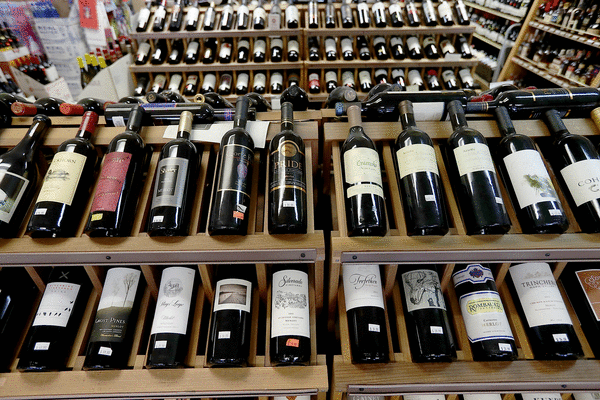
Canada’s provincial governments control alcohol distribution, and most of them have blocked U.S. wine and spirits for more than a year in retaliation for Trump’s tariffs. For U.S. winemakers and distillers, it has been a disaster for export sales. The White House has demanded the booze go back on the shelves.
All of Canada’s provincial leaders agreed to Carney’s request, according to Newfoundland and Labrador Premier Tony Wakeham. However, the country’s two most populous regions, Ontario and Quebec, had yet to publicly confirm their positions by Thursday.
Two premiers said a consumer boycott of U.S. alcohol might continue anyway. One of them explicitly encouraged it.
“What I would say to Canadians is: leave it there,” Manitoba Premier Wab Kinew said. “Let it sit on the shelf where the Liquor Mart employees will be putting it, and buy the Canadian stuff instead. We’ve done an amazing job sticking together in the face of Donald Trump’s tariff threats, and I think we should continue to do that.”
Kinew attacked Trump at length, saying: “You can’t get a good deal with a bad person.”
But the Manitoba leader said Carney told premiers that any U.S. trade truce hinges on booze being returned. “I wouldn’t say that he was begging us — but what is the step before begging?”
A survey by the Angus Reid Institute in July asked Canadians whether they would consider buying U.S. wine, beer and spirits if a trade agreement was reached; 40% said “definitely not” and another 19% said “probably not.”
Quebec Premier Christine Fréchette, whose political party is facing a difficult election fight in the coming weeks, has been publicly noncommittal about the deal Carney and his officials are negotiating.
If there’s no agreement or delay by Friday night, the U.S. is poised to impose 50% tariffs on hundreds of products from Canada — including alcohol.
“There are things that could change, but whether they’ll change enough to bring good news remains to be seen,” she told reporters Wednesday after some details of the agreement began to emerge.
Fréchette said Thursday that she followed up with “a long phone call” with the prime minister, but still needs to do more analysis.
The office of Ontario Premier Doug Ford, who has sparred frequently with Trump, hasn’t responded to requests for comment. His province’s liquor agency is one of the world’s largest purchasers of alcoholic beverages.
Nova Scotia Premier Tim Houston told reporters during a press conference Wednesday that the federal government has also asked provinces to ensure they don’t specifically exclude the U.S. in their procurement policies.
BC Premier David Eby didn’t comment on alcohol specifically, but said he’s “hopeful about the possibility of an agreement” to ease trade tensions with the U.S. Among Canada’s premiers, he has been one of the most forceful advocates for spurning U.S. products and travel.
Yukon’s premier said the northern territory will lift its restrictions if a trade deal is signed.
U.S. alcohol was already brought back to stores in Alberta and Saskatchewan, but in the latter province, sales remained 40% below the prior year, CTV News reported.
(With assistance from Josh Wingrove, Melissa Shin, Nojoud Al Mallees and Mathieu Dion.)
©2026 Bloomberg L.P. Visit bloomberg.com. Distributed by Tribune Content Agency, LLC.



Comments