GM, Ford secure Army truck contracts under new national security rules
Published in Business News
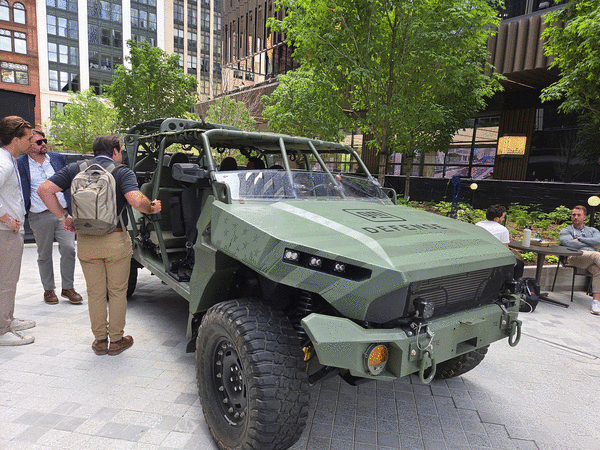
General Motors Co. and Ford Motor Co. have secured contracts to build prototype tactical trucks for the U.S. Army under new rules signed by President Donald Trump limiting access to China-sourced materials, parts and software for defense contractors.
"That puts many companies in a bind," Christopher Tang, distinguished professor emeritus specializing in supply chains at the University of California, Los Angeles, said about the new order. "They basically need to really do due diligence. ... It's really difficult to do. The supply chain cannot pivot that quickly."
Citing national security concerns, Trump signed an executive order establishing the rule a week prior to the Detroit automakers securing the contract to build three heavy-duty infantry squad vehicles for testing alongside Utah-based off-road vehicle manufacturer BC Customs LLC. Experts say the new rules are expected to create a bottleneck for the defense sector due to the challenge of quickly adjusting sourcing, but it also could create new opportunities for manufacturers, including in Michigan.
The order, which Trump signed July 20, limits U.S. defense contractors from securing waivers to buy critical minerals, rare earth elements and components from adversarial nations like China, Russia, Iran and North Korea. The policy's implementation takes effect in the new year.
GM spokesperson Erica Mitchell said in a statement that GM Defense complies with all applicable U.S. laws and the Pentagon's supply chain requirements. Ford spokesperson Dave Tovar said the automaker still is reviewing the order to evaluate impact.
GM for years has been developing the ISV-Heavy trucks based on its Silverados. Ford is adapting from its F-Series Super Duty trucks and has emphasized that off-the-shelf products from its Ford Pro commercial vehicle division can offer capacity and scale while being cost-effective for governments as well as other commercial customers.
Meanwhile, defense trade groups have voiced concerns that the timeline to meet the new rules is too short, given the limited or nonexistent availability of domestic sourcing in some cases.
"The aerospace and defense industry appreciates the Administration’s efforts to reduce U.S. dependence on adversarial nations for critical materials and are working collaboratively to strengthen supply chain resilience," a representative for the Aerospace Industries Association said in a statement at the time. "This Executive Order will impede reaching these goals."
Navigating requirements
Between tariffs and other requirements, identifying and pivoting on sourcing isn't a brand new challenge for automakers. In the final days of the Biden administration, the nation finalized rules to ban the use of Chinese software and hardware in vehicles by the 2027 model year and 2030 model year, respectively.
Automakers have had to scramble to identify part origins up the supply chain, which can get tricky as suppliers seek to protect proprietary technology and intellectual property. The requirement has prompted Polestar, a Volvo-affiliated electric vehicle brand of China-based Zhejiang Geely Holding Group Co. Ltd., to leave the United States.
More: Auto industry in 'bit of a panic' to comply with China connected vehicle software ban
"It's really, really messy and an incredibly challenging question to answer," said Brandon Barry, CEO of Detroit-based Block Harbor, a vehicle cybersecurity company that helps automakers identify sourcing from adversarial nations and consulted with the U.S. Commerce Department on the development of the rules. "We deliver a state-of-the-art solution that identifies instances of China that never would’ve been caught otherwise. What it ultimately delivers to our customers is confidence with that secondary check in place."
It's a similar scramble for the defense sector, Tang described. The writing has been on the wall, he said, but the Trump administration also ushered in new tariffs that had contractors shifting supply chains to address those changes, too. The defense industry will likely need an extension to identify uncompliant sourcing, find alternatives and build out capacity, Tang said: "It takes time."
The type of technology involved in the contract also may affect the ability of companies to pivot. If a provider can get away with older technology, it may be able to adjust quicker. But if the product has the most advanced, state-of-the-art technology, it likely will rely more on China.
The contracts that GM and Ford have for the tactical truck called for the vehicles to offer on-board mobile power for charging equipment. Given the investments in recent years for U.S. battery manufacturing, this is a requirement that likely will be easier to meet than if, for example, the specifications included requiring the vehicle to be submerged in water, Tang said.
"For the power technology, the country already has invested in that," Tang said. "It would be possible within one year or so. Some other electronics may be more complicated."
Michigan defense sector
All of this comes as Michigan seeks to leverage its heritage of engineering talent and manufacturing base to grow its defense sector.
The state has had the goal of reversing Michigan from a "donor state" that pays more in taxes to defense spending than it receives in military contracts. Depending on the data used, there can be a different determination on the state's status, said John Gutierrez, a retired U.S. Marine Corps colonel and executive director of the Michigan Economic Development Corp.'s Office of Defense and Aerospace Innovation.
"What we're focused on is the trajectory, and it's moving in the right direction," he said.
Michigan's defense sector drives more than $30 billion in economic activity, 17 military commands and installations, supports nearly 5,000 suppliers and employs about 166,000 residents, he said. A majority — 65% — is centered in Macomb County, though one of Michigan's strengths is that the sector is spread across the state as workforce and talent remain one of the biggest challenges for growth, he said.
With new opportunities potentially created by Trump's executive order, Gutierrez said Michigan is well-positioned to meet national needs.
"Michigan has always met the moment, whether it's serving as the original Arsenal of Democracy or shifting production into personal protective equipment during the pandemic," he said. "Right now, the moment is dynamic. Businesses are adapting, responding and doing what they need to stay competitive in a fast-changing global environment."
Earlier this year, ODAI released a five-year strategic plan to modernize and grow Michigan's defense industrial base. It includes building out the Michigan Space Innovation Hub to connect manufacturers, researchers, investors, federal agencies and other and help accelerate growth in the space sector.
The National Security Consortium, a partnership between eight Michigan-based universities, seeks to help build a talent pipeline. Later this year, the MI Space Challenge Hackathon will build off a partnership with the U.S. Coast Guard from last year with a new federal challenge that asks undergraduate students to tackle a real mission using space-based technologies.
The MEDC also is building out the Michigan Capital Marketplace, a centralized platform to connect private investors with Michigan's dual-use companies and projects. Additionally, it's growing its international landing zones. These ready-made sites seek to attract international defense and aerospace companies. The state also is standing up a Michigan Certification Assistance Program focused on helping smaller companies access certifications like Cybersecurity Maturity Model Certification that are required for some contracts.
Gutierrez also highlighted the Michigan National Guard's National All-Domain Warfighting Center in northern Michigan for joint military training as a strength for the state. Earlier this year, the Army Test and Evaluation Command designated the center at the Camp Grayling Joint Maneuver Training Center and the Alpena Combat Readiness Training Center as the nation's first national range for deep uncrewed aerial systems training. The designation more easily opens these ranges to private industry like startups to test drones, missiles and counter-unmanned aircraft systems. Only three other states have a similar designation.
Michigan also has expanded its APEX Accelerators that offer no-cost guidance on navigating government contracting to include a contract bid targeting system and proposal writing support service. Recently 78 Michigan-based entities contributed to an Artemis II mission, the 10-day lunar flyby in April.
Plus, Michigan's strong automotive base offers advantages to support proposed increases to national defense spending to stockpile depleted inventories and invest in advanced technologies, said Glenn Stevens, executive director of MICHauto, the Detroit Regional Chambers' automotive arm.
"Michigan is very well-positioned," Stevens said, "and is currently taking advantage of that and will continue to take advantage."
©2026 www.detroitnews.com. Visit at detroitnews.com. Distributed by Tribune Content Agency, LLC.









Comments