Chicago high-rise powered by geothermal could set new standard for development
Published in Business News
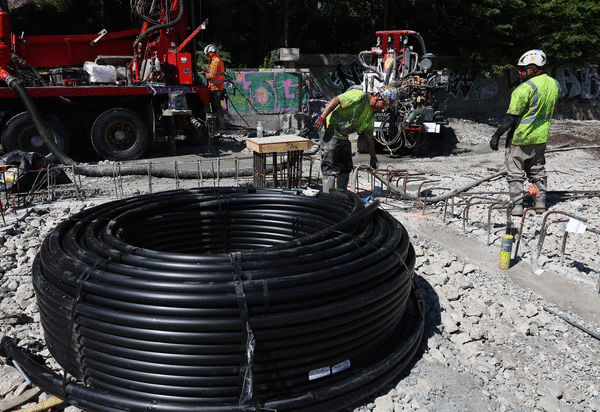
One of Chicago’s first all-electric, geothermal-powered residential high-rises is taking shape in Fulton Market.
The 33-story apartment project at 410 N. Elizabeth St. could set a new standard for Chicago development, perhaps proving that massive new high-rises can drastically reduce reliance on fossil fuels, cut carbon emissions and reduce energy costs, said Ted Weldon, co-founder and principal at Tree Street Group.
“We found out Chicago is a perfect place for geothermal, but in the development world, taking that leap of faith can be difficult,” he said. “I think it’s a lack of understanding about what geothermal is.”
Tapping into geothermal energy does require a significant amount of digging. Construction teams last week began drilling the first of 65 on-site wells that will reach depths of 820 feet, where the temperature is roughly 55 degrees year-round. Once completed, pumps will circulate water through miles of piping, helping heat the building on cold winter days and cooling it off during summer heat waves.
“We often think of clean energy coming from the sun or the wind, but we can also find energy beneath our feet,” said Karen Weigert, director of the Baumhart Center for Social Enterprise & Responsibility at Loyola University Chicago and former chief sustainability officer for the city of Chicago. “Geothermal takes advantage of the constant temperatures a bit below the earth’s surface. That allows buildings to be fully electric — which can help indoor air quality as well as reducing emissions from electricity, heating and cooking — and to have predictable energy costs.”
Getting this project underway was not easy, Weldon said. Several plans were hatched for the site, including one for a life sciences complex, approved by city planners in 2021 but later abandoned when demand slumped for new biotech hubs.
Tree Street Group partnered with Magellan Development Group and Mark Goodman & Associates to develop 410 N. Elizabeth St., and plans to launch a second residential building on the site, also using geothermal energy, for an eventual total of 724 units, with 146 designated as affordable. The property will include a park and green space open to the public, and a 30-foot wide pedestrian walkway on its southern edge.
The Chicago region’s subsurface ground conditions, along with its warm summers and cold winters, makes geothermal energy cost-effective and useful throughout the year, said Kenneth Maruyama, senior vice president of Tree Street Group.
More than 80% of the heating, cooling and hot water needs for 410 N. Elizabeth St. will come from its geothermal system, he added. The plant will use almost 60% less energy than traditional power sources, with nearly 30% reductions in energy costs and emissions, and cutting the annual carbon output by 390 tons. A triple-glazed window wall system will also increase each apartment’s energy efficiency.
“We’ve tried to pull all the tricks we can to build as sustainable a project as possible, and show the potential for geothermal in Chicagoland,” Maruyama said.
It took about three years for Tree Street Group to line up the financing needed for the 383-unit tower, Weldon said. That’s partly because persistent inflation, economic uncertainty and relatively high interest rates have made many banks and other lenders leery about supporting projects on this scale.
“This is not a Chicago issue, it’s a national issue where it’s difficult to get projects off the ground,” he said.
Developers put the finishing touches on fewer than 200 rental units in downtown Chicago in 2025, the lowest amount in more than 20 years, according to Integra Realty Resources, a commercial real estate research firm.
The capital crunch is easing a bit. About 800 new downtown units will be completed this year, according to the firm, followed by about 2,100 in 2027. That’s still fewer than downtown’s historic average of a few thousand per year.
The plan to use renewable, cheap energy for 410 N. Elizabeth St. made it a bit easier to secure funding, Weldon said.
Developer Infinite Energy Partners will own and operate the building’s geothermal system.
Geothermal energy is not unknown in the Chicago area, Weigert said. Loyola University Chicago has a total of three systems at its Chicago and suburban locations. The largest, installed in 2012, uses 91 wells and 17 miles of underground pipes to service the 217,000-square-foot School of Environmental Sustainability facility at 6349 N. Kenmore Ave. on Loyola’s Lake Shore Campus, along with other nearby offices, labs, classrooms and a 420-bed residence hall.
Using geothermal means buildings don’t burn fossil fuels, and residents or other users aren’t bothered by rumbling air conditioners or noisy heaters, Weigert said.
“Geothermal is very quiet and more efficient than other energy sources, largely because you’re simply moving heat instead of creating it,” she said. “It’s essentially a ground-sourced heat pump.”
The technology has also gotten more advanced in the past decade, making it easier to handle the hot summers and cold winters in Chicago and similar climates, said Ian LaHiff, director of energy and carbon at the U.S. Green Building Council.
“We’re going to see a proliferation of heat pumps in many different climates, and in fact, that’s been happening for a number of years,” he said.
Those advances helped make geothermal a workable solution for 410 N. Elizabeth St., Weldon said.
“The challenge in all geothermal is handling peak demand,” whether it’s 30 degrees below zero or 110 degrees, he said. “Those are the days we need to make sure we deliver.”
New York City is getting its share of new geothermal projects. Early this year, Australia-based developer Lendlease opened The Riverie, an 834-unit, all-electric, geothermal building on the Brooklyn waterfront.
Weldon said the next step for Chicago is to create geothermal systems that can power entire districts, rather than one or two buildings.
“Our hope is that geothermal will catch on and more developers build similar projects,” he said.
©2026 Chicago Tribune. Visit at chicagotribune.com. Distributed by Tribune Content Agency, LLC.









Comments