Walmart leapfrogs EV charging competitors with rapid buildout
Published in Business News
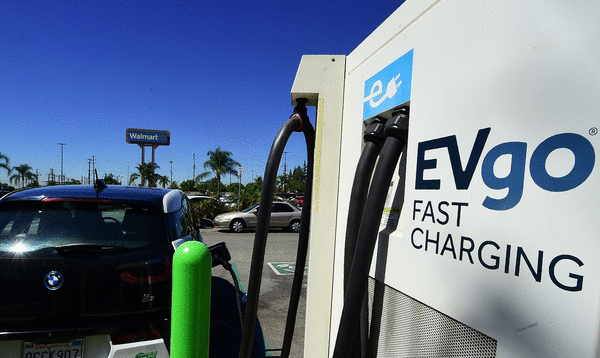
Since the start of the year, four high-speed charging stations have opened in Bentonville, Arkansas, even though the state has been a laggard in transitioning to electric vehicles.
Bentonville, however, is Walmart Inc. country and these are Walmart chargers — three at stores near the company’s headquarters and one at the airport.
In a matter of months, Walmart has become a major player in the burgeoning business of quickly fueling electric vehicles, speeding past Costco as well as more established charging companies with its in-house network of electron pumps. Walmart has hosted chargers from brands like Electrify America since 2018. But now the company is building its own network — and quickly. As of March of last year, every EV station at a Walmart is under the company brand.
While the blitz of infrastructure will fuel in-store sales, it will also redraw the American charging map, making public electrons cheaper and easier to find.
“They’re steamrolling,” said Bill Ferro, cofounder of Paren, a charging consultancy. “It’s the right time to do this and they’ve got the right locations.”
Through June this year, Walmart opened about 46 high-speed public charging stations with 380 cords, according to the U.S. Department of Energy. All told, there are now EV chargers at about 326 of Walmart’s 4,600 or so U.S. stores, and Paren estimates another 300 or so stations are under construction.
Walmart declined to answer questions or provide any detail on how much more charging it will build, but acknowledged in a statement that it has one of the critical ingredients in an electric pump empire: scads of valuable and widespread real estate.
“Our broad footprint positions us to make EV charging more accessible for communities while expanding the way we serve customers,” a Walmart spokesperson wrote via e-mail.
Charging an electric vehicle typically takes a little bit longer than fueling a gas car. That bit of technological lag has been a bug to EV sales, but to retailers like Walmart, it’s a feature — a perfect window of idle time for someone to pick up a few odds and ends.
“The fact that Walmart knows the indirect value of having charging at their facility is all the evidence you need to know that there is a real viable business there,” said Nick Nigro, cofounder of Atlas Public Policy, a Washington, DC-based climate consultancy.
Walmart’s charging plans are spooling up even as EV sales falter in the U.S. Demand for electric cars and trucks slumped after federal incentives expired in September, though they have started to recover since the Iran War spiked gas prices.
Analysts are split on where the U.S. EV market goes from here, but the installed base is sizable. There are now 7.6 million plug-in vehicles on U.S. roads, according to S&P Global, and an estimated 90% of Americans live less than 10 miles from a Walmart.
As battery-powered machines gain traction among mainstream buyers and proliferate on the second-hand market, they’ve spread from the American coasts into rural areas in the Midwest and Deep South. They’ve also gathered momentum among apartment dwellers who don’t have access to charging at home. Florida, Illinois and Texas are adding EV charging infrastructure faster than nearly anywhere else.
Walmart, meanwhile, isn’t alone in its play for EV pilots. If anything, it’s a little late to the game. Target Corp. has 150 high-speed charging stations spread around its U.S. stores, according to Paren, while Costco Wholesale Corp. is selling electrons in 42 of its lots. Home Depot Inc. and Lowe’s Companies Inc. have 101 stations between them.
Shiri Levi-Laor, chief executive officer of Driivz Inc., a consultancy, says adjacent charging generally increases a store’s sales by 5%. By 2030, she estimates one in five fast-charging stations in the U.S. will be in the parking lot of a big-box retailer.
“It’s a double-dip of revenue,” Levi-Laor said. “Retailers are not investing in charging to sell electricity; that’s not their intention. They are investing because it strengthens their core business.”
While Walmart’s chargers will no doubt juice its in-store sales, selling electrons has been good business of late. Despite a rash of new charging stations, America’s EV plugs have stayed busy, used about 16% of the time in recent months, according to Paren. In June, U.S. drivers plugged into public fast-chargers 16 million times.
To be sure, Walmart is still a blip on the U.S. charging map, though maybe not for long. Among charging networks expanding in the second quarter, Walmart was second only to Tesla.
Meanwhile, Walmart’s charging rates are cheaper than the national average, and cheaper still for loyalty members. Ferro, at Paren, expects the ubiquity of the new stations and the low prices will spur EV adoption in places where gas has been resilient, like Arkansas.
“Honestly,” he explained, “I wouldn’t be surprised if you start to see people trying to do a Walmart road trip.”
©2026 Bloomberg L.P. Visit bloomberg.com. Distributed by Tribune Content Agency, LLC.










Comments