Judge throws out UnitedHealth's defamation lawsuit against the Guardian
Published in Business News
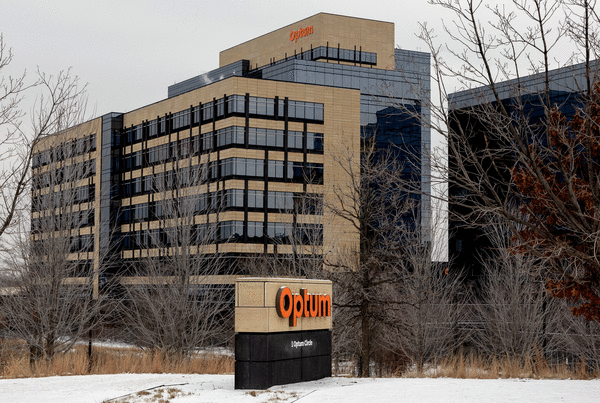
A Delaware judge dismissed UnitedHealth Group’s defamation lawsuit against the Guardian, the U.K. news outlet that published a May 2025 story alleging the Eden Prairie-based health giant made secret payments to reduce costly hospital transfers.
In a ruling Monday, Delaware Superior Court Judge Calvin L. Scott, Jr., dismissed all six defamation claims in the lawsuit.
In one count, the judge wrote that UnitedHealth Group’s lawsuit “cherry picks” language to allege the Guardian was making claims that weren’t actually part of its report.
Scott dismissed another count after finding the news outlet’s story was “substantially true” in characterizing certain nursing home bonus payments from UnitedHealth Group as “secret,” or made “secretly” or “quietly.”
And responding to the company’s complaint that omissions in the news report created a false impression, the judge wrote that the Guardian “is not required to publish facts just because United would have preferred more favorable facts. The omissions do not render the statements false.”
Kai Falkenberg, the U.S. general counsel for the Guardian, said in a statement the ruling was “a resounding victory for factual reporting and the First Amendment.”
“Today’s decision is a vindication of the Guardian’s deeply sourced, independent reporting, and a rejection of UnitedHealth’s bullying and intimidation tactics,” Falkenberg said.
UnitedHealth did not immediately respond to a request for comment Monday afternoon.
The company’s stock traded down 6% on May 21, 2025, following the Guardian’s investigative report about a UnitedHealth Group program to station medical teams in nursing homes and push them to cut care expenses for residents with health insurance from the company’s UnitedHealthcare subsidiary. Such cuts could improve UnitedHealth’s profits but provide less care to members.
The report cited several instances of nursing home residents who needed immediate hospital care but failed to receive it following interventions by UnitedHealth staff.
UnitedHealth sued, claiming the article contained numerous false accusations. Among them: The health care company secretly paid nursing homes to enroll patients in UnitedHealthcare insurance and then coerced residents to sign do-not-resuscitate (DNR) orders, preventing costly hospitalizations and lifesaving treatments.
On the DNR issue, the judge wrote: “Nothing in the article states that United was approaching [patients] and telling them to change their code status so [United] could save money.”
The Guardian’s story was published at a sensitive time for UnitedHealth. The company’s share price was plunging amid uncharacteristic financial missteps, an abrupt CEO change and a Wall Street Journal report on a criminal fraud investigation related to coding practices in United’s large Medicare Advantage business.
Filing the defamation lawsuit was seen as another example of UnitedHealth more aggressively confronting what it regarded as misinformation, including a protracted public dispute with a Texas surgeon and an activist investor over health insurance coverage denials.
©2026 The Minnesota Star Tribune. Visit at startribune.com. Distributed by Tribune Content Agency, LLC.



Comments