Gas giants use AI to raise prices, lawsuit says, another algorithmic hit to the cost of living
Published in Business News
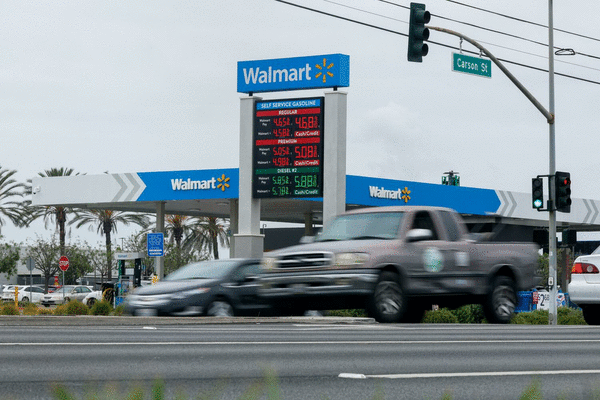
A federal lawsuit alleging that gas companies in California are colluding to keep prices high through their use of AI-powered software will test the state's antitrust law at a time of growing concerns about the effects of technology on the high cost of living.
Filed on behalf of three drivers last week, the proposed class-action lawsuit accuses roughly a dozen companies and their subsidiaries — including Walmart and 7-Eleven — of using algorithmic software to fix prices. The company that provided the software, Kalibrate, is named as a defendant.
Kalibrate's program, according to the lawsuit, encourages gas stations to upload private price data. The company's AI-powered software, called Kalibrate Fuel Prices, then uses the data to recommend prices in real time, promising in its marketing materials to help gas companies "squeeze out profit."
The lawsuit touches on a growing conversation over how companies are using technology, including AI, to push prices higher.
In a highly publicized case in 2024, the federal government sued a company whose algorithmic pricing software was used by large landlords to share private rental data, recommend prices and drive apartment rents up. Last year, reporters found that the grocery delivery company Instacart was running AI-enabled pricing experiments on customers, sometimes resulting in a nearly $3 difference in the price of individual products.
"I wouldn't be surprised if (this kind of individualized pricing) exists in all different kinds" of industries, said Robert Zeithammer, a professor at UCLA's Anderson School of Management. "If you're a car dealer, you could be doing it."
Lawyers in the gas station lawsuit assert that technology is enabling antitrust violations. Even if companies didn't communicate their pricing strategies to one another directly, the argument goes, the software is allowing them to share data and keep prices above a certain threshold.
"The quintessential image of price fixing is a secret deal made between competitors over cigars in a smoky back room," attorneys wrote in the complaint. "But as technology has advanced, so too have the mechanisms available to competitors to fix prices without the cigars, the smoke, or even the room."
The lawyers represent two firms that include staff members who worked at the Federal Trade Commission during an era of bolstered antitrust enforcement under President Biden.
The Times reached out to the companies named in the lawsuit, but only Walmart responded, saying it would address the accusations in court.
In a statement, Kalibrate denied the claims.
"We disagree with the allegations in the lawsuit and intend to defend the company vigorously," Matias Toye, legal director at Kalibrate Technologies, wrote in an email. "Kalibrate is committed to serving its customers with lawful, innovative fuel-pricing technology, and we remain focused on supporting our customers while respecting the litigation process."
The lawsuit comes as consumers report struggling to afford basic necessities. Recent polling from Gallup found that Americans are concerned most about housing and energy prices, including gas.
In California, drivers pay some of the highest prices in the country. Taxes, environmental fees and the Iran war have pushed fuel prices up; according to the American Automobile Assn., regular gas sold at an average of $5.43 a gallon on Tuesday, which is more than $2 above states such as Texas and Oklahoma.
The lawsuit alleges that Kalibrate's software drove prices at the pump even higher. It cited research on algorithmic pricing that found when a station adopted this kind of software, prices rose by an average of 6 cents a gallon.
Established in 1907, California's antitrust law makes clear that it's illegal for companies to come together and agree on prices to charge customers. The practice is anti-competitive and hurts consumers, antitrust experts say.
Legislators last year updated the law to clarify that even if businesses don't communicate directly but use algorithmic pricing software that leads to them charging a common rate, that could still be considered price-fixing.
"If every gas station owner in an area got together … and set the price of gasoline, it would be an antitrust violation," said Jamie Court, president of Consumer Watchdog, a national nonprofit based in California. "But if you have an algorithm do it for you, it's no better."
Several groups opposed adoption of the updated regulation, including the California Chamber of Commerce, saying the language was too broad.
"It doesn't mean that all businesses using dynamic pricing or pricing algorithms are engaging in inflating prices," said Eric Enson, a lawyer representing the chamber, during a legislative hearing last year.
This is not the first time the use of nonpublic price data in algorithmic software has been the target of legal action.
In 2024, the U.S. Department of Justice sued RealPage, a Texas-based software company, alleging it gathered private data from landlords to set rent prices and make it difficult for property managers to deviate from these price recommendations.
In one instance, a landlord reported to RealPage that they increased rents after just a week of using the company's software. Within a year of adoption, their rent prices had grown 25%, according to the federal government's complaint.
In 2025, the DOJ agreed to settle with RealPage. As part of the agreement, it demanded the company stop collecting landlords' private rental data.
In the case of Instacart, the company said it stopped letting grocery retailers use technology that offered different prices to different customers, after Consumer Reports and Groundwork Collaborative found that the technology led, in some cases, to a $10 difference between baskets of the same grocery items.
As consumers feel the budget crunch, there has been renewed focus on companies' pricing behavior, said Ted Mermin, executive director at the UC Berkeley Center for Consumer Law & Economic Justice.
"People can't afford to make ends meet," he said. "Why is that? A lot of that has to do with there is no competition. And people know that."
The federal government and states have begun investigating pricing strategies that companies report have led to higher profits. This includes an increased scrutiny over the practice of surveillance pricing.
Surveillance pricing is when a company uses a customer's private data to show them a cost fitted to them, instead of charging every customer the same rate. A bill currently filed in the state Assembly would outlaw surveillance pricing in California.
In 2024, the FTC asked eight companies to disclose how they used technologies such as AI and advanced algorithms to target individualized prices to customers. In a publication of some of their findings, the FTC wrote that companies said surveillance pricing had led to increased revenues of 2% to 5% and, at the same time, had helped them lower costs.
In January, California Attorney General Rob Bonta announced an investigation into surveillance pricing. It's not yet clear if that inquiry has resulted in any action.
©2026 Los Angeles Times. Visit at latimes.com. Distributed by Tribune Content Agency, LLC.










Comments