Auto review: The anti-Tesla? Bezos-backed Slate wants to sell you less car for less money
Published in Business News
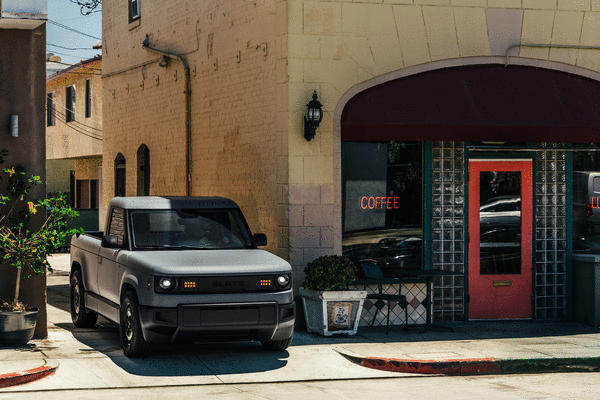
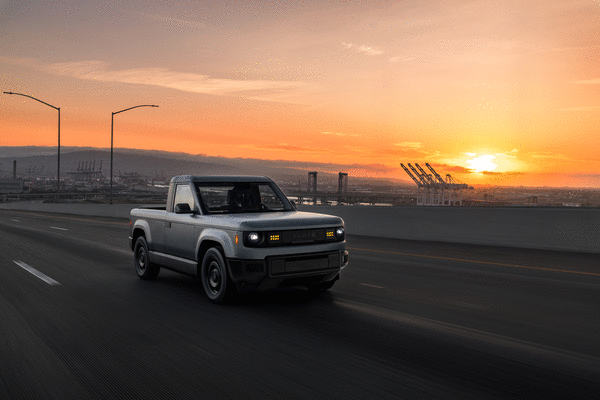
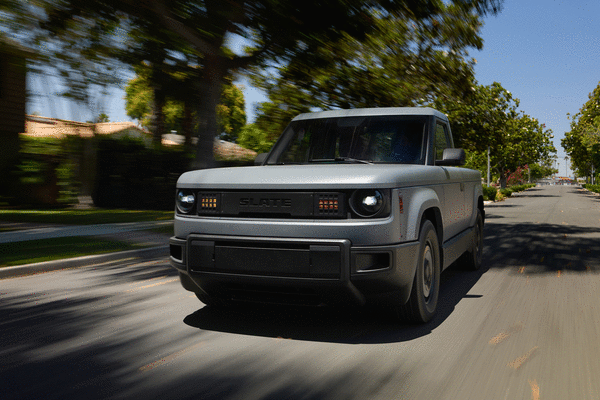



For decades, Detroit has operated on a simple premise: bigger vehicles, more features, higher prices. Trucks and SUVs that once prioritized utility have steadily evolved into rolling luxury suites packed with screens, software, and ever-expanding sticker prices. Affordability, meanwhile, has become increasingly elusive.
Which is what makes Michigan-based Slate Auto's arrival so striking.
Backed in part by Jeff Bezos, the startup is making a contrarian bet in an industry that has spent years moving in the opposite direction. Its first vehicle, the Slate Truck, starts at $24,950 before destination charge. That’s less than half the average price of a new electric vehicle in the United States. The pitch is not that consumers need more technology. It's that they may have had enough of it.
The truck's appeal is obvious. Modern pickups have become so enormous that you need air traffic control clearance to back out of a supermarket parking space. These five-ton chrome rhinoceroses cost so much that owners speak of them in the tone normally reserved for lakefront property.
Designed and engineered in Michigan and California, and built in Indiana, the Slate truck itself feels almost radical in its restraint. Like the Ford Model T, it comes in a single color: slate gray. Composite body panels bolt onto a steel frame, making customization and wraps relatively simple. Inside, there is no towering infotainment screen and no built-in audio system. Buyers can add speakers if they want them or simply use a Bluetooth speaker and the smartphone that already serves as their navigation, entertainment, and communications hub. There are power locks and old-fashioned roll-up windows. Physical knobs and switches remain. The design isn't nostalgic so much as skeptical of the industry's assumption that every inconvenience requires another screen, subscription, or layer of software.
That philosophy of simplicity and reductionism, of doing more with less, permeates the company. The truck can convert between pickup and SUV configurations, supported by hundreds of accessories and customization options. Rather than forcing buyers up expensive trim ladders, Slate is selling flexibility after the purchase.
"We believe customers should choose what goes in their vehicles," Slate CEO Peter Faricy said. "We believe ownership should be simple, and we believe innovation should be focused on making products easier to afford."
The Slate Truck’s specifications are similarly modest: roughly 205 miles of range, 181 horsepower, an eight-second sprint to 60 mph and a top speed of 90 mph. The numbers won't dominate internet forums. That's precisely the point.
Inside Slate Auto, executives describe the company using words rarely heard in modern automotive circles: frugal, scrappy, reductive. Engineers debated whether even air conditioning belonged in the vehicle before deciding it had earned its place. Designers relentlessly reused components. The same taillamp fits both sides of the vehicle. Every door shares the same handle. Even the armrest padding doubles as the lid for the optional center console. The result is a vehicle built with fewer than 800 parts, compared with roughly 6,000 in a typical vehicle — a simplification that lowers both manufacturing complexity and cost.
The result is not merely a cheaper truck. It's an attempt to rethink the economics of building one.
Slate plans to produce the vehicle in a repurposed Indiana factory, a move executives say saved hundreds of millions of dollars compared with building a traditional plant. The company claims more than 180,000 reservations and will back the vehicle with a 10-year, 110,000-mile battery and powertrain warranty, alongside a four-year, 50,000-mile bumper-to-bumper warranty.
And there’s more innovation to come. Faricy hinted that the company would offer a unique delivery process, one that includes the extra-cost option of having it delivered to your home. The company also plans to offer financing and insurance as well, making the process of buying, financing and insuring a Slate Truck a one-stop process that can be done in the comfort of your home from your computer.
And despite the company’s Amazon connection, don’t expect an Amazon Prime deal anytime soon. “I’ve got good news,” Faricy said. “All customers of Slate get the same price.”
That’s something a car dealer will never promise.
The broader wager is straightforward: that the auto industry didn't simply overcomplicate the automobile, it overthought and overpriced it. And somewhere, beneath the layers of leather, software, subscriptions, and screens, consumers may still want something remarkably old-fashioned: a practical truck they can actually afford.
There is, of course, an irony embedded in this story.
Slate's rebellion against technological excess is being financed, in part, by one of the fortunes most closely associated with technological disruption itself. The company is betting that the next innovation in transportation may not be adding more, but less.
The modern economy has spent decades convincing us that every object requires an app, a subscription, a login, a password reset, and three mandatory software updates. The Slate Truck appears to have looked at all this and asks an obvious question: What if the truck minded its own business?
2027 Slate Pickup Truck
Base price: $24,950
Powertrain: Single motor, rear-wheel drive
Horsepower/Torque: 181/195 pound-feet
Estimated range: 205 miles
Recharge time (240V, 20-80%): 4 hours
Length/Width/Height: 175/71/68 inches
Ground clearance: 7.8 inches
Bed length: 5 feet
Payload: 1,550 pounds
Towing capacity: 2,000 pounds
©2026 Tribune Content Agency, LLC










Comments