Bayer jumps 20% on Supreme Court win over Roundup warnings
Published in Business News
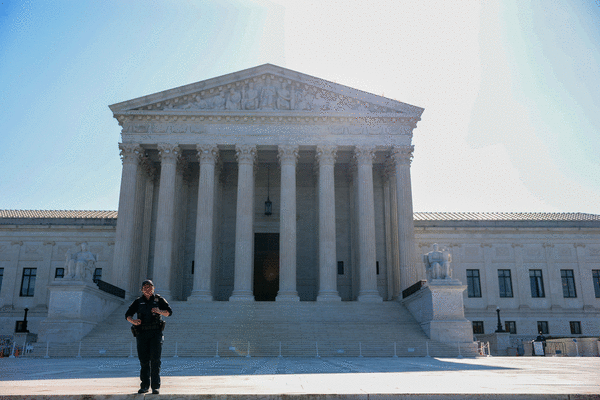
The U.S. Supreme Court shielded Bayer AG from tens of thousands of claims that its Roundup herbicide should have been labeled as a cancer risk in a ruling that will help end a decade-long flood of lawsuits that have cost the company more than $10 billion.
Voting 7-2, the justices threw out a $1.25 million jury verdict won by a Missouri man who blamed Roundup for his non-Hodgkin lymphoma. The majority said consumers can’t sue Bayer for the absence of a cancer warning given that federal regulators concluded a cautionary statement wasn’t necessary.
The ruling marks a milestone in Bayer’s drive to contain the Roundup litigation by the end of the year. The company is also trying to entice Roundup users to take part in a proposed $7.25 billion class-action settlement.
Bayer rose as much as 20% in Frankfurt, the biggest intraday gain since March 2003.
Justice Brett Kavanaugh wrote for the majority that federal law “demands” uniform pesticide labels and that the state law “failure-to-warn” claim at issue in the case “would require a cancer warning on Roundup’s label — a requirement ‘in addition to’ and ‘different from’ the label required” by the Environmental Protection Agency.
Justices Ketanji Brown Jackson and Neil Gorsuch dissented. Jackson wrote that the majority endorsed a labeling requirement that didn’t exist in the U.S. law at issue and failed to acknowledge a ban on “misbranding” that was part of the statute. The court’s interpretation of the law “is both remarkable and regrettable, for it unjustifiably closes the courthouse doors to state tort plaintiffs,” she wrote.
‘Failure-to-warn’
Bayer issued a statement saying the decision “is good for science, farmers, and industries that depend on regulatory clarity for innovation. It should help significantly contain the Roundup litigation after nearly a decade of legal battles. The ruling should result in the dismissal of current warning-based claims and bar future failure-to-warn claims.”
The high court ruling in favor of Bayer was “disappointing,” said Ashley Keller, an attorney who represented the plaintiff, John Durnell, in the appeal.
Bloomberg Intelligence analyst Holly Froum said the ruling “solidifies our view that the company can resolve existing claims for $7.5 billion. Despite a probable delay, the lower court is likely to approve Bayer’s proposed $7.25 billion class-action deal, but we think it will be reversed on appeal as to future plaintiffs.”
Bayer inherited the legal morass after buying Roundup manufacturer Monsanto for $63 billion in 2018. The litigation has cast such a cloud over Bayer’s stock that Chief Executive Officer Bill Anderson has been weighing whether the company should even continue making glyphosate.
The ruling could also help the medical-device, cosmetic and food industries, which are governed by laws similar to the one at the core of the Bayer case.
Labeling rules
Bayer contended that federal law supersedes, or “preempts,” traditional state-law claims for failure to warn. The case centered on the Federal Insecticide, Fungicide, and Rodenticide Act, which sets out rules for pesticides including the requirement of an adequate label. FIFRA, as the law is known, also says that states can’t impose additional mandates.
Bayer said the latter provision meant that once the EPA approved Roundup’s label without requiring a cancer warning, the company couldn’t be sued for not having one. The company, which had the Trump administration’s backing in the case, has steadfastly maintained Roundup is safe and doesn’t cause cancer.
Lawyers for Durnell said EPA’s determinations don’t preclude state courts from making their own judgments about the need for a warning.
President Donald Trump has embraced glyphosate, the active ingredient in Roundup, moving in February to ramp up domestic production. The administration’s stance has angered members of the Make America Healthy Again movement who have pushed to get glyphosate out of the food system.
Various farm, business and nonprofit groups filed briefs in support of Bayer, arguing that a uniform standard is better than a patchwork of state rules.
Durnell’s supporters included consumer and food-safety advocates who said the EPA review process is inadequate because of loopholes, data gaps and corporate influence over the agency.
The case is Monsanto v. Durnell, 24-1068.
(With assistance from Paul Jarvis, Zoe Tillman and Jef Feeley.)
©2026 Bloomberg L.P. Visit bloomberg.com. Distributed by Tribune Content Agency, LLC.










Comments