Seattle attracts tech startups amid AI boom
Published in Business News
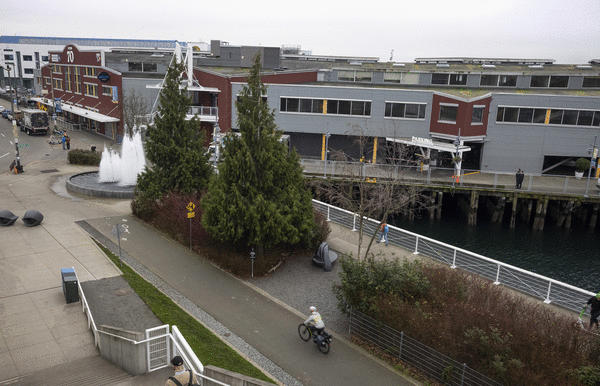
On the north end of Seattle's waterfront, in a building once made famous by MTV, there's a growing artificial intelligence startup.
Yoodli, which develops AI-powered speech-coaching software, could have been based in San Francisco. Its founders, Varun Puri and Esha Joshi, worked for Google in the Bay Area but instead chose Seattle. The company recently doubled its head count to reach about 100 employees.
Puri and Joshi spun Yoodli out of AI2 Incubator, which renamed itself the AI House on Thursday. The startup incubator moved last year into Pier 70, a building that housed contestants on MTV's The Real World" in 1998. Led by investors and former startup founders, AI House provides early funding and coaching to up-and-coming startups.
The incubator raised $80 million last year, according to a regulatory filing. It's raised about $120 million through three rounds since 2020.
Yoodli, which started with AI House in 2021, stuck with the incubator through the move. Employees now take advantage of the waterfront views of Puget Sound and the close walk to the Olympic Sculpture Park.
As the tech industry navigates its postpandemic future, billions of dollars have been poured into AI technology. Titans of the industry are racing to build out the infrastructure, and the wave of startups building AI models on those platforms is not far behind.
San Francisco perhaps boasts the largest amount of AI and tech talent, but Seattle-area boosters, including AI House, are doubling down on the city.
Sri Chandrasekar, who was named AI House's managing director Thursday, said companies like Yoodli choose Seattle over cities like San Francisco for a number of reasons, but primarily for the rich depth of tech talent and the amount of venture capital firms hungry for startups with fresh ideas and products.
Chandrasekar, who moved from the Bay Area to Seattle in 2021, said this realization brought him to the city as well.
"It's like there are 10,000 firms chasing 1,000 good ideas in the Bay Area," Chandrasekar said. "And in Seattle, there are like 20 firms chasing 1,000 good ideas. This is a place to make money for investors."
Seattle's business climate has clouded this narrative recently. Critics say the city's tax policies, such as the JumpStart payroll tax, are burdensome. The recently passed "millionaires tax" has also drawn the ire of business leaders and tech entrepreneurs, who say it disincentivizes startup founders from choosing Seattle. Microsoft President Brad Smith has repeatedly spoken out against the tax, saying it could harm the state's tech sector growth.
But the Seattle area is still drawing in startups like Yoodli. And AI House has plans to keep that going. Four years after splitting off from the Allen Institute for Artificial Intelligence, the early startup investor and coaching firm is making a new requirement for the startups it funds: spend at least one month a year in Seattle, working in Pier 70 every day.
"I've been in venture capital for a really long time, and I've never felt like I've known less about what it takes to build a company than I do right now," Chandrasekar said. "To me, the best place to figure out how to do this is to come to Seattle and learn from other founders."
The AI talent pool is also growing for those founders choosing Seattle.
After moving into two floors in a former Microsoft office tower in downtown Bellevue last year, AI powerhouse OpenAI scooped up another 10 floors this year. OpenAI's rival Anthropic is eyeing a major office expansion in Seattle's South Lake Union neighborhood.
Moves by major AI companies and startups are driving most of the region's office leasing activity recently, according to the Puget Sound Business Journal. More than 292,000 square feet of office space in the Puget Sound region has been snapped up by AI companies this year, and there are more deals expected through the next six months.
A company like Yoodli choosing Seattle was the right move, said Yifan Zhang, a managing director at AI House who also co-founded the property management company Loftium.
"The Seattle ecosystem has a lot more reality versus hype and in those early days you can hype and raise rounds," Zhang said. "But you ultimately have to build a real company and that's when an incubator and the Seattle ecosystem is the most helpful.
©2026 The Seattle Times. Visit seattletimes.com. Distributed by Tribune Content Agency, LLC.







Comments