Retailers are making billions selling ads, not just products
Published in Business News
For decades, retailers made money the old-fashioned way: buying merchandise and selling it for more than they paid.
Now, some of the industry’s biggest players are finding a lucrative business beyond the products on their shelves.
Retailers increasingly see themselves not just as sellers of goods but as media companies, using the data generated by millions of shoppers to help brands reach consumers and influence buying decisions.
Those advertising operations, known as retail media networks, still account for a small share of most retailers’ sales. But they have become one of the industry’s fastest-growing businesses and a valuable source of profit in an industry known for thin margins.
“(It’s) highly, highly profitable,” said Matt Marsh, managing partner at Deloitte in Minneapolis.
“From a retailer standpoint, the old model was, ‘I bought a product, I marked it up and I sold it to a consumer,’ ” Marsh said. “Now it’s evolved into, ‘Wait a minute, I can monetize other aspects of my business.’ ”
The growth comes as retailers grapple with tariffs, supply chain disruptions and inflation-weary shoppers. Advertising revenue can provide a cushion when selling another television or a package of diapers becomes more difficult.
“This isn’t the next wave — the wave has already hit,” said retail consultant Carol Spieckerman. “Services and solutions have become the profit engine that pure product sales can’t be right now.”
The shift is changing how some retailers describe themselves.
During a recent earnings call, incoming Best Buy CEO Jason Bonfig said the company is “becoming a retail, media, advertising and technology company” and has described Best Buy Ads as a “high-margin, high-growth” business.
The Richfield, Minnesota-based electronics chain expects advertising collections — the total amount billed for services — to approach $1 billion this year after topping $900 million last year. Best Buy nearly doubled its number of advertising partners to 750 in its most recent fiscal year.
For comparison, Best Buy generated more than $41 billion in revenue last year, meaning its advertising collections grew to the equivalent of roughly 2% of the company’s sales.
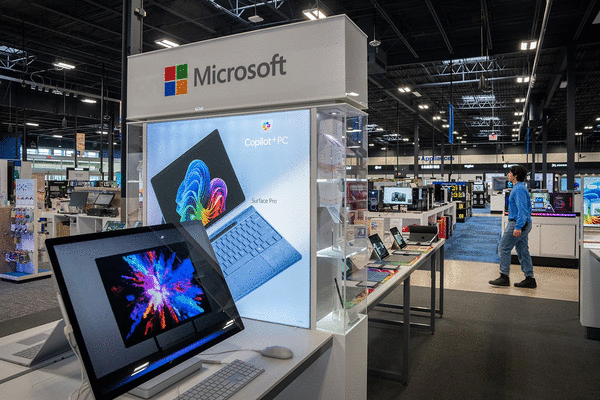
Last year, the company introduced “store takeover” packages that allow brands like Nintendo, Meta and ESPN to advertise throughout stores using displays and checkout screens.
Bonfig said diversifying revenue streams has become increasingly important.
“We compete with some of the largest companies in the world,” Bonfig said in an April interview with the Minnesota Star Tribune. “There’s a need for us to be more diverse in the way that we go to market.”
Target’s advertising business, Roundel, grew revenue by double digits last year. The company said the unit generates over $2 billion in value, boosting overall sales while offsetting the cost of goods.
The Minneapolis-based retailer is also expanding its partnership with OpenAI, testing sponsored messages within ChatGPT that appear alongside some shopping-related conversations.
Despite the push by Minnesota retailers to highlight their advertising businesses, experts say they still lag behind larger rivals like Walmart.
Spieckerman said Walmart has emerged as the industry leader, openly touting advertising growth and positioning its media business as a key driver of future growth. The company generated $6.4 billion in advertising revenue last year.
Google and Walmart recently announced a partnership that will allow brands to use Walmart’s shopper data to deliver more targeted ads on YouTube and track whether those ads resulted in purchases at the Arkansas-based retailer, giving advertisers a clearer picture of which campaigns are driving sales.
Target and Best Buy, by contrast, have used the business to help offset pressure on their core retail operations, she said, describing their advertising divisions as more of a “defensive margin tool.”
Retail media networks, in some ways, evolved from the banner ads retailers once sold on their websites.
Today, companies use information gathered through loyalty programs, apps and purchase histories to help brands target shoppers more precisely, Marsh said. Ads can appear on retailers’ websites, inside stores and across other digital platforms.
A Pampers commercial on YouTube that includes a link to buy the product at Target is one example.
The strategy relies heavily on first-party data — information retailers collect directly from customers. That data, combined with AI, can reveal buying habits, brand preferences and even when shoppers may be ready to replace an older product.
“As AI gets smarter and it’s deployed against these large data sets, there’s going to be more and more personalization,” Marsh said.
The growth of retail media networks initially sparked fears that retailers would siphon business from traditional advertising agencies.
Instead, the two industries are increasingly learning to coexist, experts say.
Jennifer Spire, CEO of Preston Spire, said in-house ad agencies do take revenue from traditional firms, but she doesn’t view them as direct competitors. The Minneapolis-based agency works with clients including Mayo Clinic, Medtronic and the Mall of America.
Keri Starr Paison, who leads commerce media for Deloitte Digital, said agencies focused primarily on execution could face pressure as retailers build more capabilities in-house.
But firms that combine strategy, creativity, technology and data expertise are likely to continue playing an important role.
“The agency model has to evolve,” Paison said. “So I would frame this less as a threat to agencies overall and more as a shift toward the next generation of agencies.”
(Dee DePass of the Minnesota Star Tribune contributed to this story.)
©2026 The Minnesota Star Tribune. Visit at startribune.com. Distributed by Tribune Content Agency, LLC.










Comments