Aviation has a climate problem. A WA refinery may help fix it
Published in Business News
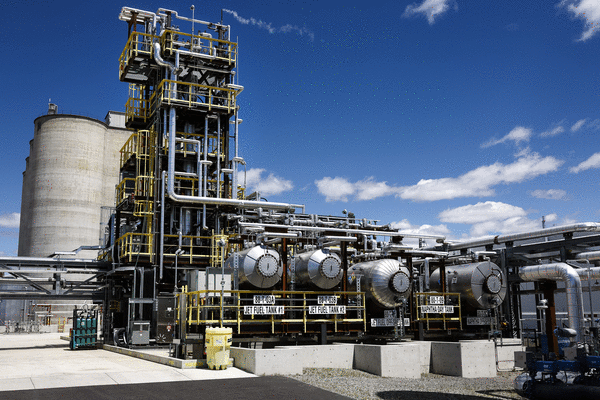
MOSES LAKE, Washington — A startup-style company developing a greener way to produce jet fuel using carbon dioxide, water and renewable electricity has fired up its first commercial production plant.
California-based Twelve, named after the atomic mass of the molecule at the center of its innovative process, built its first production facility in Moses Lake to capitalize on state tax credits and other subsidies for so-called sustainable aviation fuel, the state’s deep aviation history, and the region’s abundant access to renewable electricity.
After breaking ground in July 2023, Twelve started running the facility last fall and producing its first commercial jet fuel this spring, according to Ashwin Jadhav, the company’s vice president for business development.
Last Wednesday, Twelve officially celebrated the start of commercial production, a milestone for the company and the industry.
The 24/7 factory will produce about 50,000 gallons of sustainable aviation fuel annually when it is running at full tilt.
But that’s just a drop in the bucket for an industry that regularly burns through billions of gallons of fuel every year.
The International Air Transport Association, a trade group representing global airlines, said in June that sustainable aviation fuel production this year will represent just 0.8% of all jet fuel use. Twelve and the other companies working to decarbonize aviation will have to significantly scale up operations to even make a dent in the industry’s sustainability goals.
But last week, Twelve and its partners celebrated the start of the process and touted the company’s ambitious plans to keep expanding.
Alaska Airlines will use the sustainable aviation fuel on its commercial flights, but it postponed its first flight with Twelve-produced fuel because some of the fuel had a higher-than-expected carbon intensity. The company is still full-steam ahead" in its support for Twelve, said Ryan Spies, Alaska's managing director for sustainability.
Microsoft has invested in the company through its Climate Innovation Fund and will use the sustainable fuel on Alaska’s flights to decrease the impact of its corporate travel.
Washington Gov. Bob Ferguson pledged the state will continue to support sustainable aviation fuel projects like Twelve’s facility, telling reporters that “everything is on the table.”
To the crowd, Ferguson quoted back the words of former Washington Gov. Jay Inslee, who said on the day of Twelve’s groundbreaking that the Moses Lake site was the “most exciting place on planet Earth."
With the plant now up and running, Ferguson said he had to one-up his predecessor, declaring the same site the “most exciting place in the universe.”
In an interview before the groundbreaking, Twelve's CEO Nicholas Flanders said the company was prepared to scale up, with the speed and cost of each plant decreasing as it worked out the kinks in production and became more efficient.
“We have a long-term vision at Twelve. We want to be building dozens of AirPlants in the U.S. and around the world to ultimately scale to the needs of the airline industry,” he said. “Aviation is one of the hardest sectors to decarbonize, so it will take time to build up … but our goal is to do that as quickly as possible.”
Testing the 'blueprint'
Twelve’s Moses Lake facility, known as AirPlant One, will be a “blueprint” for future, larger facilities, Flanders said.
AirPlant Two, which doesn’t yet have a location, will be capable of “making tens of millions of gallons of fuel per year,” he said.
Twelve makes two products at its factory: sustainable aviation fuel, which it calls E-Jet, and something called E-Naphtha, a low-emission version of the material that makes up the backbone of many common consumer products, from automotive parts to running shoes to laundry detergent.
The process is the same for both products, until the very end, where Twelve separates the two finished products to different tanks.
As Flanders puts it, a CO2 molecule goes in one end of the plant and an aviation fuel molecule comes out the other.
The site has four “electrolyzer reactors” to break down carbon dioxide into carbon and a separate electrolyzer to break water into hydrogen. It then combines those two products to produce something called syngas.
That syngas goes to another reactor, the large centerpiece of the AirPlant One facility, where it is turned into hydrocarbon molecules. The size of that reactor is confidential, Twelve said, but it's located in a space that's 12 feet long, 12 feet wide and 53 feet high.
At this point, the material is separated by weight into the distinct products: E-Naphtha goes to the top of the tank, E-Jet goes to the side, and the heaviest material goes to the bottom, where it will be reused for the same process.
Nick Taylor, Twelve’s engineering manager, said the system then uses “chemical scissors” to cut the hydrocarbon chains into the right length to form jet fuel.
The finished product goes to one of several “day tanks,” where it is tested, before moving to the final storage tank, where it waits for pickup and delivery to customers.
The plant can produce up to 210 gallons of total product per day, Jadhav said, and can continuously change the ratio of E-Jet to E-Naphtha. The day tanks that store the product before testing can hold hundreds of gallons of product, while the final storage tanks can hold tens of thousands of gallons.
In the future, Twelve could scale up the Moses Lake facility, which sits on 14 acres on a former sugar beet mill. Right now, the process area takes up only 4.5 acres.
For an expansion, Twelve would use the same central reactor but add more pipes, storage tanks and supporting infrastructure. Jadhav compared it to a soccer stadium: They’ve built the pitch and now can add more seating and parking.
Twelve’s executives declined to share the cost of the facility but Flanders said it represented a “significant investment in Washington.” Twelve itself is funded through a mix of venture capital, private equity and corporate partners, including Alaska Airlines and Microsoft.
Twelve’s major customers include Alaska Airlines; IAG, the parent company of British Airways and several other airlines; and the U.S. Air Force. The Air Force was the first to test Twelve’s E-Jet fuel, Flanders said, and the company hopes to one day build a dedicated facility for the Air Force’s continuing contract.
Flanders said federal interest in sustainable aviation fuel hasn’t waivered with the new administration. "There still is an alignment with current priorities,” he said.
It’s a domestic fuel source, a way to turn waste into a useful product and a path to increase supply resiliency. Though sustainable aviation fuel is still much more expensive than traditional jet fuel, Flanders said the product offers airlines a more predictable price than conventional methods. He’s seen increased customer interest in the months since the war in Iran led to volatile prices, particularly for jet fuel.
Spies, from Alaska Airlines, agreed that in addition to reducing emissions, sustainable aviation fuel could offer more stable fuel pricing.
“It’s no longer a decarbonization story. It’s a resiliency story,” Spies said.
Tweaks and delays
Twelve broke ground for its Moses Lake facility in 2023, with plans to begin producing fuel for customers in 2024. It took a few years longer than anticipated but Flanders said that’s in line with industry standards.
“I think we set a really ambitious timeline,” he said. “There’s not one big on button. You start up each individual section, make sure those are working.”
Flanders said Twelve stuck to its original plan for the core function of AirPlant One, but made some tweaks along the way to ensure it could operate in all weather conditions, like adding insulation to protect the system during cold snaps.
The initial startup process produced E-Jet that was more carbon intensive than Twelve’s “standard,” Flanders said, leading Alaska Airlines to cancel its first commercial flight with the product. That flight was scheduled to take off Thursday from Seattle-Tacoma International Airport and fly to San Francisco International Airport.
Flanders said the fuel itself was within the appropriate specifications but emissions from some of the equipment used brought the product's lifetime emissions over its threshold.
Twelve has a plan to address the concern, he said, and “the fuel will be on aircraft, we expect, within this month.”
Spies said Alaska postponed the flight because it didn't want to rush the process. The airline wasn't worried about the "tweaks it wanted to see, Spies continued; it recognizes that making a new type of jet fuel is simply hard.
“We don’t want to put extra pressure on these guys,” Spies said.
©2026 The Seattle Times. Visit seattletimes.com. Distributed by Tribune Content Agency, LLC.









Comments