Gensler says Kalshi is flat wrong: Sports bets aren't swaps
Published in Business News
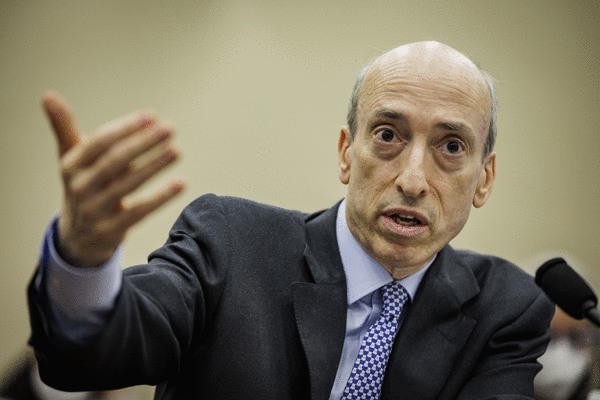
Gary Gensler, overseer of Wall Street for significant parts of the last two decades, has a message for anyone arguing sports betting is a matter for federal financial regulators: They’re wrong.
After seeing prediction market giant Kalshi and the federal agency he once ran, the Commodity Futures Trading Commission, argue that sports bets are swaps under federal oversight, Gensler decided to file a brief in a federal appeals court in Ohio on Thursday.
The issue — an age-old question of federal power versus the states — has become a major dispute across the country that will likely eventually land at the US Supreme Court. Kalshi and the Trump administration’s CFTC want federal oversight, while the American Gaming Association and dozens of states argue they are the real authorities.
The 2010 Dodd-Frank Act, which he helped implement after the global financial crisis, simply does not pertain to sports bets, Gensler said. The legislation was a direct response to the housing meltdown, the collapse of Lehman Brothers and the lack of regulatory oversight of the multi-trillion dollar swaps market.
“To see somebody trying to kind of tuck into that whole thing, wow, the Commodity Futures Trading Commission was given exclusive jurisdiction and preempts the states for sports betting,” Gensler, a Democrat, who later headed the Securities and Exchange Commission, said in an interview ahead of the court filing. “Nothing could be further from what we were working on.”
Kalshi spokesperson Elisabeth Diana pushed back against Gensler’s argument, saying he is “wrong” about what qualifies as a swap.
The CFTC argues in the Ohio case between Kalshi and a state agency that it is the primary regulator of the prediction markets industry, which includes trading around questions like who will win the World Cup or the National Basketball Association finals. The CFTC has treated those contracts as swaps.
But Gensler said that Harry Reid, the veteran Nevada politician and Senate Majority leader when Dodd-Frank was adopted more than a decade ago, would never have given up his state’s ability to regulate sports betting.
“No one working on Dodd-Frank — in the Executive Branch or Legislative Branch — was attempting to put a curve ball by the Senate Majority Leader to legalize a national sports-betting regime or preempt the Nevada Gaming Commission,” Gensler said in his brief, noting that Reid, who died in 2021, had also chaired the state gaming commission.
Reid “would not have allowed it,” he said.
Prediction markets, including Kalshi, have argued that sports-based contracts can serve a hedging interest, such as by allowing retail and entertainment businesses in a city hosting a championship game to protect against potential losses if their home team doesn’t make it to the playoffs.
But Gensler said that Congress never considered that swaps would encompass bets such as “how many points a player would score in a quarter, or sportsbook-style parlays.”
“These contracts do not have hedgers meeting speculators,” he said.
In an interview, Gensler said he had no financial interest in the case. He decided to file the amicus after the topic was raised by students at the Massachusetts Institute of Technology, where he teaches since leaving the SEC at the end of the Biden administration. His filing applied only to sports-betting and didn’t opine on other categories of prediction markets.
“Since antiquity, people have wanted to bet on sports and bet on other things,” Gensler said in the interview. “So on some level, I understand the economic interest of the people setting up the platforms and to kind of fill that demand and compete with the casinos and compete with the FanDuels and DraftKings of the world.”
“But I do think that there’s a misrepresentation of what we were doing in 2010.”
(Updates with Kalshi comment in sixth paragraph.)
©2026 Bloomberg L.P. Visit bloomberg.com. Distributed by Tribune Content Agency, LLC.





Comments