Pressure mounts on rookie chair Warsh as jobs fuel Fed-hike bets
Published in Business News
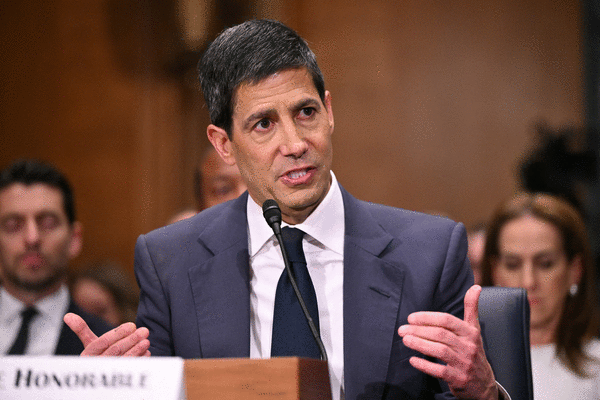
The U.S. labor market is back on its feet, strong employment data showed Friday, stoking concerns of another inflation sting and bolstering arguments from some Federal Reserve officials that they may need to raise interest rates later this year.
For newly installed Fed Chairman Kevin Warsh, the changing outlook is an early test of his ability to convince markets he has what it takes to contain prices, while fending off pressure from the White House for cheaper borrowing costs.
When he chairs his first policy meeting on June 16-17, the easy part, say Fed watchers, will be dropping any hint of a near-term rate cut from the post-meeting statement. The hard part will be signaling how he plans to curb inflation.
“Kevin Warsh has to come out really strong on inflation,” said Heather Long, chief economist at Navy Federal Credit Union. “Otherwise he’s going to lose the trust of the bond market.”
Warsh had been an ardent inflation hawk since his time as a Fed governor, from 2006 to 2011, but in the months leading up to his nomination to be Fed chairman he said interest rates should be cut and repeatedly pointed to factors he believed would eventually justify low rates. President Donald Trump suggested he picked Warsh for the top job based on his openness to reducing rates.
Even after the strong jobs report, Trump warned in a social media post that “growth does not mean inflation!” hinting at continued pressure on the Fed.
Trump aside, however, the outlook has shifted dramatically from just a few months ago when Fed officials were more worried about a soft job market than inflation, and most saw the potential for additional rate cuts this year.
The employment data comes atop an April report on prices showing the Fed’s preferred measure of inflation hit 3.8% from a year earlier, the largest increase since 2023. That was driven largely, but not exclusively, by the shock to energy prices from the war on Iran.
Traders are already betting the Fed will move rates higher at least once by the end of 2026, and economists are shifting their expectations, too. BNP Paribas now expects the Fed to start raising rates in December and to continue hiking in the subsequent months to reverse the 75 basis points of easing the central bank pushed through in 2025.
“Today’s solid payrolls release tilts the scales for us,” BNP analysts wrote in a note to clients.
There were some caveats as economists sifted through the data. Outsized hiring linked to the World Cup — which will be co-hosted by the U.S. in June and July — will slow or be unwound following the tournament, meaning the jobs rebound may yet fizzle.
Still, for now the robust employment picture means the focus remains on inflation.
Fresh warnings
“We are not far from the unemployment rate declining and Fed members starting to become concerned with second-round wage effects next year,” said Joe Brusuelas, chief economist at consulting firm RSM US.
Minutes from the Fed’s last policy meeting in April showed a majority of officials warned the central bank would likely need to consider raising interest rates if inflation continued to run persistently above their 2% target. At that meeting the Federal Open Market Committee kept its benchmark federal funds rate unchanged in a range of 3.5% to 3.75%.
Those warnings have since been ramped up.
Fed Governors Lisa Cook and Christopher Waller, who led the calls for cuts last year, have each in recent weeks said inflation is headed in the wrong direction and may yet merit an interest-rate hike.
In a response to Friday’s jobs data, Federal Reserve Bank of Cleveland President Beth Hammack doubled down on her views that some policy tightening may be needed.
“For today, it’s reasonable to keep rates steady given the uncertainties around the economic outlook,” Hammack wrote in a LinkedIn post. “But if recent trends continue, it may soon be appropriate to act.”
Spotlight on Warsh
Warsh, who has yet to comment publicly on policy since being sworn in as chairman last month, is expected to hold a press conference after the June policy meeting. That will be his first opportunity to set out his views on the economy and how plans to steer rates over coming months.
At the same meeting, the central bank will reveal new forecasts from policymakers that are likely to reflect expectations for higher inflation and rates than in their March projections.
Policymakers will get their first reading on May inflation next week ahead of the meeting. That’s expected to show the ongoing impact from surging energy, commodity and fertilizer prices. Economists expect consumer prices rose 4.2% in May from a year ago, which would be the highest inflation rate in more than three years.
Neil Dutta, head of economics at Renaissance Macro Research said the jobs data lend themselves to “boomflation” that will force the Fed to respond.
“For the Fed, the debate will now shift,” he wrote in a note to clients. “The first step will come later this month as the easing bias will drop. The next step may come later this summer when a tightening bias is adopted, perhaps as soon as July.”
(With assistance from Jonnelle Marte and María Paula Mijares Torres.)
©2026 Bloomberg L.P. Visit bloomberg.com. Distributed by Tribune Content Agency, LLC.





Comments