Soon-to-be CEO says Best Buy 'not just a retailer anymore'
Published in Business News
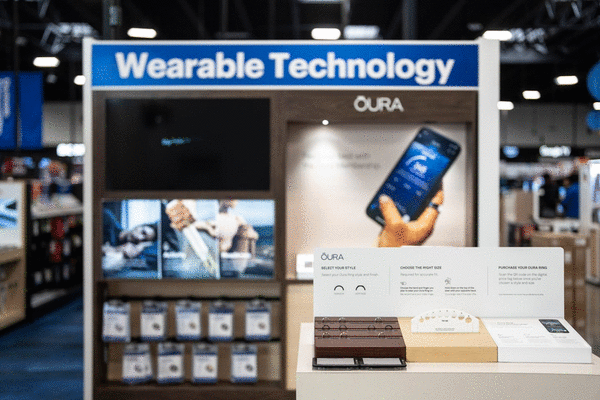
Best Buy’s incoming chief executive said stronger-than-expected financial results are adding momentum as the company seeks to redefine its role in a rapidly evolving retail market.
Beyond its core business as a consumer electronics store, the Richfield, Minnesota-based company wants to expand into a broader mix of services, including its online marketplace and advertising businesses.
Best Buy shares rose about 18% by mid-afternoon following the upbeat earnings report, which included plans to open more stores.
The retailer reported a 2% increase in comparable sales during the February-to-April period, and profits rose more than 30% from a year earlier.
Current CEO Corie Barry, who has led Best Buy since 2019, announced last month she will step down this fall. Jason Bonfig, the company’s chief customer, product and fulfillment officer, will take over Nov. 1.
On Thursday’s earnings call, Bonfig said the company needs to evolve its identity.
“We’re not just a retailer anymore,” he told analysts. “We’re becoming a retailer, media, advertising and technology company, and each of those words matter.”
The leadership change comes as Best Buy confronts uneven demand for big-ticket electronics and intensifying competition from Amazon, Walmart and other big-box and direct-to-consumer technology brands.
The company also continues to dig out of a post-pandemic slowdown that weighed on sales and investor sentiment.
Bonfig said Best Buy needs to grow higher-margin businesses, including Best Buy Ads, the company’s advertising platform that allows brands to market directly to shoppers using its customer data and its website, app and stores.
It also includes growing Best Buy Marketplace, which lets third-party sellers offer products through the retailer’s website.
“We compete with some of the largest companies in the world,” Bonfig said in an April interview with the Star Tribune. “There’s a need for us to be more diverse in the way that we go to market.”
On the core business, Best Buy must better understand customers’ buying habits, including what products they own and when they may be ready to upgrade. It then needs to make those upgrades easier through trade-ins, installation and haul-away services, he said.
The strategy reflects broader shifts across retail as companies increasingly pursue new revenue streams beyond traditional product sales. Retail media networks, online marketplaces and membership programs have become priorities.
Other retailers have made similar shifts. Walmart moved its stock listing from the New York Stock Exchange to Nasdaq in December, joining Amazon, Nvidia and Microsoft and signaling a deeper push into technology.
Target also recently said nonmerchandise sales grew nearly 25%, driven by growth in its advertising business, membership revenue and online marketplace.
For Best Buy, “the four priorities are built on where we already were headed in many ways,” Bonfig said on a Thursday media call. “What you see with the priorities is actually us being a little bit more out loud [about] the transition that we’re looking to make.”
He signaled plans to expand partnerships and newer product categories, citing initiatives such as Ikea and Yardbird shop-in-shops and growth in collectibles and AI-related devices.
Best Buy plans to expand its physical footprint as well with smaller stores aimed at urban neighborhoods and underserved suburban markets. The stores will range from about 12,000 to 15,000 square feet, significantly smaller than many Best Buy locations.
“It’s not about replacing,” he said when asked whether the smaller stores would lead to closures of larger-format locations. “It’s really about reaching new markets and customers that we haven’t been able to reach before.”
Best Buy’s first-quarter results reflected continued strength in computing and mobile phones. Gaming sales were lifted by demand for Nintendo Switch, PlayStation 5 and Xbox products, along with popular software releases.
The company’s appliance business remained weak, however, and home theater sales were still slightly below year-ago levels despite improving television trends.
When Bonfig was named the retailer’s sixth CEO in April, analysts were cautious in assessing the transition, saying they wanted more clarity on his long-term strategy.
But the market reaction on Thursday was likely driven in part by Bonfig’s plans, analysts said. UBS analyst Michael Lasser wrote in a note ahead of earnings that Bonfig’s vision for the company would be a “key input” in determining Best Buy’s stock value over the next year.
Barry said Best Buy continues to see resilient consumer spending patterns despite broader concerns about inflation and a “K-shaped” economy, in which wealthier consumers continue spending while lower-income households pull back.
“There is a lot of conversation around the K-shaped economy, which is absolutely real and you can see it in lots of metrics,” she said during a media call Thursday. “However, in our business we are not seeing that bifurcation.”
Instead, Barry said customers across income levels are still buying technology products when they see a clear need or meaningful innovation, though shoppers remain focused on promotions and value.
Bonfig said most customers arrive with a set budget when shopping, rather than making purely impulse-driven purchases.
Best Buy’s sales growth also slightly lagged the broader electronics market, according to Neil Saunders, managing director of GlobalData. U.S. retail sales at electronics and appliance stores rose from February through April.
“Best Buy is becoming a less relevant player in the electronics landscape,” Saunders wrote in a post-earnings note. “To be fair, it remains large and significant, but more of the gains are now accruing to other retailers which, if the trend continues, is a threat to its long-term standing.”
©2026 The Minnesota Star Tribune. Visit at startribune.com. Distributed by Tribune Content Agency, LLC.







Comments