Evan Ramstad: We've been through massive physical tech investments before, but not like this
Published in Business News
MINNEAPOLIS -- It’s still the earliest days of artificial intelligence usage and understanding, yet AI companies are gobbling capital like a hippo’s maw and soaring in market valuation.
Everyone in business these days seems to be searching for a tale from history to meaningfully describe the growing importance of AI. I personally think it will transform the way people work with their digital devices and information. But we’re at a very confusing time in its development.
So the tale in history I’m going to invoke comes from the late 1990s and early 2000s: the time when the internet was in its hockey-stick period of fast adoption.
The buildout of the commercial internet had enormous effects on company valuations, but also on the nation’s physical environment, just as AI now does. Many people have forgotten how much the nation was ripped up to build what was initially called an “information superhighway” but eventually became known as the broadband network.
In July 2001, the longtime tech writer of the Star Tribune, Steve Alexander, wrote, “The information superhighway is getting wider in the Twin Cities.” He then described plans to lay fiber-optic lines along Interstate 94 and Interstate 35E in St. Paul — at a cost of around $10 million.
How quaint that seems when set against the multibillion-dollar expense of a single data center in 2026.
I was working in Dallas back then, and I also wrote a story in 2001 about urban buildouts of broadband after seeing a street in front of a Thai restaurant torn up more than a dozen times over two years. Around that time, a broadband crew accidentally hit a water main in downtown Dallas, flooding an underground parking lot and ruining cars on two levels.
There was no talk of placing moratoriums on the broadband builders, as there is today with AI developers. To the contrary, my 2001 story noted that officials in Austin, Texas, put such a premium on the internet buildout that they shelved all other street improvements until 2002.
Back then, though, the action happened in daylight: Telecom carriers raced upstart internet service providers to lay new data cables from coast and coast, boasting about what they were doing as they tried to snag market share with consumers and businesses.
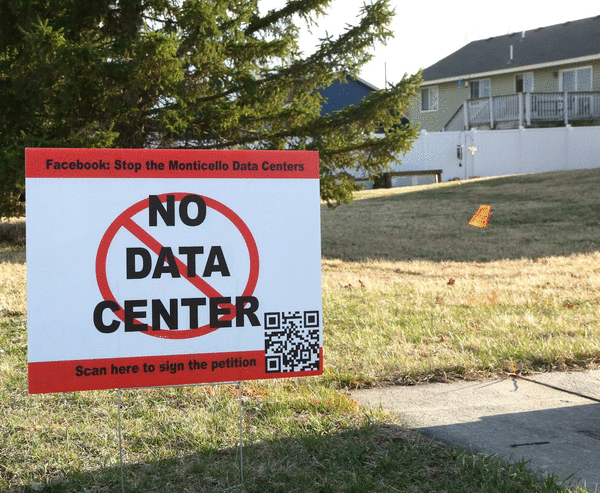
Today, AI data center developers seek anonymity, in part to pressure communities for tax breaks but also to avoid controversy around the noise data centers make and power and water they consume.
The 2026 Minnesota Legislature failed to pass a bill banning nondisclosure agreements (NDAs) between data center builders and local communities, missing a chance to lead a growing movement for transparency. Microsoft this spring became the first major company to say it would no longer sign NDAs in places where it intends to build.
But just like now with AI data centers, little about that broadband rush a quarter century ago was efficient. Austin and other cities persuaded telecom carriers to dig common trenches through urban streets, but the companies insisted on their own access to the buried lines. The result can still be seen in cities where there are streets with a half-dozen or more manholes in a row.
When those digs were happening, articles like Steve’s and mine wondered whether the efforts to expand access to the internet would pay off. “Some doubt there is enough demand,” Steve’s piece said.
Again, how quaint. Even 25 years later, with broadband service having become wireless, it still sometimes feels like our networks and devices aren’t fast enough.
Today, I’m very reluctant to say AI is being overhyped or overbuilt. And I wouldn’t even try to predict the effect AI will have on jobs and the environment.
AI may very well turn out to be overinvested in, however. The entire case for massive data centers may be overturned by an advance in software programming or by the decentralization of processing power as chip technology advances. AI companies’ debt loads may become too much to bear, even if the companies turn fabulously profitable. I remember stories about broadband buildouts appeared not long before a big crash in internet-related stocks.
The commercial internet did justify its investment, despite the bursting of an initial bubble that wiped out billions in shareholder value.
At the moment, however, the numbers on AI investments are jaw-dropping, even if you’ve got the mouth of a hippo.
When the big AI-related developers — so-called “hyperscalers” like Google, Meta, Amazon, Oracle and Microsoft — reported earnings last month, their collective forecast for capital spending this year tallied up to $725 billion. That’s about twice the revenue of UnitedHealth Group, Minnesota’s largest company.
Some of that money is flowing to private Minnesota companies that don’t appear in the Strib 50 ranking of the state’s largest publicly traded firms.
Mortenson, a Golden Valley-based contractor, ranked ninth in 2025 data center construction with $1.7 billion in project revenue, according to a list compiled by the trade publication Building Design + Construction. Minneapolis-based Ryan Cos. was ranked 18th, at $934 million. Two other Twin Cities builders, Adolfson & Peterson of Bloomington and Kraus-Anderson of Minneapolis, were among the top 65 builders last year.
It’s like we’re living in 2001 again, with two differences. Deal values and capital spending on AI are even more jacked up. And the physical makeover to the nation is happening in rural areas and exurbs more than urban centers.
Yet there’s also a chance, with things moving so fast and so much money at stake, this AI era may prove incomparable.
©2026 The Minnesota Star Tribune. Visit at startribune.com. Distributed by Tribune Content Agency, LLC.









Comments