Nostalgia grows for 'old Target' as retailer reshapes stores
Published in Business News
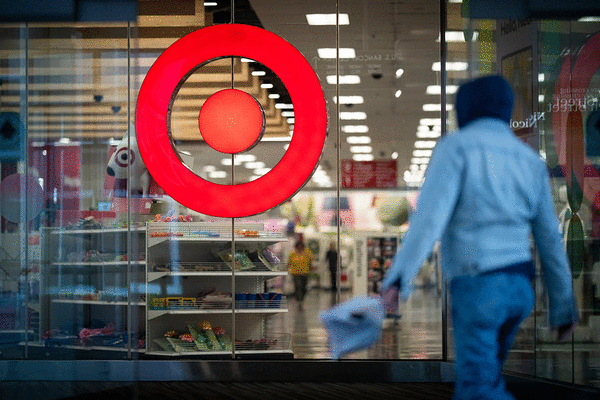
Nostalgia for the “old Target” is showing up everywhere.
Part of it reflects a broader throwback trend. Another part comes as the retailer plans to revamp stores after several years of sluggish sales.
Social media posts often point to the food courts that have largely disappeared, particularly the extra salty popcorn and slushy machines. Others recall the neon lights and bright, playful colors — a sharp contrast to today’s pared-down palette of white, gray and red.
Some users have gone further, posting video essays dissecting what they see as the retailer’s softening appeal. One video has drawn thousands of comments, with people recalling childhood trips to the DVD section and browsing such clothing brands as Mossimo.
Even Target’s Instagram account has joined the trend with a “What were you like in the 90s?” post.
The Minneapolis-based retailer has acknowledged the need to improve its stores. In April, the company brought together store directors from across the country for training focused on improving customer service, which analysts and shoppers alike agree has slipped since the pandemic.
CEO Michael Fiddelke has said that both product assortment and the store experience are priorities for improvement.
It’s an open question whether executives’ vision for restoring “joy and delight” in the stores can align the company with both the affection many shoppers hold for the brand and their current desires on price and selection.
Target’s stock has climbed nearly 30% over the past year, and some analysts are growing more optimistic about the company’s trajectory. But many shoppers say the stores still fall short, citing everything from cluttered aisles to declining quality.
“We’re going to come back to knowing who we are in the years to come,” Fiddelke said on a March earnings call. “I’ve seen Target at our best. I’ve seen us when we’re not at our best.”
CEO views stores as the ‘heartbeat’
Fiddelke has described stores as the retailer’s “heartbeat,” signaling a shift in priority to in-person shopping after pandemic-era services such as drive-up and pickup drew customers from the aisles.
Stores changed significantly under his predecessor, Brian Cornell, as they became distribution hubs for both drive-up and home delivery.
Target also outsourced its pharmacy business to CVS, expanded its partnership with Starbucks to include drive-up and added shop-in-shops with brands such as Warby Parker, Ulta Beauty and Disney.
Those changes — along with the company’s retreat from some DEI efforts and a $1 million donation to President Donald Trump’s inauguration — have made some shoppers rethink their relationship with Target.
“I don’t think (Target) understands what that niche is anymore. It used to be Walmart, Target and Lunds & Byerlys,” said Brian Kolling, 57, of Maple Grove, Minnesota. “Right now, I could see myself going to either side, but I don’t know why I would go to Target in the middle.”
Others said the changes have distracted Target from basics such as consistent stocking of groceries and having a balanced mix of national brands alongside its private labels.
Several shoppers recently told the Minnesota Star Tribune that the experience at some urban stores, notably the Lake Street location in Minneapolis, makes it difficult to complete a full trip. Essentials such as baby formula and laundry detergent are often locked up, requiring employees to provide access.
And some said the quality of Target’s clothing — once a go-to for basics — has declined, making items harder to sort through and, in some cases, not worth the price.
“We’re focused on delivering a store experience that’s easy, inspiring and friendly every time a guest walks in,” Adrienne Costanzo, Target’s chief stores officer, said in a statement to the Star Tribune. “While we know this work takes time, we’re already seeing results — and I’m incredibly proud of our team.”
Training for a reset
One of the most visible changes inside stores will be a tighter dress code. Starting this summer, employees will again be required to wear red shirts with blue jeans or khakis, though vests will remain optional.
Around the recent holidays, the retailer rolled out a “10-4” training program that encourages employees to acknowledge any shoppers within 10 feet and greet those within 4. The guidance is paired with a broader service philosophy: Greet, help, thank.
The effort reflects a push to rebuild what executives often describe as “my Target” — the connection shoppers feel to their local store.
Leandra Hulett, group vice president of stores, told a room of store directors in April that the renewed focus on service is partly a response to the more transactional interactions that took hold during the pandemic.
Led by Hulett, the two-day program focused on how to communicate expectations to employees, including performance factors, such as teamwork, task execution, reliability and guest interaction.
“Prior to COVID, there was just an aura of the Target magic,” said Janice Daley, store director at the Nicollet Mall location. “During COVID, we went into operational mode (by) filling our floors and just making sure that we’re meeting the guest’s needs. But we lost our experience.”
Target has struggled to boost sales amid the complaints about store conditions, pricing and less compelling merchandise. Inflation has also weighed on discretionary spending, particularly in home goods, where the retailer has lost market share for two consecutive years.
The company plans to overhaul about 75% of its home assortment by June, with a bedding refresh in the fall and kitchen and dining updates set for 2027. It is also moving on from its partnership with Ulta Beauty, replacing it with a curated “Beauty Studio” concept.
In grocery, Target is emphasizing fresh foods, bakery items and health-focused offerings, such as gluten-free and high-protein products. The category is a major focus of the company’s $5 billion investment this year.
“If I were to step back and draw a heat map of the entire store … you’d see more change to what we sell and how we sell it than you’ve seen in a decade,” Fiddelke said.
The retailer is also revamping its baby department with a more boutique-style layout featuring popular brands and testing a concierge service in select stores.
Those plans are in progress, but some customers are impatient for meaningful improvement.
Kolling said he used to browse end caps for clearance “treasures” and was willing to pay a little more to support a hometown retailer. Now, he said, he feels like Target’s “charm has been lost.”
Kolling goes to Target competitors for some of his needs — shopping on price at Aldi or Costco and finding groceries at regional chains, such as Cub or Coborn’s. He said he now questions where Target fits in his spending.
“I think Target maybe is trying to be everything to all people,” Kolling said. “I’m not sure I know who their preferred customer is.”
Jackie Hilgert, 65, of Richfield, Minnesota, echoed that sentiment. She said Target’s selection has become so broad in recent years that “they’re not really doing anything well anymore.”
“If it was a store I couldn’t live without, I would still probably shop there,” Hilgert said. “But there’s nothing in the grocery department that I can’t find in other places. There’s nothing in the clothes that’s interesting to me.”
Analysts, meanwhile, say the turnaround will take time.
“There aren’t many proof points to speak to the moment,” said Neil Saunders, managing director of GlobalData. “Target’s too early on the journey for that, so there is still a disconnect.”
He added that customers are also feeling as if they’re being asked to “spend more and receive less in return.” Target’s overly broad assortments, he said, can strain store operations and dilute the shopping experience.
Still, several shoppers said recent changes, including the updated dress code and better in-stock levels, were noticeable improvements. Some Twin Cities residents also said they prefer supporting a hometown retailer.
A Target spokesman said guest satisfaction and in-stock availability have continued to rise since January.
In March, Fiddelke said Target was reinvesting “hundreds of millions” of dollars in store labor and training.
Stores will have flexibility in how they use the added payroll budget, a company spokesman said. That could mean more hiring or more hours for current associates.
The investment includes an AI-powered Store Companion tool. Previously, store employees relied on a chatbot to answer basic questions, with information spread across multiple platforms, said Alden Kooken, senior vice president of store operations.
The new system brings those functions into one app, allowing employees to pause drive-up orders during a storm or quickly look up merchandise details.
Target also introduced a guided workflow on employees’ handheld devices that walks them through setting up displays — a task Kooken said was previously among the most complex and labor-intensive.
“We continue to prioritize ways to make it simpler for our team members to do their daily tasks and jobs,” he said in an interview with the Star Tribune. “That is mission one for us in store operations.”
©2026 The Minnesota Star Tribune. Visit at startribune.com. Distributed by Tribune Content Agency, LLC.








Comments