High beef prices drive blame game among farmers, processors and sellers
Published in Business News
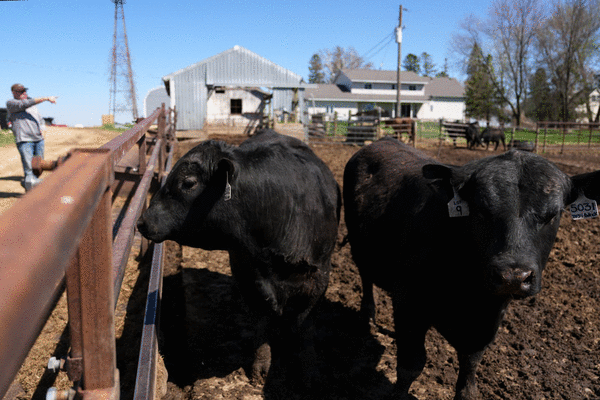
CANNON FALLS, Minn. — Consumers hungry for protein are still buying beef, but the meat’s producers from the farm to the butcher shop know it’s too expensive.
At Everett’s Foods in southeastern Minnesota, some customers are starting to pick the store’s signature sausages over pricier cuts of beef, employees said. Cannon Falls rancher Bruce Waugh said he feels “empathy” for consumers, and he has tried to keep ground beef costs in line with only one price increase in the post-pandemic era. The problem is, inflation has outpaced that.
The average price of a pound of ground beef has increased from $4.76 in March 2022 to $6.70 last month, the Bureau of Labor Statistics has reported, and this inflation hasn’t dramatically reversed like some other foods, such as eggs.
The U.S. Department of Justice (DOJ) has launched a criminal investigation to determine if large meatpackers, which process farmers’ cattle and sell it to grocery stores, engaged in criminal anticompetitive conduct, the Wall Street Journal reported April 20. President Donald Trump accused these companies in November of driving up prices for consumers. Minnesota commodity giant Cargill is among the four major meatpackers controlling most of the American beef-processing market.
Cargill declined to comment on the reported probe, as did the DOJ. But it has brought into sharper focus the factors making beef so expensive. While the simple answer is low supply and steady demand, economists and beef experts said the full explanation is complicated, involving the pressures of the pandemic and farm consolidation.
“If you asked 100 people, ‘Give me your top-two or three reasons why the beef price is high?’ You would get probably about 100 answers,” Waugh said.
Sarah Little, a spokeswoman for the Meat Institute, a trade group representing meatpackers including Cargill, said the organization has “no knowledge of” DOJ activities.
“For the majority of the last 20 months, public [U.S. Department of Agriculture] data shows that beef packing companies have been losing money while paying producers record prices for their cattle because there are simply not enough cattle to meet strong consumer demand for beef,” she said in an email.
Conditions at the farm
At Waugh’s Cannon Falls ranch on a recent Friday, angus and wagyu cattle foraged on hundreds of acres of grassy pasture wedged between large southeastern Minnesota crop farms. Aside from selling some beef directly to consumers, this operation is one of the first cogs in the complex beef supply chain, as it sells breeding cattle to cow-calf operations raising animals supplying the food system.
Ranches are expensive to operate. An average cow costs close to $1,500 to feed and raise, requiring 20 acres of grass for grazing in parts of the Upper Midwest over a roughly five-year lifetime, said Julie Walker, an extension beef specialist at South Dakota State University.
For years, expenses made it difficult to turn a profit as beef prices held steady. From 2016-22, ranchers in Minnesota were on average losing money for each head of cattle they raised, and the number of cow-calf operations dropped from 115 to 85, according to the Center for Farm Financial Management at the University of Minnesota.
These low margins, Waugh said, gave ranchers a reason to leave the grueling industry. Including hours he works at a second job so he can fund his farm’s growth, the rancher recalled a recent 14-hour day that involved lugging cattle across the state.
“I think, long-term, one of our biggest threats is just having the young guy to step in here and raise the cattle,” Waugh said.
Walker said some farmers have looked toward other uses of their land, such as growing crops, to avoid grueling year-round work.
The COVID-19 pandemic shifted the balance between supply and demand. Walker said farmers struggled to find processers to accept their cattle when meatpacking plants faced large virus outbreaks among workers, which slowed and stopped production. With less meat heading to the grocery store, demand for cattle dropped, too.
Brian Buhr, a dean and professor of applied economics at the University of Minnesota, said there’s a “time lag in cattle” for the effect of a “shock” like COVID-19 to reflect in cattle supply. There have been “nothing but disruptions” for the past six years, he said.
“We’re still, in my view, experiencing the aftereffects of COVID,” Buhr said, adding that droughts are also an immediate issue challenging ranchers.
In the years since the pandemic, Americans’ craving for protein has intensified. Beef sticks exploded in popularity, and social media trends have encouraged young people to maximize intake of proteins such as ground beef. But cows take years to raise, leaving a weak pandemic supply to feed growing demand.
Waugh said he “can’t believe how resilient [consumers have] been through this,” pointing out “price and supply have not crashed.”
The blame game
The rancher said there’s no easy fix to bring the price of beef down and noted the high prices are “not Trump’s fault, and it’s not Biden’s fault, and it wasn’t Obama’s before that.”
But Trump’s Justice Department is reportedly pointing its finger toward the meatpackers.
Consolidated meatpackers arose after technical innovation allowed for boxes containing smaller cutouts of cattle in the 1960s and ’70s to ship directly to urban centers, Buhr said. Urban butcher operations that could break down an entire cow became obsolete.
Now, four meatpackers — Tyson Foods, JBS, National Beef and Minnetonka-based Cargill — control the vast majority of the U.S. meat market. Meatpackers set the price that beef cattle ranchers receive. This consolidation has long drawn scrutiny from bipartisan legislators and customers.
In November, this intensified when the DOJ said it was investigating Cargill and others for alleged price-fixing, accusing them of potentially colluding and manipulating prices.
Peter Carstensen, a former attorney for the DOJ’s Antitrust Division, said government attorneys “need to have evidence beyond a reasonable doubt that the parties have entered into a relatively explicit understanding to fix prices or allocate customers or allocate geographic markets” to bring forth a criminal antitrust case.
Criminal investigations increase pressure on executives, Carstensen said.
“If you’re a manager that was involved in the conspiracy, on the other hand, you’re looking at jail time. And that’s scary,” said Carstensen, now a professor of law emeritus at the University of Wisconsin Law School in Madison. A criminal investigation could be a way to deter meatpackers from “implementing any more reductions in production,” he added.
Carstensen said there’s an “enormous problem” with just four companies controlling the meatpacking industry, and this consolidation ultimately harms consumers. But he said his “guess is that [the DOJ is] going to have a hard time finding any very substantive violation.”
“I think that they are well enough advised and operate in such a concentrated market for beef … that the kind of overt collusion that is the basis for criminal cases seems to me to be unlikely,” Carstensen said in an email.
Buhr, the Minnesota economist, said he follows the spread between live cattle prices and the wholesale price that meatpackers set, and “those margins have been tightening up.”
“The packers’ margin, amount they’re getting in that, is getting squeezed,” Buhr said.
The limited number of meatpackers is “always in the back of a producer’s mind,” said Walker, the South Dakota specialist. In her nearly 30 years on the job, ranchers have told her at times that their packers are “taking all the profit” and they were not getting their fair share.
“But I haven’t heard much from them recently on it,” she said, as ranchers are “feeling pretty good.”
©2026 The Minnesota Star Tribune. Visit at startribune.com. Distributed by Tribune Content Agency, LLC.







Comments