As planting begins, Minnesota farmers wary of war's impact
Published in Business News
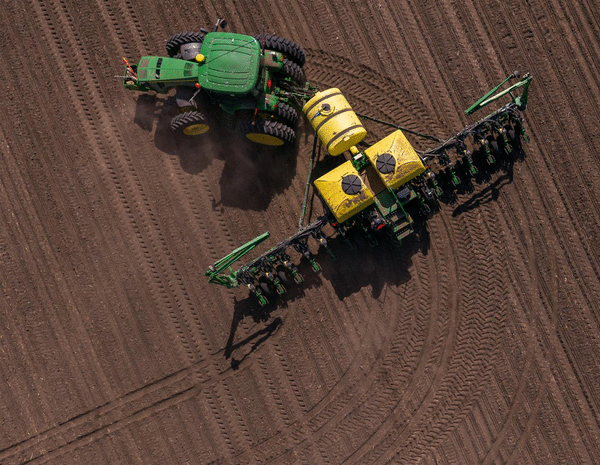
Around 2 a.m. on the late February day the U.S. went to war with Iran, a soybean and corn farmer in St. James, Minnesota, texted his local fuel supplier, who then scrambled to purchase diesel for the upcoming season.
The Middle East conflict was going to balloon diesel fuel and fertilizer prices. And for Minnesota farmers already dealing with razor-thin profit margins, that could be the difference between survival and failure.
“Had he not responded to me, I think we would have been in trouble,” farmer Andrew Karau said.
Farmers’ harvests in 2025 were mostly unprofitable, and many growers are expecting to again lose money this year. And that’s not just because of the war’s impact; the prices for crops continue to flag, and President Donald Trump’s ongoing trade war is limiting international buyers.
As a result, officials expect farmers to grow fewer acres of crops across the state this year compared to last year.
“I think farmers by nature are optimistic — if we weren’t, we wouldn’t be farming,” said Rob Tate, a corn and soybean farmer in Cannon Falls, Minnesota. “So we do have hope that at some point in time, things will get better. But right now, this is a tough spot for most of our producers to be in.”
The income from Minnesota farms growing corn and soybeans, often planted after each other on the same fields to improve crop yield, remained low in 2025. Government payments hoisted these operations roughly up to the break-even line, data from the Center for Farm Financial Management at the University of Minnesota shows.
Pauline Van Nurden, an economist at the center, said the costs of farmland rent, seed and other expenses, such as interest payments, have remained high. Tom Slunecka, CEO at the Minnesota Soybean Research and Promotion Council, said there’s no way for farmers to make up for these higher costs.
“We can’t raise our prices and pass that on because we are price takers, not price givers,” Slunecka said.
The commodity price of corn and soy have fallen by at least 30% since a peak in 2022. Slunecka said very few farmers are planning to turn a profit this year.
“At best, it’ll be a break-even year,” he said.
Van Nurden said farmers are making up for losses by dipping into savings built up during the pandemic years, which produced profits.
“A lot of producers have learned their lesson over time,” she said, adding one of those lessons is to create a healthy reserve of cash called working capital to carry through tough times.
Government funds, such as $11 billion in one-time payments the U.S. Department of Agriculture has provided for farms, are assisting, too. What would help more, though, is broader trade with foreign countries, Slunecka said.
Many soybean farmers rely on China to purchase their crops, but a trade war in 2025 strained this relationship.
“Every farmer will tell you that they want trade, not aid, and they mean that,” Slunecka said.
Jim Falk, who sells seeds and grows crops on a 700-acre farm in western Minnesota with his son, farms specialty soybeans for customers overseas. His business results were worse last year compared to the previous 20 years of working with customers in Asia, he said.
Falk said tariffs have soured international customers’ feelings about doing business with American farmers.
“My fear is that we are simply destroying those relationships in a very short period of time with the type of trade policy that we have now, where it seems to ignore the fact that trade is a two-way street,” Falk said.
U.S. Sen. Amy Klobuchar, the top Democrat on the Senate Agriculture Committee, has pushed for year-round E-15 fuel to provide crop farmers relief. At a roundtable event in early April, she pointed to another effort: pressuring the White House to end the Iran war.
“There is so much volatility out there because of the tariffs and the war that we have to look at other solutions,” Klobuchar said.
Financial results for farmers growing wheat and sugar beets, Minnesota’s next most common crops after corn and soy, were even less profitable in 2025. These markets are not expecting a comeback this year.
Commodity wheat prices have dropped by nearly 50% since a peak in 2022 as supplies around the world have increased. Minnesota wheat farmers have now lost money on average for three consecutive years, the Center for Farm Financial Management’s data shows.
“There’s not a lot of optimism,” said Brian Sorensen, executive director of the Minnesota Association of Wheat Growers.
As a result, the USDA expects wheat acreage to be lower this year than in any other year since records began in 1919.
“It just feels like there’s less and less wheat being grown,” said Van Nurden, the agriculture economist. “And I think the current pricing scenario lends to that even more.”
To survive, some farmers are using savings, Sorensen said, while others are working separate jobs or relying on a spouse’s income.
Government funds can help, but it still looks like wheat farmers could “lose money with every acre they plant,” Sorensen said.
Among Minnesota’s top four crops, losses in 2025 were greatest for sugar beet producers.
Rob Johansson, director of economics and policy analysis at the American Sugar Alliance, said the primary driver of financial losses for these farmers in 2025 was the low price of sugar, which has fallen by 50% since a peak in late 2023.
When prices were high, sugar production abroad increased as growers looked to cash in on the profitable crop, Johansson said. This increased supply. Simultaneously, the price of ethanol fell, and farmers in countries such as India and Brazil decreased production of the vital chemical they created from sugar plants. Instead, the foreign producers shipped their sugar abroad for consumption, further saturating the global market.
“High prices lead to more production. Low oil prices lead to more sugar going into the world market. Both of those translate into lower prices,” Johansson said.
The price of ethanol roughly correlates to the price of oil.
While sugar prices fell, input costs — including higher equipment expenses partly due to tariffs — remained high, Johansson said. Lots of rain, as well as plant disease, added to headaches for sugar beet farmers in 2025.
“For sugar beet producers in Minnesota, that translated into very tight” or negative balance sheets, Johansson said.
The American Sugar Alliance said in an April 15 letter to the Office of the U.S. Trade Representative the “viability of America’s sugar industry is threatened by a glut of low-priced imports from foreign countries whose policies have flooded the world market — including the United States — in cheap sugar." The office should use its authority to address this, the letter said.
Most growers are expecting another year of losses ahead, Johansson said. He recently heard from a group that advocated for the industry to federal officials. Their message, he said: “We need help sooner than later.”
(Christopher Vondracek of the Minnesota Star Tribune contributed to this story.)
©2026 The Minnesota Star Tribune. Visit at startribune.com. Distributed by Tribune Content Agency, LLC.










Comments