Seattle renters, landlords clash over ratio utility billing system
Published in Business News
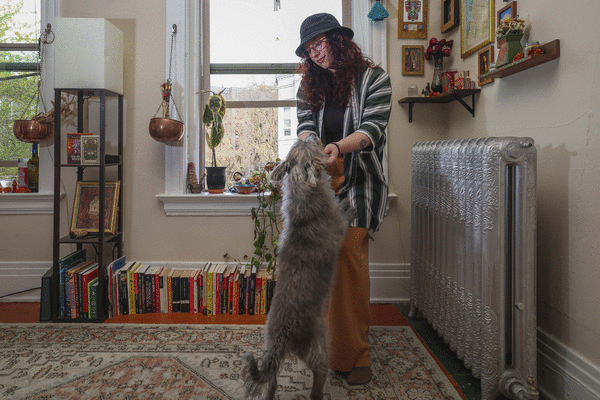
How renters pay for utilities in Seattle has become a hot topic over the last year.
A system that divides a building’s total utility bills between units instead of a flat rate has raised fairness and transparency concerns among tenants. Some claim the system allows landlords to rake in more money while circumventing recently imposed rent increase caps.
The opposition to the ratio utility billing systems, often called RUBS, led hundreds of Seattle renters to form a campaign advocating for a citywide ban. The system is banned or restricted in some parts of the U.S., including California’s West Hollywood and San Jose, Connecticut and Massachusetts.
Under RUBS, landlords disperse a building’s total utility costs, minus whatever tenants pay directly to utility companies, among units based on size and occupancy. The formulas landlords use to determine each unit’s share of the building’s utility costs are often convoluted or farcically complex, campaign members claim.
Tenants say RUBS leaves them with much higher, unpredictable monthly utility charges from their landlords — sometimes on top of other utility bills.
“You don't know if your bill is accurate, and you might not be able to afford it from one month to the next,” said campaign member Lexy Salas, 28. “This is an abusive, predatory system.”
Landlords don’t agree, saying the system is vital and that its ban would present a major blow to Seattle’s multifamily market. Fixed rates often fail to cover buildings’ higher, inconsistent utility costs, they argue, and installing submetering in older buildings is expensive and cumbersome.
Some multifamily providers say they’re open to practical improvements to city RUBS regulations, but any changes must be executed with surgical precision.
“If we get this change wrong, we risk making housing more expensive and much harder to build in the city of Seattle in the middle of probably the largest housing crisis we’ve seen,” said Jake Mayson, the Washington Multifamily Housing Association’s director of government affairs.
The campaign
Almost a dozen members of Seattle Ban RUBS sat on the floor of a tiny Capitol Hill apartment last month. An old tabby cat rubbed against their knees, prompting jokes about the pet being “pro-RUBS.”
Although they live in different buildings, the members have grown close since launching the campaign a year ago. Videos on the campaign’s Instagram page, which has amassed about 500 followers, feature the group discussing RUBS and protesting in Seattle streets with homemade signs.
The campaign includes tenants from 80 different buildings in Seattle, Salas said. But it originally started with just her building — the Qualman Apartments on Capitol Hill.
When Qualman’s property management company, Cornell & Associates, announced it would swap a flat utility fee of $50 a month for RUBS billing in mid-2024, Salas didn’t think much of it. She only began to panic after she saw her utility bills jump hundreds of dollars.
The new bills varied wildly. Some months she owed less than $100. Others, she owed over $250. There were no noticeable changes in her utility usage between months, she said.
The new system felt unfair and untransparent to her. How could she know she was paying her fair share? If her neighbor took three-hour-long showers or left the lights on constantly, would everyone foot the bill? How could she know the money was actually going toward utilities?
She wasn’t alone in her frustrations. Qualman residents began to organize a campaign against the billing system last year and quickly found tenants from other Seattle apartment buildings who wanted to join.
Salas and other residents sent complaints to the city’s hearing examiner, who ordered that some of the bills be repaid to tenants. Cornell & Associates billed utilities using estimates based on industry standards rather than a clear, building-specific methodology, which the city requires landlords to disclose to tenants, according to the hearing examiner’s findings.
Cornell & Associates did not respond to requests for comment.
Salas said the time-consuming experience only strengthened her belief that the city should ban RUBS.
“That's a lot to put on tenants to try to figure out,” she said.
Nothing much has changed since the hearing examiner’s conclusion in October, she said, prompting half the tenants in the building to stop paying their utility bills four months ago.
“This is more than just the Qualman,” she said.
The Seattle Ban RUBS campaign isn’t the only group pushing for a ban on RUBS. Tenant groups in Tacoma and Los Angeles are also encouraging their cities to ban RUBS.
The Seattle Renters’ Commission, which advises the city on renters’ issues, wrote a letter to the Seattle City Council and Mayor Katie Wilson in January proposing that all residential utility charges that are not individually submetered must be included in rental rates. (Wilson declined an interview for this story through a spokesperson.)
Under RUBS, tenants struggle to anticipate utility bills, which have no limits, the letter said. Landlords are not incentivized to repair or maintain utility infrastructure since they can pass off utility costs to tenants, and there is no proactive enforcement to ensure renters are not being overcharged.
That last point has especially frustrated residents of buildings using RUBS who have faced utility shut-off notices.
After a year of paying around $50 more a month under RUBS, Capitol Hill renter Bradley Dosch received a 7-day water shutoff notice from Seattle Public Utilities a few weeks ago. The building hadn’t paid a $134,000 water bill, it said.
“Naturally, that left a lot of us pretty angry and confused,” said Dosch, 29. “There just feels like a lack of transparency about where the money is actually going.”
Catastrophic consequences
Landlords argue a citywide ban on RUBS would pull a rug out from under Seattle’s multifamily market.
Banning or capping RUBS costs would be “catastrophically disruptive,” a group of multifamily housing builders and managers called the Seattle Housing Roundtable wrote in a letter to City Councilmember Eddie Lin last month. (Lin did not respond to a request for comment.)
Apartment construction has slowed amid a perfect storm of still-high interest rates, rising construction costs and economic uncertainty. Apartment permitting in Seattle was down 66% in the first six months of this year, compared with the same period a year ago.
Banning RUBS would “all but shut down” future capital investment in new apartment construction in Seattle,” the Seattle Housing Roundtable wrote.
The controversy over utility payment systems follows years-long policy discussions in Washington about how to quell a rise in rent-burdened households, which led to a new state law last spring capping rent increases.
Some campaign members believe that the law has inadvertently incentivized the switch from flat utility rates to RUBS. Flat utility rates laid out in leases are part of rent under the law, which limits annual rent increases to 7% plus inflation, or 10%, whichever is lower.
If landlords take the flat rate out of leases and bill separately through RUBS, campaign members argue, they can bill tenants more for utilities without contributing to the cap.
“We’re seeing this major trend we’ve been able to catch,” said Salas.
Ben Maritz, a Seattle-based affordable housing developer, said in a June LinkedIn post that he historically charged tenants flat utility fees, which provided tenants “predictable, fair monthly bills.” But higher utility costs and Washington’s new rent cap law have forced buildings to switch over from flat utility fees to RUBS, he said.
After finding major vendors offering RUBS services lacked transparency in their calculations and inaccurately allocated costs amongst tenants, he said in the post that he built his own ratio billing system last August.
“This isn’t just a technical fix — it’s a response to the reality that the rules are getting more complex, and the stakes are higher than ever,” he wrote.
WMFHA’s Mayson said RUBS has always been an important tool for landlords, even before the rent cap law.
Retrofitting older buildings with submetering would cost hundreds of thousands of dollars in construction while units are still occupied, he said, making a flat rate the only realistic option. But that’s not ideal either.
Utility rates and their increases are predictable — they’re set years in advance. But a tenant’s utility usage could change every month. So if a building’s utility bills are higher than what the flat rates cover, the landlord must make up the difference.
That gap can sometimes be significant, he said, as energy demand, climate initiatives and aging infrastructure push up utility bills. Landlords need some way to recoup that money, and if it’s not through RUBS, it’ll probably be through higher rents, he said.
“RUBS is the most fair, most transparent, most cost-effective way to be billing out these utilities,” Mayson said.
Multifamily housing providers, including WMFHA and Seattle Housing Roundtable, say they’re open to strengthening the city’s current RUBS laws to make formulas more accessible for tenants and create a stronger dispute process.
Seattle Ban RUBS members say they believe RUBS in any form is fundamentally unfair, especially as many are seeing rent increases in addition to higher utility bills under RUBS.
“We’re not seeing any improvements to our living conditions, but we’re paying hundreds more than before,” Salas said. “This isn’t about affordability for landlords. This is about landlords seeing how much they’re able to get away with charging people.”
Campaign members and multifamily housing providers have spoken with city staff about their proposed changes. But so far, no legislation proposal has been put forward.
©2026 The Seattle Times. Visit seattletimes.com. Distributed by Tribune Content Agency, LLC.








Comments