Boeing lost $7M at the start of the year; plans to boost Max production this summer
Published in Business News
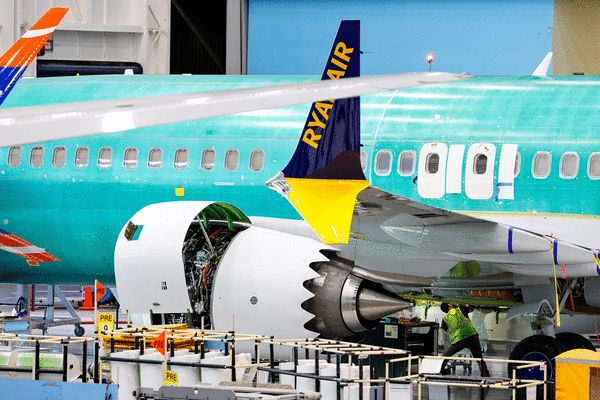
Boeing lost $7 million in the first three months of the year, failing to turn a profit but marking a drastic turnaround from the same time period a year ago, when it lost $31 million.
The company again spent more money than it brought in during the first quarter, burning through $1.5 billion in cash from January through the end of March. But that was a significant improvement from a year earlier, when it burned through $2.3 billion in the same time period.
Revenue increased 14% year-over-year, from $19.5 billion in the first three months of last year to $22.2 billion in the first three months this year.
The company attributed much of that turnaround to continued improvement in commercial airplane production, something it has been chipping away at since a panel flew off an Alaska Airlines 737 Max at the start of 2024, upending Boeing’s manufacturing cadence.
On Wednesday, Boeing CEO Kelly Ortberg said the manufacturer was gearing up to increase production again, aiming to move from a rate of 42 Max planes per month to 47 this summer.
Our production system is very stable," Ortberg said in a CNBC interview after the company reported its first-quarter financial results. "All systems are a go for this next rate increase for us."
Boeing did not report any charges in the first quarter, something that has recently plagued its defense division as the company navigated costly fixed-price contracts on military programs.
All three of the company’s business divisions reported increased revenue in the first quarter.
Boeing Commercial Airplanes saw revenue jump 13%, from $8.1 billion to $9.2 billion, while its defense, security and space division saw revenue increase 21%, from $6.3 billion to $7.6 billion. Boeing Global Services, the company’s aftermarket support division, saw revenue bump up 6%, from about $5 billion to $5.4 billion.
The $7 million net loss in the first quarter equates to a loss of $0.11 per share, compared with a loss of $0.16 per share in the first quarter last year.
“We’re off to a good start and continue building on our momentum with stronger performance across our business,” Ortberg said in a note to employees on Wednesday. “In the past few months, we’ve had some big wins and hit important milestones that remind us of what we’re capable of when we all work together.”
Ortberg pointed to Boeing’s commercial airplane deliveries, the highest for a first quarter since 2019, and the launch of NASA’s Artemis II mission, which used a Boeing-built rocket to send four astronauts to circle the moon for the first time in more than 50 years.
“We’re making steady progress across the board,” he said.
Boeing delivered 143 commercial airplanes in the first quarter this year, a 10% increase from 130 planes in the same three months of 2025 and a massive jump from just 83 planes in the first quarter of 2024. The midair fuselage blowout in January 2024 slowed Max production in Boeing’s Renton factory as the manufacturer worked to address concerns about its quality and safety practices.
The Federal Aviation Administration granted Boeing permission to increase Max production rates above 38 planes per month in October, lifting a threshold that had been in place since the panel blowout.
Ortberg said Wednesday Boeing would work with the FAA to ensure it is prepared for the next rate increase to 47.
Boeing's production system ran into a hiccup in the first quarter of this year when it found small scratches on some 737 Max wiring. The issue was due to a machining error and did not pose a safety risk, Boeing said in March. The company expects to rework about 25 Max planes to fix the issue.
On its South Carolina-built 787 Dreamliner, Boeing has faced delivery delays due to slow regulatory certification for seats. Boeing delivered five 787s in January and just three in February, before bumping up its delivery rate to seven in March.
Seat-related delays could hold up final delivery to airline customers but won’t affect Boeing’s production, Ortberg told analysts earlier this year. The company hopes to reach a rate of 10 787s per month this year.
In a blemish to its otherwise strong production recovery, Boeing is still working through the FAA’s certification process for three long-delayed commercial programs: the 737 Max 7 and Max 10, and the 777X family.
The company said Wednesday it has made progress on the final phase of certification flight testing for the Max 10, the largest Max variant, and expects to certify both new Max models in 2026, with first delivery in 2027.
It expects to deliver the first 777X in 2027.
On the defense side, Boeing was one of several companies urged by President Donald Trump to increase weapons production amid the Iran war that started in February.
The U.S. has deployed many Boeing-made products in the conflict, from KC-46 and KC-135 aerial refueling tankers, to the Whidbey Island-based electronic attack aircraft EA-18G Growler, to a system known as JDAM, or joint direct attack munition, a low-cost guidance kit attached to bombs.
"Whenever there's a great increase in operational tempo like we're seeing right now, our products are being used extensively," Ortberg said on CNBC Wednesday. "I think we'll see increased orders, particularly around our weapons systems as we go forward.
In April, Boeing and the defense department entered into a seven-year framework to triple production of PAC-3 seekers, the technology that guides missiles on Lockheed Martin’s Patriot air-defense system.
Boeing manufactures most of its weapons, including its fighter jets, in St. Louis, now the headquarters of its defense, space and security division. It delivers some commercial planes built in Everett and Renton to its defense arm, including the KC-46 Pegasus, a derivative of the 767, and the P-8 Poseidon, a maritime patrol aircraft that is a derivative of the 737 NG.
©2026 The Seattle Times. Visit seattletimes.com. Distributed by Tribune Content Agency, LLC.









Comments