New lawsuit alleges Uber is violating drivers' rights. Here's how
Published in Business News
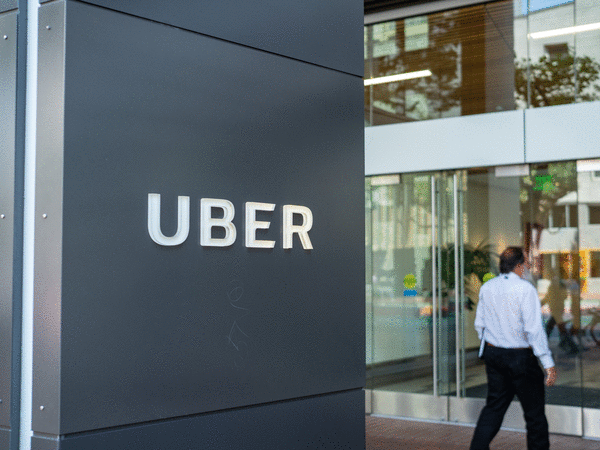
A gig drivers organization filed a lawsuit against Uber, alleging the company violated their rights by not providing a sufficient appeals process for deactivated accounts.
The lawsuit was announced Monday during a news conference by Rideshare Drivers United, an independent organization that represents more than 20,000 app-based drivers in California.
The organization, represented by attorney Shannon Liss-Riordan, said thousands of drivers have been terminated with little to no explanation, many of whom had worked as drivers for years and had high ratings.
"Drivers want to stand up for themselves and for basic fairness, and we can't when there is no fair appeals process," said Jason Munderloh, the chairman of the organization's Bay Area chapter.
The lawsuit is the latest in a long battle between drivers and major ride-hailing service companies. Uber, a frequent target of lawsuits, has often faced claims of labor violations and vehicle collisions.
The tension could reach the November ballot, as the ride-hailing giant attempts to curb the laundry list of legal action. Uber is advocating for legislation that could cap how much attorneys can earn in vehicle collision cases.
Rideshare Drivers United said Monday that Uber is violating Proposition 22, which passed in 2020 and was upheld by the state Supreme Court in 2024. The legislation was a win for gig economy companies, allowing them to classify drivers as independent contractors rather than employees, provided certain requirements are met.
Uber is violating a clause in the proposition that requires the company to provide an appeals process for drivers who are terminated, the organization said.
"Uber has had six years of hiding behind Prop. 22 on issues favorable to it and ignored the law when it seemed inconvenient," Munderloh said.
The lawsuit seeks a statewide judgment that Uber has failed to comply with Proposition 22, along with an opportunity for the thousands of deactivated drivers to appeal their terminations. The suit also seeks reactivation and back pay for drivers who were unfairly terminated.
Uber denied the claims in the lawsuit and reaffirmed that it offers a clear appeals process, in compliance with Proposition 22, a spokesperson told The Times.
"This is a baseless lawsuit by an opportunistic trial lawyer seeking to overturn Proposition 22 and the will of California voters," the spokesperson said. "We'll fight this publicity stunt in court while continuing to strengthen drivers' voice on the platform."
The company posted on a blog Friday that details its termination and appeals process. Every deactivated driver is given a reason for termination and offered a review process for more information. Drivers can then appeal, and the appeal is evaluated by a real person, according to the website.
Rirdeshare Drivers United said drivers are often terminated for vague reasons and are met with endless automated chatbots when inquiring about their terminations.
Drivers who request an appeal are either automatically denied or given the runaround without being offered an actual appeals process, Liss-Riordan said.
Devins Baker had given about 18,000 rides for Uber in eight years and boasted a 4.96 rating when his account was unexpectedly terminated just before Christmas in 2024. An automated message from the company claimed Baker had driven recklessly and offered no other information, he said.
He wasn't told what resulted in his termination, but said that during his last ride, he had to drive defensively to avoid crashing into a vehicle that was merging recklessly on the freeway.
Baker had to hit the brakes to avoid the collision, and the passenger, who wasn't wearing a seat belt, fell off the seat.
Baker was not offered a chance to appeal, he said.
Proposition 22 carved out a new classification for gig economy workers, affording them limited benefits, but not the rights granted to full-fledged employees.
The legislation received strong financial backing from Uber.
A group of drivers challenged Proposition 20 in 2024, claiming the law is unconstitutional because it interferes with the state Legislature's authority to provide workers' compensation protections to drivers. Their claims were ultimately rejected by the state's highest court.
Ride-hail drivers have long raised concerns about low wages, minimal workplace protections and exploitative practices.
More recently, they have grappled with rising gas prices amid the war in the Middle East, which has driven some away from the ride-hailing business.
"The pay is not good in the first place. We do what we can to create a solid framework for ourselves and our families," said Munderloh, who works as a part-time Uber driver. "It's hard enough with how little they pay us, and then even that is taken away."
Various gig companies, including Uber, Lyft and DoorDash, have said Proposition 22 is a crucial component of their businesses and threatened to shut down in the state if the proposition were struck down. These companies poured hundreds of millions of dollars into a campaign to sway voters on the proposition.
©2026 Los Angeles Times. Visit at latimes.com. Distributed by Tribune Content Agency, LLC.








Comments